The writing has been on the wall for Syria's armed Kurds since early 2025 as the US, once their close ally, forged ties with its rivals in the Syrian government.
In March 2025, Washington pressured the Syrian Democratic Forces, the mostly Kurdish militia set up in 2015, to sign an integration deal with President Ahmad Al Shara. A community that was on the political ascendancy during Syria's civil war became an obstacle for major powers jostling for position in a new Syria.
But it was not until Tuesday that SDF leader Mazloum Abdi announced that the militia had disbanded, dealing the final blow to aspirations of its supporters, as well as other Kurds, for autonomy. Mr Abdi said the integration of SDF fighters into the regular Syrian security forces had been completed.
“Abdi refused to realise that the political game was over until the last minute,” said a Syrian political figure connected with the SDF and the US administration. “The Americans kept signalling to him, even before Assad was removed, that the SDF will have to submit eventually to Damascus.”
-

Fighters from the Syrian Democratic Forces inspect ISIS vehicles that were equipped with explosives, in Al Hol in November 2015. Reuters -

One of three men the SDF claimed were ISIS fighters shows defiance as he is taken prisoner, near Al Shadadi in the Hasakah countryside, in February 2016. Reuters -

SDF fighters carry coffins of comrades killed by ISIS militants in Raqqa, during a funeral in Tal Abiad, Syria, in June 2017. Reuters -

SDF fighters injured by a mortar round fired by ISIS militants wait to be treated in a field hospital in Raqqa, in June 2017. Reuters -

Members of the SDF try to locate an ISIS sniper in Al Senaa, a district of Raqqa, in August 2017. Reuters -

An SDF sniper takes aim during fighting with ISIS in Imru' Al Qais, a district of Raqqa, in August 2017. Reuters -

The SDF with a captured ISIS flag during fighting in Raqqa, in August 2017. Reuters -

Ahmed Abu Kholeh, head of the Deir Ezzor military council which fought under the SDF, speaks at a press conference in the village of Abu Fas, Hasakah province, in September 2017. Reuters -
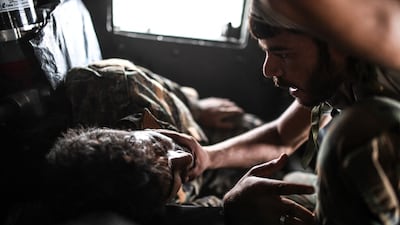
A member of the SDF comforts his wounded comrade after the latter was shot by a sniper on the eastern frontline of Raqqa, in September 2017. AFP -
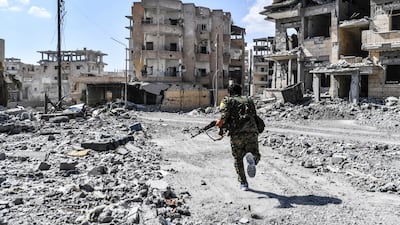
A member of the SDF runs for cover during heavy fighting in Raqqa, in October 2017. AFP -

SDF members escort a blindfolded civilian suspected of links to ISIS, in Raqqa, in October 2017. Reuters -

Children play by a blanket of stale bread being dried under the sun at a refugee camp for people displaced by fighting between the SDF and ISIS, in Ain Issa, Syria, in October 2017. Reuters -
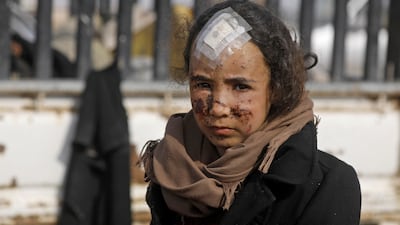
A wounded girl fleeing the ISIS holdout of Baghouz stands in a field in February 2019, during an operation by the US-backed SDF to drive out the militants from the eastern Syrian province of Deir Ezzor. AFP -

The Kurdish YPG of the SDF coalition taking thousands of ISIS women and children out of Baghouz, to drop them at Al Hol camp a few hours away, in February 2019. Reuters -

Mazloum Abdi, SDF commander in chief, announces the end of ISIS control of land in eastern Syria, at Al Omar oilfield in Deir Ezzor, in March 2019. Reuters -

The SDF conducts a live-fire exercise alongside US soldiers in Syria, in March 2022. Reuters -

Fighters of the Turkish-backed Syrian National Army take part in a military parade in the countryside of Aleppo, as part of preparations for military action in SDF-held areas, in June 2022. Reuters -
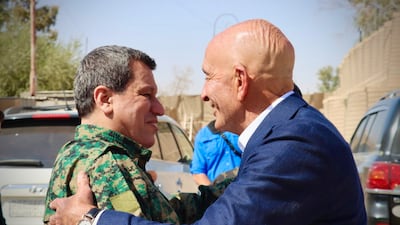
Mazloum Abdi with US special envoy Tom Barrack, in October 2025. Photo: Mazloum Abdi -

Members of Syrian government security forces stand guard after taking control of Al Hol camp following the withdrawal of the SDF, in Hasakah, January 2026. Reuters -

The Syrian army uncovers major underground fortifications after SDF withdrawal, in Sarrin, Aleppo, January 2026. Reuters -

Members of the Kurdish Internal Security Forces celebrate in the city of Qamishli during a curfew, following an agreement between the SDF and the Syrian government, February 2026. Reuters -
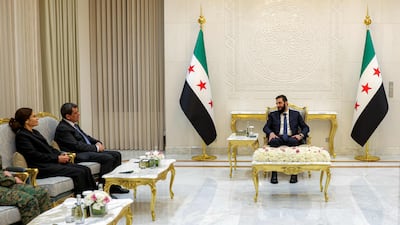
Syria's President Ahmad Al Shara, right, attends a meeting with Mazloum Abdi, leader of the SDF, at the People's Palace in Damascus, in August 2026. AFP


Changing US policy
In the last two years of Bashar Al Assad's presidency, the US administration of Joe Biden sought but failed to find an accommodation with the regime, after holding several meetings with its representatives.
In December 2024, militants led by now-President Al Shara toppled Mr Al Assad and soon changed direction by becoming friendly with the US. Mr Al Shara pledged a united Syria and equal citizenship, meaning the rights of the myriad minorities in the country would not be undermined by the Sunni order.
However, at least 1,400 civilians were killed in early 2025 in a government forces' campaign in the Alawite coastal heartland to defeat what authorities called an insurgency. Days later, the SDF integration deal was signed by Mr Al Shara and Mr Abdi in Damascus.
Mr Abdi was on a plane when he first approved the deal, the Syrian politician said. “They wanted to save Al Shara because the killings were undermining him internationally and they were already starting to abandon the SDF.”

Other than stipulating the merger of SDF personnel into the security forces, the deal was vague and did not address the main SDF demand for federalism that could have created a Kurdish-ruled area similar to the semi-autonomous Kurdistan regional in northern Iraq.
Two months later, US President Donald Trump met Mr Al Shara in Riyadh and announced his intention to lift US sanctions on Syria in another boost for the new order.
Stalling tactics
However, in July last year, the government launched a campaign to seize control over the mostly Druze governorate of Sweida in southern Syria. Hundreds of civilians, mostly Druze, were killed, reinstating fear among minorities. The killings revived Kurdish demands for autonomy, even outside the SDF support base.
The politician said Mr Abdi thought the SDF could benefit from Mr Al Shara's missteps in Sweida to sow doubt in American circles about allowing Damascus to take over Kurdish areas. “The Americans pushed again to make the integration happen and when they saw that Abdi was still resisting, they allowed Al Shara to send his troops into the east,” he said.
The SDF retreated to Kurdish areas in the north-east, relinquishing most of its vast territorial acquisitions in the ancient Euphrates Valley. The area accounts for most of Syria’s oil, gas, commodities and power production, although most of these areas are Arab-majority.
The SDF is an amalgamation of mostly Kurdish militias created in eastern Syria in 2015 as the ground component of the war against ISIS. It positioned itself as a protector of the Kurds during Syria's 2011 to 2024 civil war, although not all Kurds supported the SDF.
It is not clear how many of the several tens of thousands of SDF members are now in the regular security forces. Many personnel defected or left the group after a government military sweep that stripped the SDF of most of the territorial gains it made in eastern Syria during the civil war.
The campaign was supported by Turkey and had tacit approval from Washington. The SDF, regarded as outlaws by Ankara, did not put up a fight.
Another Syrian source said Turkey played a major role in ensuring a relatively peaceful outcome to the Kurdish question in Syria, pointing out that the SDF had maintained channels with Ankara throughout the crisis.
“There are Kurdish political parties in Turkey and [President Recep Tayyip] Erdogan needs them politically,” the source said. “It would not be good if Kurds next door end up being massacred. There is also depth for Syrian Kurds in Iraq and this also helped assure Abdi about the future of his people.”
The source said the “Turkish model” is being implemented in Syria, with regard to the Kurds, expecting the government to allow them to exist as a distinct society, and if Syria becomes a parliamentary system, they could form their own parties.