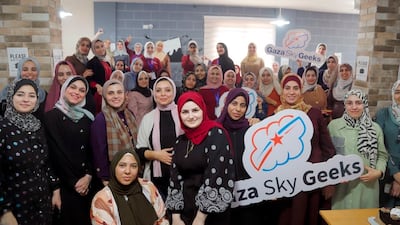

Freelancers in Gaza who once worked from home are increasingly turning to shared working spaces, where solar power and reliable internet connections offer a vital link to jobs and clients outside the war-torn Palestinian territory.
According to the International Labour Organisation's latest assessment, Gaza's unemployment rate is 85 per cent. With the labour market close to collapse due to Israel's relentless war with Hamas and other militant groups, online and freelance work has become a lifeline for many.
Amira Nassar, a journalist and voice-over artist who typically works from 9am to 6pm, pays about 300 shekels ($90) a month to work in a coworking space five days a week.

“I started using coworking spaces because I need stable internet and electricity, as well as a quiet environment where I can work,” the 28-year-old Gaza resident told The National. “I live in Gaza city’s Al Sabra neighbourhood, where internet access remains unreliable, and electricity is still not consistently available.”

The office in the nearby Al Sana neighbourhood has stable internet and power, allowing her to work without interruption, even if she has to walk about 30 minutes through the heat to reach the place, due to the lack of a reliable transport system.
“Given the current situation in Gaza and the sharp rise in unemployment, I do not have many other choices,” explained Ms Nassar, whose family depends on her income.
Qosai Hassouna, 26, a programmer from Gaza city, sits beside Ms Nassar. His work involves frequent client meetings, which can be difficult to conduct during the war.
“Imagine trying to convince a client of your professionalism and competence through a meeting that has been scheduled in advance, and suddenly, in the middle of the meeting and discussion, the internet cuts out,” Mr Hassouna said. “We go directly to places like these to get our work done where that will not happen.”
Professional community
One of several programmes in the coastal territory that supports freelancers is called Gaza Sky Geeks. Run by Mercy Corps, it has offered vital support for technology companies and coworking spaces in an effort to keep Gaza's digital workforce operating.
Rand Safi, a senior manager who oversees operations and technical training, said its programmes were briefly disrupted after the attacks of October 7, 2023, when much of the organisation’s attention shifted towards emergency humanitarian assistance.
Technical programmes later resumed, with the central objective remaining to keep the young professionals among Gaza's population of two million connected to the rapidly changing global technology industry.
“We continue to offer training programmes aimed at developing their technical skills and supporting their professional development,” Ms Safi told The National, including artificial intelligence training.

The organisation also helps workers establish themselves on freelance platforms and connects them with experienced trainers to help them compete for international contracts, even when getting paid for work carried out online has become more complicated in Gaza, with limited access to cash and occasional problems with bank accounts.
One of those businesses supported by the initiative is Concept Company in Gaza city. Founded in 2020 by Mohammed Halawa, it quickly built a professional community around IT and remote work.
Gaza Sky Geeks began supporting his company in 2025. After he returned to Gaza city in the north following displacement to the south, the organisation helped Concept open a third base and expand its solar power system. The new premises can accommodate about 30 people.
A full-time monthly subscription costs about 250 shekels, while workers can pay 10 shekels for a full day or five shekels for five hours.
“There is a significant difference between someone who works within a professional community and someone who works in isolation, especially when it comes to finding job opportunities, developing their skills and advancing professionally,” Mr Halawa said.

