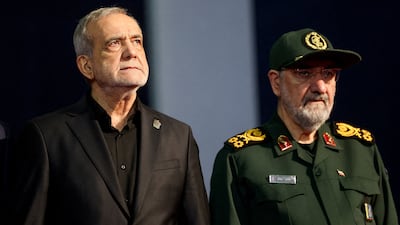

Mohsen Rezaei’s appointment as Iran's new security chief looks less like a change in policy than an attempt to tighten control over how policy is made and carried out.
The 71-year-old former Islamic Revolutionary Guard Corps commander replaces Mohammad Bagher Zolghadr as secretary of Iran's Supreme National Security Council (SNSC) as Tehran faces a crucial choice: continue its confrontation with Washington or use the current ceasefire to pursue a broader deal.
Mr Rezaei commanded the IRGC from 1981 to 1997 and later spent more than two decades as secretary of the Expediency Discernment Council, a powerful regime body that arbitrates political disputes.

He is also an adviser to the supreme leader, Mojtaba Khamenei, and will serve as his representative to the SNSC, giving him a direct link to the centre of power.
His appointment comes after an unusually short tenure for Mr Zolghadr, who was appointed only months ago after his predecessor, Ali Larijani, was killed in an air strike. Mr Zolghadr has now been moved to the role of political adviser to Mr Khamenei.
Both men are hardliners and former IRGC commanders, so the change does not necessarily signal a shift in policy. Instead, it may reflect an effort to ensure the SNSC follows decisions made at the top.
senior Iran analyst at the democracy and human-rights organisation DAWN
Omid Memarian, senior Iran analyst at the democracy and human rights organisation DAWN, sees two broad factions inside the leadership.
“There are at least two main factions,” he told The National. “One believes that they should act aggressively and suicidal, and bring the US to a point to make a good deal with them.”
This hardline camp includes IRGC chief Ahmad Vahidi and ultra-conservative politician Saeed Jalili. Mr Khamenei “seems to be on that side, if he is alive”, Mr Memarian said.
The other faction includes Parliament Speaker Mohammad Bagher Ghalibaf, who led Iran’s delegation in talks with the US.
“They think they might lose the opportunity to make a deal and they might lose everything… some even go further and believe it’s the time for a grand deal with the US to get off the war-ceasefire cycle,” Mr Memarian said.
Who is pulling the strings?
Mr Rezaei was a trusted security operator who was unlikely to challenge whoever was ultimately in charge.
“It’s hard to guess who is ultimately pulling the strings now, but those who want to make a deal are not in a position of power," Mr Memarian said. “Rezaei barks a lot, but he is known to be an [obedient] soldier. He is in this position because whoever pulls the strings can be sure he will obey the orders.”
The change comes just days after Mr Zolghadr set out conditions for the reopening of the Strait of Hormuz. The conditions include an end to the US military campaign, the lifting of the naval blockade, a withdrawal of forces from around Iran, compensation, sanctions relief and the release of frozen Iranian assets.
“These are not new demands,” said Esfandyar Batmanghelidj, founder of the Bourse & Bazaar Foundation think tank. “The six demands are essentially a restatement of key articles of the MoU,” referring to the memorandum of understanding signed by the US and Iran on June 17.

He called the statement “a constructive and encouraging signal”, arguing that Tehran was giving US President Donald Trump “a second chance to make good on promises he has already made”.
The demands, therefore, do not necessarily mean Iran has closed the door to negotiations. Tehran may instead be using the Strait of Hormuz as leverage while setting the terms for a wider agreement.
That leaves Mr Rezaei with a potentially important role: not necessarily to change Iran’s position, but to ensure the leadership’s position is carried out consistently.
The appointment and the Strait of Hormuz statement point to a leadership trying to centralise decision-making while preserving room for a deal. But the biggest question remains: who is making those decisions?
“The main mission now is to determine who has the ultimate say,” Mr Memarian said. “Mojtaba’s absence is increasingly troubling, and it is becoming hard for officials to act on decisions made by a leader whom no one has even seen in person.”

