


Modern tankers can take a direct hit from a drone or a missile and stay afloat thanks to the training of their crews.
Lessons learnt from the Red Sea conflagration, when more than 175 vessels were attacked during the Houthi blockade over two years, can be applied to the Arabian Gulf during the current conflict, captains told The National.
Despite highly flammable cargoes, crews familiar with the many ways of tackling the flames and preventing explosions can avert costly disasters.

The Kuwaiti oil tanker Al Salmi was hit in an Iranian drone attack off Dubai on Tuesday, resulting in a fire which was brought under control.
The ship was heading to Qingdao, China, carrying 1.2 million barrels of Saudi crude oil and 800,000 barrels of Kuwaiti crude, according to monitoring service TankerTrackers.com. The Strait of Hormuz carries a fifth of global oil volumes but journeys through the waterway have fallen to a handful per day in March.

Despite being fully loaded, the fire on board was brought under control and the ship remained afloat.
Captain Mustapha Zhehhaf said gas and oil tankers are equipped with portable and fixed firefighting systems.
For large deck fires, water, foam and powder can be sprayed from fixed points for a rapid response to the emergency, after which crew will then fight the fire, Capt Zhehhaf told The National.
When fire breaks out, there is a danger of the cargo catching fire. Fuel oil is hard to set alight but when air meets its vapour under certain conditions, it can result in an explosion, so tankers also employ an inert gas system for containment.
Oxygen in cargo tanks is replaced with non-flammable gas, reducing it to a level at which it does not burn.
Capt Zhehhaf, master of liquid natural gas carriers, added: “Despite the crew being trained for these situations, we don’t want to witness (fires) on board at all.”
-
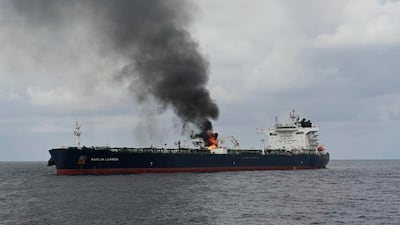
Fuel tanker Marlin Luanda on fire off the coast of Yemen after after a missile strike claimed by the Houthis. AP -
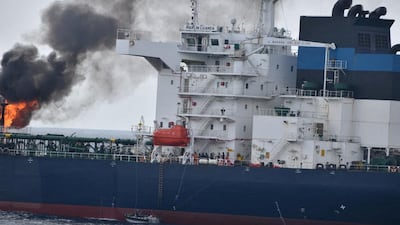
Smoke rises from the Marlin Luanda in the Gulf of Aden. Reuters -

The attack caused a fire in a cargo tank, but there were no casualties or injuries among the crew, according to London-based multinational company Trafigura, which said the vessel was operating on its behalf. Reuters -

An Indian Navy image shows the stricken Marlin Luanda in the distance. The fire was later extinguished. AP -
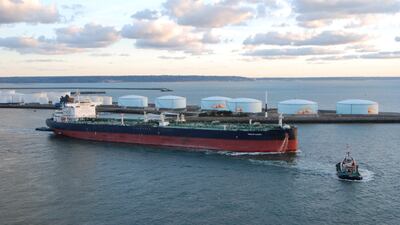
The Marlin Luanda in Le Havre, France, in September 2022. Reuters


Another captain, Avhilash Rawat, told The National what happened when his ship, the Marlin Luanda, took a direct hit from a Houthi missile in 2024.
In the tanks were 84,147 tonnes of naphtha, a highly flammable and volatile liquid mixture of hydrocarbons used in industrial processes.
Dramatic images showed flames leaping into the night sky but the actions of the crew meant the ship did not sink. The vessel continues to ply its trade today, under a different name.
Capt Rawat said the foam lasted for about 30 minutes, after which the crew relied on the inert gas system and sea water.
“Above all, every member of a crew is fully trained in firefighting, so they know what to do in what might appear daunting circumstances,” he said.
His comments came before he picked up an International Maritime Organisation Exceptional Bravery at Sea Award.
“Initially, when we saw the fire, I thought 'We are trained for firefighting and the resources we have on board should extinguish the fire.'”
The strike on Al Salmi is the latest attack on merchant vessels by missiles or explosive air and sea drones in the Gulf and Strait of Hormuz since the US and Israel launched attacks on Iran on February 28.
All 24 crew members were safely accounted for, after the vessel was struck in an apparent Iranian drone attack.
Kuwait Petroleum Corporation said the giant crude oil tanker was subjected to a “direct, heinous Iranian attack”.

