Both America and Iran wanted confrontation more than compromise, an academic close to mediators between the two countries told The National in the final hours before strikes rained down on Tehran.
Talks had failed to make sufficient progress and US President Donald Trump's declaration “we’re either going to get a deal, or it’s going to be unfortunate for them” came to pass.
Regardless of the 11th-hour diplomacy, in the end there was one decisive factor that persuaded the US President to act: unfinished business.

It may be that the protests that erupted against the Iranian regime in January persuaded Mr Trump the time was right to strike.
But Clarke Cooper, who served as an assistant secretary of state during the first Trump administration, told The National there were four factors that guided the US all along - just as they did last June when the US decided to act during that 12-day war initiated by Israel.
Nuclear capability, ballistic missiles, terrorism or proxy control and the disruption of global trade all remained aligned. "The risk of a nuclear-capable Iran is a remaining primary issue to deter," he said.
Yet January's crackdown, which saw tens of thousands killed during street protests could not be ignored. Mr Cooper describes the regime crackdown as "so extraordinary, so significant" that any US president would have to acknowledge how it changed the overall picture.
"A regime like the one in Tehran has less to bargain with when they’ve got a general population that is so unhappy and not politically supporting the regime," he said.

Trump's record
Mr Trump has been in this position before, taking action against Iran during his first stint as President.
He acted decisively against the country in 2018 when he pulled the US from the international nuclear deal with Tehran.
Similarly in 2020, Mr Trump authorised the strike on Qassem Suleimani, killing the commander of the Islamic Revolutionary Guard Corps’ Quds Force outside Baghdad airport.
Within months of his return to the White House last year, in June, the US leader used 17-hour B52 bomber missions against Iran's nuclear programme.
Resolving the nuclear impasse proved impossible at the talks between envoys in Geneva that broke up on Thursday.
Steve Witkoff, the US special envoy, and Jared Kushner, Mr Trump's son-in-law, spearheaded the first direct talks between Washington and Tehran, which came seven months after the June strikes and with the same amount of time remaining until the critical November mid-term elections.
"The strategic plan and desire towards nuclear capability has not abated, and it didn't even abate after those directed strikes occurred," Mr Cooper said. "And so the strikes occurred, but Iran didn't hold up its hands and say, Oh, we're not doing that anymore."

Now with the Atlantic Council, where he is a fellow on the Middle East programme, Mr Cooper said any US president would take into account where the US shared concerns with neighbouring states as well as what the strikes might mean for regional stability.
"There maybe some nuanced aspects on [US] posture but the risk of a nuclear-capable Iran remains as a primary issue, as does the need to deter the increased capacities of ballistic missiles plus the command and control and supply of proxy terrorist organisations like Hamas, like the Houthis, like Hezbollah is again an issue that needs to be deterred.
"Finally deterring the disruption of global trade."
He acknowledged none of the states in the region were active in pursuit of the state of war but he also saw the countries' pragmatism in the face of US action.
Mr Cooper points to long-term issues that are threatening Iran's future, which also weigh in the US calculus.

Water diplomacy
Iran's water crisis, in which officials fear a "day zero" drought in the capital Tehran at some point in 2026, is an opening for post-bombing diplomacy. This is an "existential" crisis, Mr Cooper said. "The regime is at a critical moment. Its political posture at home is degraded. Its diplomatic posture globally is degraded. Their economy is degraded. And there are existential factors, like the cities in Iran that are without water.
"Their Gulf-state neighbours and Israel have very high capabilities on desalination, or access to aquifers - so with some space, there could be room for greater hydro diplomacy."
US Secretary of State Marco Rubio spoke before Geneva of the wider agenda, touched upon by Mr Trump, for a ballistic missile standstill as well as snuffing out the country's nuclear development. “If you can’t even make progress on the nuclear programme, it’s going to be hard to make progress on the ballistic missiles as well,” he said.

Just cause
The five-day meeting of the International Atomic Energy Agency’s board in early March is the moment to lay down a new resolution censuring Iran for its nuclear programme. That could lead to a referral to the UN Security Council for further action, something that set the stage for the 12-day confrontation.
Israel began strikes within 24 hours of the IAEA board’s decision to slap down Iran after it failed to co-operate with monitors. US officials cited the IAEA when asked for a legal justification for its own military intervention.
“It potentially gives the administration the hook it needs to attack Iran in an attempt to effect regime change,” said Tariq Rauf, the former head of nuclear-verification policy at the IAEA.
-

Anti-government demonstrators and supporters of exiled Iranian crown prince Reza Pahlavi outside the Houses of Parliament in London. EPA -

Iranians during a protest in Tehran on January 9. AFP -
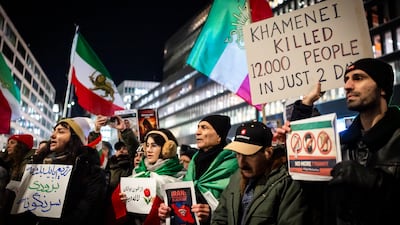
Protesters attend a rally in Zurich on January 13 in support of the nationwide mass demonstrations in Iran. EPA -

A screengrab shows body bags lying outside Kahrizak Forensic Medical Centre in Tehran, after deadly protests across Iran. Reuters -

Activists attend a rally in support of the protesters, in Los Angeles, California. AFP -

Protesters burn a picture of Iran's supreme leader Ayatollah Ali Khamenei outside Downing Street, in London. AFP -

Demonstrators gather in Paris to support the Iranian people amid the anti-government protests in Iran. AFP -
Smoke rises from a mosque as protesters gather amid evolving anti-government unrest in Tehran, Iran, on Friday. Reuters -
Protesters gather amid evolving anti-government unrest in Tehran, Tehran Province, Iran, on Friday. Reuters -
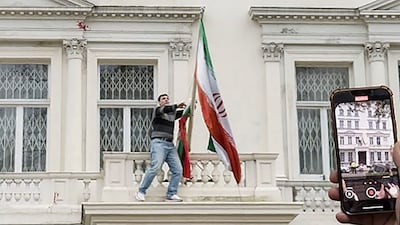
A protester pulls down the Iranian flag from the balcony of Iran's embassy in central London on Saturday. AFP -
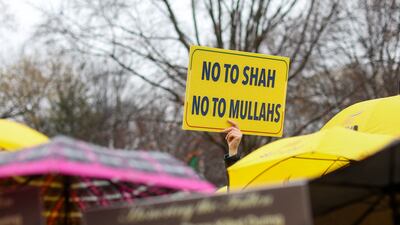
A person holds a placard, as demonstrators and activists rally in support of nationwide protests in Iran, outside the White House in Washington. Reuters -
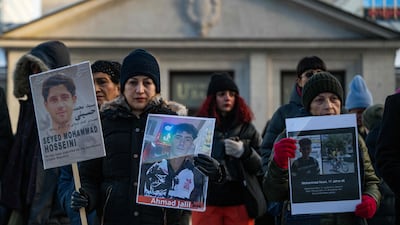
Protesters display placards featuring portraits of Iranians executed by the Iranian regime, during a rally in Berlin on Saturday. AFP -
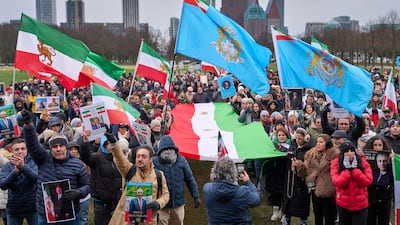
People protest in solidarity with demonstrations in Iran at Malieveld Square, Netherlands on Saturday. AFP


Security framework
Mohamed Chihi, executive director of the Global Institute for Strategic Research at Qatar's Hamad bin Khalifa University, told a security conference at Chatham House that the countries of the region could only address the "multi-front" conflicts involving Israel and Iran through communications with the US.
"I believe that the US remains the region's key security player," he said. "Therefore it is essential the US makes consistent engagement with our security otherwise it would lead to chaos and war."
At the end of the day, Mr Cooper said what gave the strikes an inevitability was that leaders in Tehran were "irrational about their irrationality".