Pakistan declared “open war” against Afghanistan on Friday, bombing cities including Kabul after cross-border clashes that killed dozens.
Afghanistan's Taliban authorities confirmed drone attacks as they launched air operations against “key” Pakistani sites. The explosions heard across Kabul early on Friday came from Pakistan's military striking “defence locations” in the Afghan capital.
Pakistan's military said it had struck against "Indian proxies" and the foreign ministry demanded "the Afghan regime ended the impunity" for the groups, Fitna-al-Khawarij and Fitna-al-Hindustan operating on Afghan soil.

“Our cup of patience has overflowed. Now it’s an open war between us,” Pakistan's Defence Minister Khawaja Asif wrote on X. “Now there will be chaos and reckoning.”
Pakistani Foreign Minister Ishaq Dar spoke with a representative of Qatar's Foreign Ministry on Friday, as the violence sparked a flurry of diplomatic calls. Doha said the mediator had also spoken to the Taliban's acting foreign minister.
Foreign ministries in the region and around the world appealed for each side to take a step back. Turkish Foreign Minister Hakan Fidan said he would hold phone calls with officials in Pakistan, Afghanistan, Qatar and Saudi Arabia.
Pakistan's leadership, including Prime Minister Shehbaz Sharif and Chief of the Army Staff Field Marshal Asim Munir, had met Sheikh Tamim, Emir of Qatar, earlier this week in an attempt to strengthen ties between their nations.
Countries urge both sides to de-escalate
British Foreign Secretary Yvette Cooper issued a statement, expressing deep concern for the escalation in tensions between Afghanistan and Pakistan. "We urge both sides to take immediate steps towards de‑escalation, avoid further harm to civilians and re‑engage in mediated dialogue," she said.
Iranian Foreign Minister Abbas Araghchi called for restraint and urged Afghanistan and Pakistan to "resolve their existing differences through dialogue". Iran is ready to offer "any assistance in facilitating dialogue and strengthening understanding and co-operation between the two countries", he added in a post on X.
Russia also urged the countries to "halt cross-border attacks immediately and resolve their differences through diplomatic means", state media reported on Friday, quoting the Foreign Ministry. It also said it would consider acting as a mediator if asked by Islamabad or Kabul.
The Foreign Ministers of Pakistan and Saudi Arabia on Friday discussed reducing tensions, the kingdom said. The two nations signed a defence pact last year in which Islamabad and Riyadh committed to mutual strategic defence. Analysts described the agreement as a significant upgrade in the countries' long-standing security relationship.
Relations 'never been so bad'
The Taliban retook control of Afghanistan in 2021, with observers suggesting Islamabad was involved in the group's return to power. But ties between the Taliban and Pakistan's military and intelligence establishment have soured and senior western officials expressed deep concern on Friday that relations between Pakistan and Afghanistan have “never been so bad”.
Before the cross-border bombing raids, a British official told an internal meeting that the situation between the two countries “was much worse than we have ever seen it before”.
“Pakistan now realises the Taliban are now speaking with one very extreme voice, including the people in Kabul, and have become an impossible government to deal with,” the official said. “What the Taliban are doing is not Islamic."
Pakistan soon found the Taliban were not as co-operative as it had hoped. Islamabad said the leadership of militant group Tehrik-e-Taliban Pakistan and many of its fighters are based in Afghanistan. It added that armed insurgents seeking independence for the south-western Pakistani province of Balochistan also use Afghanistan as a safe haven.
The main result is distrust over the Taliban’s support for the cross-border raids by the TTP into Pakistan. It is also understood that the Taliban are angry with Pakistan’s intelligence services for allegedly supporting insurgent groups in Afghanistan.
A recently released picture of men wearing balaclavas and holding AK-47s from a group called the Afghanistan Freedom Front is said to have annoyed the Taliban. “They can look at that and say, ‘Well, we know you're supporting militias against us,'” a western source said.
-

A convoy of Taliban security personnel moves along the streets as they celebrate the third anniversary of the Taliban takeover of Afghanistan, in Herat. AFP -
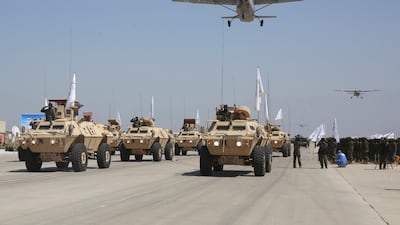
Taliban military vehicles are displayed during a military parade in Bagram Airbase in Parwan province, Afghanistan. AP -
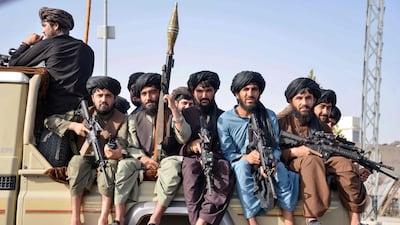
Members of Afghanistan's military 205 Al-Badr Corps sit on a military vehicle during a parade in Kandahar. AFP -
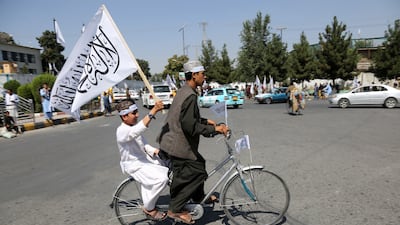
Supporters of the Taliban government in Kabul. EPA -
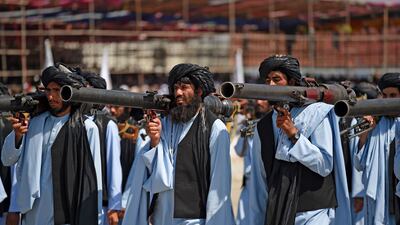
Taliban security personnel parade at the Bagram Airbase. AFP -
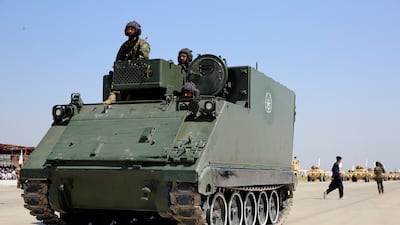
Taliban military vehicles at Bagram Airbase. AP -
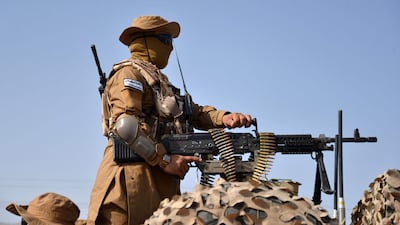
A member of Afghanistan military's 205 Al-Badr Corps atop a military vehicle in Kandahar. AFP


Pakistan has been facing dozens of cross-border attacks by Afghan-based militants using safe havens given to them by the Taliban.
David Loyn, an Afghanistan expert at King's College London, said there were concerns over 20,000 foreign fighters, including Pakistanis, Bangladeshis, Uzbeks and Syrians “who are inside Afghanistan training as suicide bombers”.
“It’s an extremely serious situation not just for the Middle East but for the international community, because Afghanistan has once again become a crucible of global terror,” he said. “Afghanistan had gone off the international radar and wrongly so."
Exchange of fire
Pakistani Information Minister Attaullah Tarar said the country's military destroyed key Taliban sites in the capital, Kandahar and Paktia. He said 133 "Taliban operatives" were killed and more than 200 were wounded. He added that "Pakistan's effective counter-operations are ongoing".
Hours later, the Taliban Defence Ministry announced air operations targeting "key" Pakistani military sites, centres and installations. It said it "successfully carried out" those strikes in response to Pakistani attacks.

Kabul claimed its air and drone strikes penetrated Islamabad as well as Abbottabad, Swabi and Nowshera, Pakistan. Interim Afghan government spokesperson Zabihullah Mujahid said 55 Pakistani soldiers were killed.
Pakistan estimated its air strikes hit 22 Afghan military targets, killing 274 while Afghanistan strikes were said by Islamabad to have killed at least 12 Pakistani soldiers.
Mr Mujahid called the attacks a response to “repeated border violations and provocations from Pakistani military circles”. Kabul had said this week it would respond to Pakistan’s air strikes in several provinces.
Tension has been high since Islamabad accused the Taliban of hosting militant groups that plan attacks in Pakistan, an allegation denied by Kabul. The two countries failed to extend a truce brokered by Qatar and Turkey in October last year.
Pakistan recorded its deadliest year of violence in a decade as deaths from insurgent attacks climbed to 3,967 nationwide in 2025.