
Iran insisted on Sunday that it would not end its uranium-enrichment programme, rejecting the key US demand two days after resuming negotiations on a nuclear deal.
"Zero enrichment can never be accepted by us. Hence, we need to focus on discussions that accept enrichment inside Iran while building trust that enrichment is and will stay for peaceful purposes," Foreign Minister Abbas Araghchi said at a forum in Tehran.
He led the Iranian delegation that held indirect talks in Oman on Friday with US negotiators led by special envoy Steve Witkoff. The Omani-mediated talks in Muscat followed weeks of tension amid a US military build-up in the region, prompting Iran's supreme leader Ayatollah Ali Khamenei to warn of a regional war if his country was attacked.
"Iran's insistence on enrichment is not merely technical or economic … it is rooted in a desire for independence and dignity," Mr Araghchi said. "No one has the right to tell the Iranian nation what it should or should not have."
He repeated that Iran's missile programme, which the US wants to include in negotiations, had never been part of the agenda.
Mr Araghchi spoke of mixed signals from the US, saying some indications suggested seriousness, while the continuation of certain sanctions and military activities raised doubts about Washington’s intentions, state news agency Irna reported.
-
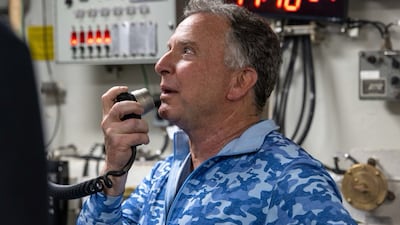
President Donald Trump’s Middle East envoy Steve Witkoff and Jared Kushner, Mr Trump's son-in-law, visited the USS Abraham Lincoln aircraft carrier on Saturday morning, a day after concluding talks with Iran. SEPeaceMissions -
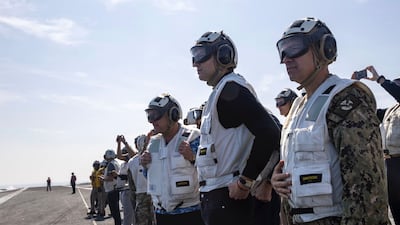
Mr Kushner and Mr Witkoff were invited to visit the carrier by US Central Command commander Adm Brad Cooper. The visit was intended to express gratitude to American service members in the region.SEPeaceMissions -
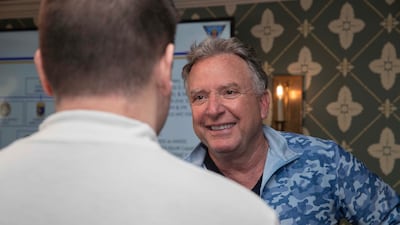
Mr Witkoff said on X after the visit that he, Mr Kushner and Adm Cooper met “the brave sailors and Marines aboard the USS Abraham Lincoln, her strike group and Carrier Air Wing 9”. SEPeaceMissions -
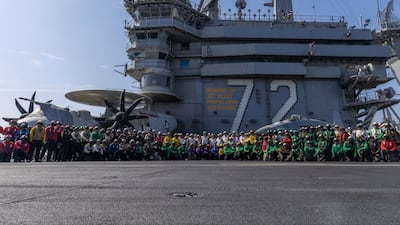
The visit served as a reminder that while the US and Iran have resumed negotiations after rising tension this year, the administration of US President Donald Trump continues to maintain a significant military presence in the Middle East. SEPeaceMissions -

Mr Witkoff waves aboard the USS Abraham Lincoln in the Arabian Sea. Reuters


Mr Witkoff on Sunday visited the USS Abraham Lincoln, part of US President Donald Trump's military build-up in the region as he pressured Iran to resume talks. The special envoy, who was accompanied by Jared Kushner, Mr Trump's son-in-law who also took part in Friday's talks, said the aircraft carrier and its strike group were “keeping us safe and upholding President Trump’s message of peace through strength”.
Mr Kushner is also closely involved in a US effort to find an alternative to the current Iranian regime should Mr Khamenei be toppled, sources told The National.
He is helping to assemble a group of Iranian-American business leaders to advise on the formation of a transitional entity to help govern Iran in the event of the regime's collapse, a source said.
Iran's theocratic regime last month faced the biggest challenge to its rule since the 1979 Islamic revolution, as protests caused by economic hardship swept across the country. The Human Rights Activists News Agency in the US said it had confirmed more than 6,500 demonstrators were killed as authorities suppressed the protests after imposing an internet blackout on January 8.
Nuclear talks that began last year were suspended after Israel launched a 12-day war in Iran, in which the US joined by bombing three nuclear sites before Mr Trump announced a ceasefire.
Members of Israeli Prime Minister Benjamin Netanyahu's office said he plans to meet Mr Trump in Washington on Wednesday to discuss the negotiations with Iran, and “believes that any negotiations should include placing limitations on the ballistic missiles and a cessation of support for the Iranian axis”, referring to Tehran-backed armed groups in the region.

