
Orange suits littered the ground in Shaddadi prison in the Hasakah province of north-eastern Syria, its cold cells empty.
Inside, the smell of body odour lingered along a corridor of about 20 cells. Their doors appeared to have been torn off. The prison used to hold about 120 ISIS prisoners but all of them escaped on Monday.
“They were all ISIS fighters,” an inspector from the Syrian forces told The National as he toured the jail. Mattresses were scattered across the cells. Food was piled up in corners. Bullet cases were strewn over the ground.

-

Empty cells at Al Shaddadi prison after inmates, mostly ISIS members, fled following the withdrawal of the Syrian Democratic Forces, whose fighters had guarded the prison for years. Reuters -

The SDF says prisoners escaped as its fighters fled Syrian government attacks, in Hasakah. Reuters -

The Syrian army says it has taken control of the city and re-arrested dozens of the 120 ISIS members who escaped from the prison. EPA -

An open gate at the prison after inmates escaped. Reuters -
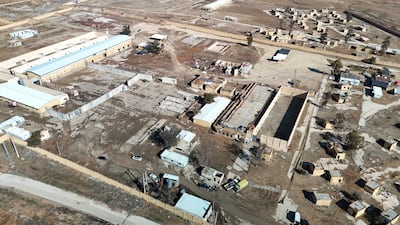
Some witnesses claim local tribes released the prisoners and insisted they had been wrongfully accused of being members of ISIS. EPA -
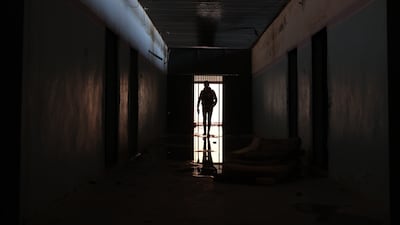
Others say the SDF freed the detainees and that it was the only force able to access the highly-secured facility. EPA -
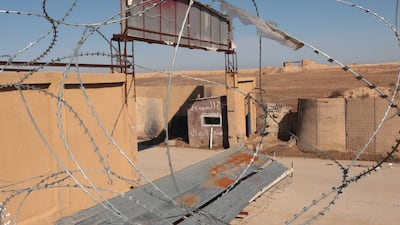
Barbed wire at the prison. Some of those released gathered in the town’s mosque, where their relatives met them, residents say. EPA -
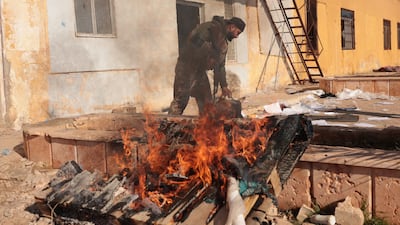
A soldier stands inside the prison, after government troops took it over. EPA -

Clothes and other belongings left by inmates as they fled. Reuters -
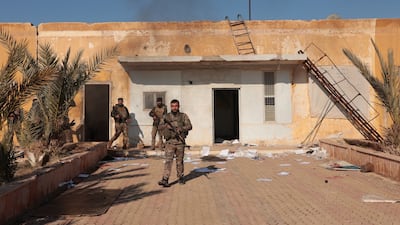
Soldiers stand guard inside the prison complex after the government takeover. EPA


Syrian forces began searching the local area on Monday night to find those who escaped and managed to capture most of them. “About 30 are still missing,” a member of the security forces said. “But we’re still searching.”
The National was one of the first media outlets to be allowed into the empty prison. It is in an area where battles have taken place recently.
The Syrian government has blamed the Kurdish-led Syrian Democratic forces (SDF) for the prison break, saying it held them “fully responsible for any release of ISIS elements from prisons under their control.” The SDF accused pro-government fighters of attacking the prison, saying it had “fallen outside the control of our forces”.
The incident worries western diplomats. The international community has made the fight against ISIS a priority as it re-engages with the year-old Syrian government. Although defeated in Syria in 2019, the extremist group still poses a threat to international security and local communities, as its sleeper cells remain active.

On the ground, residents shared conflicting accounts. One said local tribes, who had mobilised in the area before the army arrived, released the prisoners and insisted they had been wrongfully accused of being members of ISIS. Others said the SDF freed the detainees and that it was the only force that could get into the high-security jail.
Videos posted online by the SDF purportedly show Syrian forces releasing prisoners did not seem to show the place The National's staff visited.
The events at the prison came as government forces advanced north towards SDF pockets after seizing territory that the Kurdish-led force had controlled in eastern Syria. That came after months of stalled negotiations over the integration of the Kurdish authorities into the Syrian state. Before the military push, the SDF were in control of about a quarter of Syrian territory, including oilfields and dams.
Despite a truce agreed on Sunday, fierce clashes continued. SDF fighters resisted the offensive around Shaddadi and on the road to the city of Hasakah, the Syrian military’s next target.
The government and SDF announced a new four-day ceasefire on Tuesday evening as part of an integration deal.
SDF collapse
Syrian forces were in full control of the town of Shaddadi and the surrounding area by Tuesday. Beside the group’s charred military vehicles were walls painted with the SDF’s logo. Residents took selfies in front of the burnt-out wrecks, giving V for victory signs.

Once one of the most powerful forces in Syria, and Washington’s most loyal ally in the fight against ISIS, the SDF is now facing extinction and the end of its dream of Kurdish autonomy.
Its rapid downfall was visible all around Shaddadi following the swift takeover of checkpoints by government forces. Walls are already painted with anti-SDF slogans. Torn flags lie on the streets patrolled by Syrian forces.
US envoy Tom Barrack on Tuesday said the SDF has become obsolete now that its anti ISIS-role is no longer needed, with Washington co-operating with the Syrian government to fight the extremist group.
But the Shaddadi prison break has shattered the illusion of what had looked like an easy military campaign. It has exposed one of the major challenges of integration: the takeover of ISIS camps and prisons. The SDF-controlled north-east is home to detention camps and prisons holding thousands of ISIS members and their families, often described as a “ticking time bomb”.
Analysts said the ISIS file has been exploited by both sides to rally international support, each building a case against the other. For the Damascus government, newly aligned with the US, the aim is to show that the SDF, once held up as a model partner in the fight against ISIS, is no longer a reliable ally. For the SDF, it suggests that the transformation of Syrian President Ahmad Al Shara, an extremist commander turned statesman, now welcomed internationally, and of his forces, is little more than a rebrand.
Mobilisation of tribes
Residents in Shaddadi told The National that tribal fighters, including members of the Baggara, Aqidat and Jubour tribes, among the largest tribal confederations across eastern Syria, entered the area days before the army arrived on Monday evening.

That pattern played out in the provinces of Raqqa and Deir Ezzor, where tribes mobilised against SDF rule, speeding up the collapse of the Kurdish-led fighting.
“Before the army entered, the tribal forces demanded the fall of the SDF,” one tribe member said, declining to give his name. “They were the first ones to take down the SDF military relations office, the Asayish centre and military police.”
He added that tribes released the prisoners, whom he described as “civilians” rather than ISIS members and said they were unlawfully detained by the SDF. He said that he did not take part in the prison break.
Tribal factions have shifted allegiances several times over the years and are not unified under a single leader. Some tribal factions that used to co-operate with the SDF have turned against it, citing grievances in Arab areas, such as Shadaddi, over lack of representation, arrests and perceived marginalisation.
The tribe member said clashes with them and the SDF remained limited. “The SDF quickly withdrew. Thank God, we managed to take control of the centres.”
Those released gathered in the town’s mosque, where their relatives met them, residents said. Saleh Al Ahmad, who owns a shop close to the mosque, told The National that he saw “about 100 men, most of them Syrians”. He said he considers prisons that were run by the SDF as unlawful.
“They have many reports of indiscriminate arrests under the pretext of terrorism,” he said. “They put you in prison just for criticising them.”
The Syrian government said in its statement that the Shadaddi prison was an ISIS facility. Other residents insisted the prisoners were released by the SDF.
“The Kurds were controlling it, said Hassan Jasser, 42. “We can’t reach the prison, it’s a military zone. It’s impossible for anyone other than the military to open the prisons. A civilian can’t open the prison. It's impossible.”
He added that the prisoners were freed before the Syrian army arrived in Shadaddi. “This was the only card the SDF had left,” his friend, Mohamad Hassan added. “They had no cards left for blackmail, except the prisons. They could use only that to blackmail the tribal forces and the government.”

