

Israel is on high alert for any escalation with Iran and has warned Tehran against testing its military capabilities, the country's ambassador to the UN said on Tuesday.
Iran has been rocked by widespread protests in recent weeks, with thousands of demonstrators reported killed and regional tension soaring amid threats of intervention by Israel and the US.
“We are in high readiness. If something will happen … we are ready with our defence capability,” Danny Danon told a group of reporters at UN headquarters in New York.

Mr Danon accused Iran’s leadership of spending billions of dollars supporting militant groups across the Middle East, including Hezbollah, Hamas, Yemen’s Houthis and allied militias in Iraq, rather than on domestic needs.
He accused Tehran of continuing to advance its missile programme, conceal enriched uranium and crack down violently on dissent at home.
“Unfortunately, we had hoped that after the war we had, together with the US against Iran – the 12-day war – that the Iranians would change their actions,” Mr Danon said, referring to a series of retaliatory strikes in June that ended with a US strike on Iran's nuclear sites.
“But apparently, it didn’t happen. They continued with building ballistic missiles. They continue to hide the enriched uranium, and we saw what happened with the actions of the regime against their own people.”
Mr Danon said any further steps against Iran would depend on decisions made by Washington, which Israel would respect.
“We are prepared for scenarios,” he said. “We are talking with them and we are co-ordinating with them.”
-

Anti-government demonstrators and supporters of exiled Iranian crown prince Reza Pahlavi outside the Houses of Parliament in London. EPA -

Iranians during a protest in Tehran on January 9. AFP -
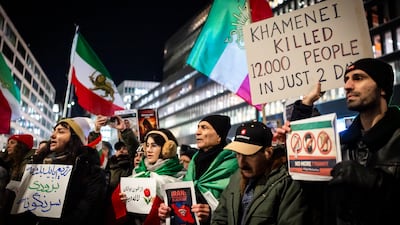
Protesters attend a rally in Zurich on January 13 in support of the nationwide mass demonstrations in Iran. EPA -

A screengrab shows body bags lying outside Kahrizak Forensic Medical Centre in Tehran, after deadly protests across Iran. Reuters -

Activists attend a rally in support of the protesters, in Los Angeles, California. AFP -

Protesters burn a picture of Iran's supreme leader Ayatollah Ali Khamenei outside Downing Street, in London. AFP -

Demonstrators gather in Paris to support the Iranian people amid the anti-government protests in Iran. AFP -
Smoke rises from a mosque as protesters gather amid evolving anti-government unrest in Tehran, Iran, on Friday. Reuters -
Protesters gather amid evolving anti-government unrest in Tehran, Tehran Province, Iran, on Friday. Reuters -
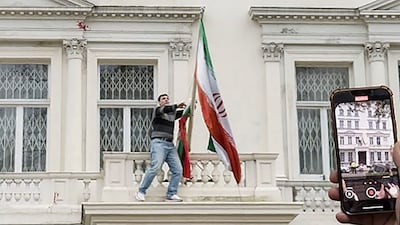
A protester pulls down the Iranian flag from the balcony of Iran's embassy in central London on Saturday. AFP -
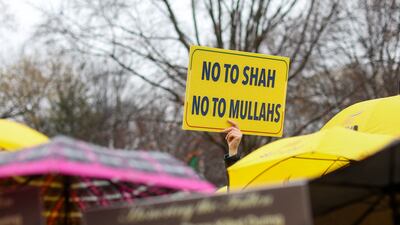
A person holds a placard, as demonstrators and activists rally in support of nationwide protests in Iran, outside the White House in Washington. Reuters -
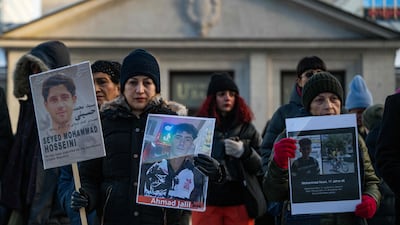
Protesters display placards featuring portraits of Iranians executed by the Iranian regime, during a rally in Berlin on Saturday. AFP -
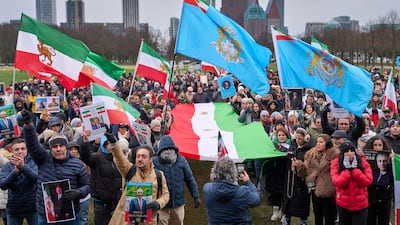
People protest in solidarity with demonstrations in Iran at Malieveld Square, Netherlands on Saturday. AFP


A spokesman for Iran’s armed forces warned the US against any move against Iran’s supreme leader Ayatollah Ali Khamenei, days after President Donald Trump openly questioned the cleric’s continued rule.
“Trump knows that if any hand of aggression is extended towards our leader, we not only cut that hand but also we will set fire to their world,” said Gen Abolfazl Shekarchi.
Mr Trump, in an interview with Politico published on Saturday, described Mr Khamenei as “a sick man who should run his country properly and stop killing people”, saying “it’s time to look for new leadership in Iran”.
Mr Danon said Israel hopes for political change in Iran, pointing to the economic hardship facing ordinary Iranians.
“We hope, we pray for change in Iran,” he said. “I don't think it's up to us to decide who will lead that change or would be the next leader of Iran. It's for the Iranian people to decide it. But change is necessary also.”
The unrest in Iran was caused by economic hardship and political repression. The US-based Human Rights Activists News Agency said on Tuesday that at least 4,484 people had been killed in the government crackdown.
Mr Trump had threatened to hit Iran "very hard" if the government continued to kill protesters, but he appeared to step back last week, thanking Tehran from deciding not to execute a group of detained demonstrators.
Asked whether Israel was disappointed that Washington has appeared to pull back from taking immediate military action against Iran, Mr Danon said the mobilisation of US forces takes time and involves assessing American interests.
A US aircraft carrier, the USS Abraham Lincoln, which had been operating in the South China Sea in recent days, has passed through the Strait of Malacca, according to ship-tracking data. US media outlets, quoting anonymous officials, have reported that the carrier is heading to the Middle East.
Turning to Lebanon, the Israeli envoy said efforts to disarm Hezbollah are incomplete. Israel has repeatedly claimed – without providing evidence – that Hezbollah is seeking to rebuild and rise again
“They made an effort but the effort was not completed. They didn't achieve 100 per cent of the mission … they should be more aggressive,” Mr Danon said.
Lebanon's army said it had completed the first phase of its disarmament plan in the South Litani region near the Israeli border. The Lebanese Armed Forces had set the end of 2025 as the deadline to clear non-state weapons from southern Lebanon as part of the initial phase, before moving on to other areas of the country.
Asked whether he believed the Lebanese government was capable of disarming Hezbollah, Mr Danon told The National: “Yes, at least in southern Lebanon, that's the first stage. It's easy. They have a lot of support.
"It's going to be harder to go to the Bekaa Valley and Beirut. It's going to be much harder than in southern Lebanon and I think they're capable.”

