
Syria and Israel met for talks in Paris on Tuesday overseen by US special envoy Tom Barrack as Damascus is seeking an Israeli withdrawal to positions held before Bashar Al Assad was toppled.
Damascus also wants a reciprocal security framework guaranteeing its sovereignty and preventing interference in its internal affairs.
Syrian state media reported that the discussions in Paris were focused on reviving a 1974 disengagement agreement that established a UN-monitored buffer zone between Israel and Syria after the 1973 Arab-Israeli War.
Israeli troops advanced deeper into Syria after Assad was toppled on December 8, 2024 by rebel fighters who assumed Syria's leadership. Israel has also intervened in what it calls missions to protect the Druze ethnic minority in south-western Syria.
What's the 1974 disengagement agreement?
The agreement set out arrangements for a lasting ceasefire between the two countries and established a UN-monitored buffer zone between Syrian and Israeli troops on the occupied Golan Heights.
Under the agreement, Israel and Syria will scrupulously observe a cease-fire on land, sea and air and will refrain from all military actions against each other, in implementation of UN Security Council Resolution 338 dated October 22, 1973.
-
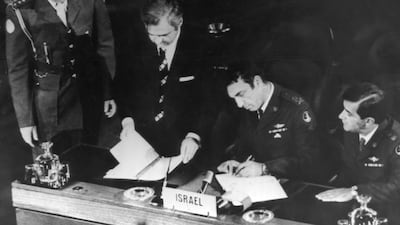
31st May 1974: The signing in Geneva of the disengagement agreement to end hostilities between Israel and Syria. General Sharif signs the agreement on behalf of the Israelis. (Photo by Keystone/Getty Images) -
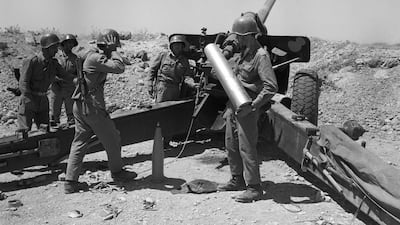
Syrian army soldiers conduct artillery training exercises at the border with Israel on June 3, 1974 -
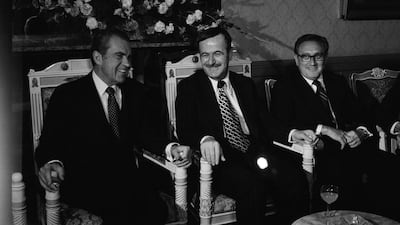
Richard Nixon, left, and Henry Kissinger, right, then US president and secretary of state, respectively, flank Syrian president Hafez Al Assad in Damascus, June 16, 1974 -
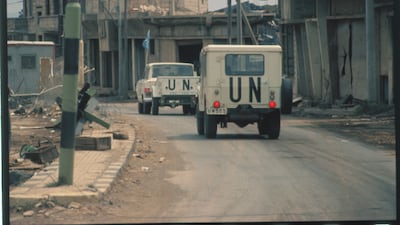
Qunaitra, south-western Syria. UN disengagement forces take up positions vacated by the first Israeli withdrawal from occupied Syrian lands in more than seven years, on June 14, 1974 -
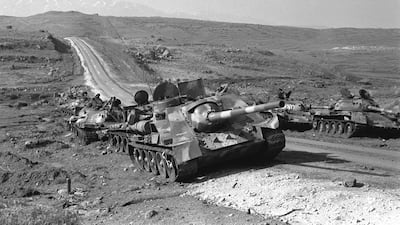
The remnants of Syrian tanks struck by the Israeli air force are left to rust by the roadside, after fighting in October 1973 -
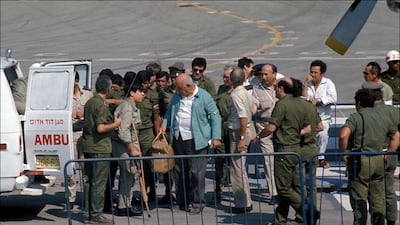
The treaty between Israel and Syria took hold on May 31, 1974, with an early exchange of prisoners of war in Tel Aviv. Here, the seriously injured are led out first -
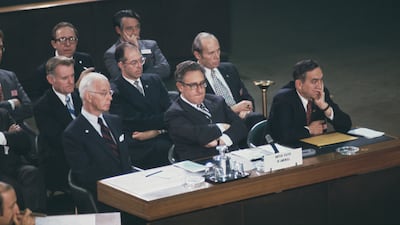
December 21, 1973. The US delegation attending the Geneva Conference in Switzerland to discuss the Israel-Syria situation. Front, left to right: Ellsworth Bunker, diplomat; Henry Kissinger; and Joseph Sisco, US head of Middle Eastern affairs -
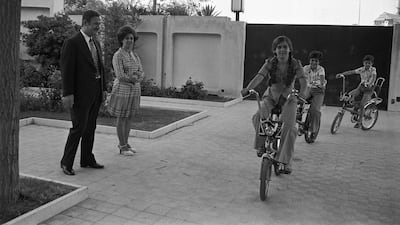
Hafez Al Assad with his family at their residence in Damascus, June 4, 1974. His son Bashar would succeed him as Syrian president in 2000


The map agreed upon set out lines and boundaries for the two troops, with an area in between Line A and Line B that was considered an area of separation. Here, the United Nations Disengagement Observer Force (UNDOF) was stationed.
Israel and Syria also agreed that the function of the UNDOF under that agreement would use its best efforts to maintain the ceasefire and to ensure it is enforced.
Israel’s recent actions and incursions break the 1974 armistice that led to the creation of a UN-controlled buffer zone between Syria and the Israeli-occupied Golan Heights, seized during the 1967 Arab-Israeli War. Israel sent forces across the zone within days of the fall of the Assad regime.
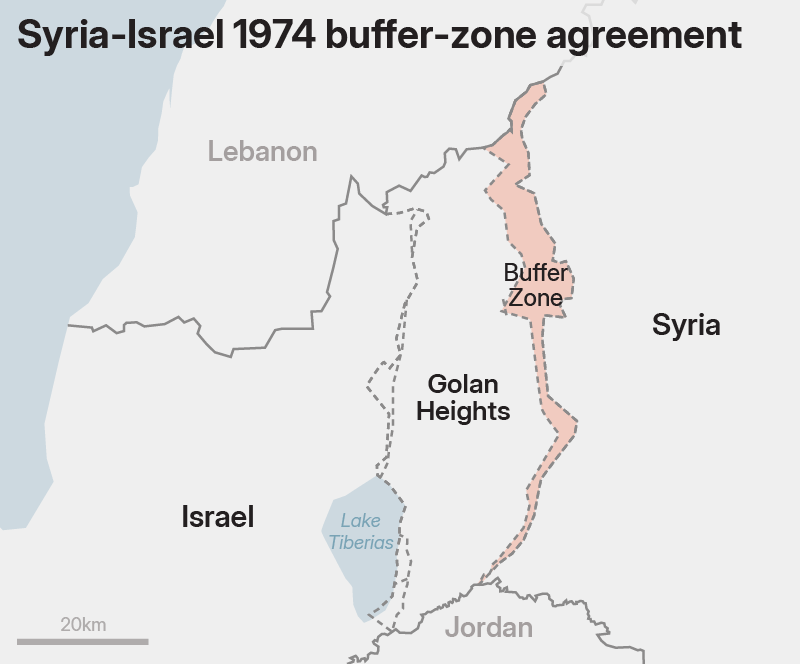
In 1981, Israel moved to formally annex the area, but most countries reject that step and continue to view the Golan as occupied Syrian territory under international law. The UN Security Council declared it “null and void”.
Israel has said that its new territorial acquisitions in Syria are aimed at ensuring its security by enlarging the buffer zone. In the last two years of Mr Al Assad's rule, groups linked to Hamas and Hezbollah, as well as other pro-Iranian factions, launched limited attacks against Israel from the Golan Heights frontier. But the 1974 armistice largely held.
In the past year, the UN has repeatedly called on Israel to respect the 1974 disengagement agreement and criticised Israeli Prime Minister Benjamin Netanyahu's "illegal visit" to the the area in November.

