

The push for more caravans to house homeless Gazans is exposing a central dilemma: how to meet urgent humanitarian needs without locking displacement in place.
Nearly one million people − about half of Gaza's population − are currently displaced, many surviving winter storms in flimsy tents that are easily torn apart by strong winds and routinely flood. Demand for sturdier shelters by families has surged as conditions worsen.
But international non-governmental organisations warn that expanding caravan use comes with long-term consequences. What begins as an emergency fix risks becoming permanent housing, slowing reconstruction and normalising displacement, rather than resolving it.
Currently, many Gazans are having to endure squalid conditions in tents. At least four people have died − three of them children − due to hypothermia, local authorities have said. Images and videos shared with The National showed waterlogging, with mattresses, blankets and clothing soaked in contaminated water.
Concerns of waterborne diseases have also been raised as Israel continues to block heavy machinery from entering the strip to help with rubble and waste removal and the restoration of wastewater infrastructure.
“Most sites don’t have proper latrines, so people are digging pit toilets,” an official from US-based NGO Mercy Corps said.
Humanitarian organisations recognise there is a massive issue with bringing in tents, primarily because Israeli authorities have rejected dozens of requests by aid groups to do so, either on the pretext that they're not authorised to bring in aid, or that the shelters themselves are being viewed as “dual use”. Israel says tent poles are viewed as a potential security risk.

Despite this, several aid groups say that bringing in caravans − or other prefabricated structures − runs the risk of making temporary displacement permanent.
“It could impact the reconstruction process,” another NGO official said, calling for the need for immediate solutions, such as an increase in shelters.
Both officials spoke on the condition of anonymity, given the sensitivity of the matter.
Gaza’s reconstruction remains stalled because the political conditions required to begin rebuilding are not yet in place. Large-scale reconstruction depends on rubble removal, restoring basic infrastructure and allowing in heavy machinery – all of which remain blocked or severely restricted.
Aid groups say the longer this limbo continues, the more temporary displacement hardens into something permanent, complicating any future effort to rebuild neighbourhoods in a planned and sustainable way.
This paralysis is directly tied to delays in the implementation of the later phases of the US-brokered ceasefire in Gaza. While the first phase of October's agreement has focused on halting active hostilities and increasing humanitarian access, subsequent stages are meant to address governance, security arrangements and reconstruction. Negotiations are continuing on their implementation.
Aid officials say without progress on those later stages, there is no political framework that allows donors, UN agencies or development banks to shift from emergency response to rebuilding homes, roads and public services.
As a result, Gaza is stuck in a policy no-man's-land: too fragile for reconstruction, yet deteriorating too quickly to rely on short-term aid alone.

Caravans, according to one of the NGO officials, are “extremely big, not readily available and difficult to bring in and store”, adding that there have been instances where caravans were brought in as a transitional solution but ended up staying long-term.
For now, aid groups authorised to bring in supplies are providing people with blankets, jackets, and mattresses, alongside tents. However, alternative solutions are being considered.
The UN Development Programme has confirmed that it “procured and pre-positioned” 3,100 transitional units ready to be delivered.
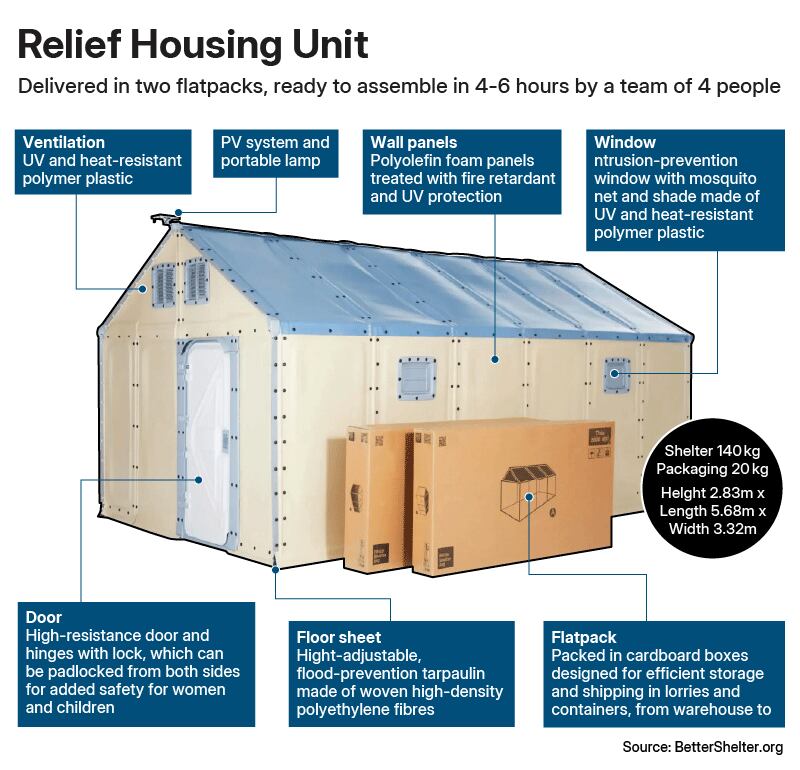
These are known as Relief Housing Units, provided by Swedish non-profit BetterShelter. The flat-pack homes are 17.5 square metres in size, come with a lockable door, four windows, and ventilation. They can be assembled in four to six hours by a team of four and are rainproof and resistant to winds up to 28 metres per second, according to BetterShelter's website.
They have a 10-year frame lifespan and can be packed at 52 units per lorry, the website says.
The UNDP also said it is establishing “new neighbourhood-based shelter sites”, although further clarity is required as to what this might entail and whether Israel will allow it.

