


Israel has restricted the delivery of aid into Gaza, whether through Jordan, Egypt or Israel itself, in breach of the ceasefire agreement of October 10.
For three months, Israel blocked the passage of goods over the King Hussein Bridge, connecting Jordan and Israel, which were later to be brought into northern Gaza. The crossing, known as Al Karama or Allenby, reopened this week.
There are several other entry points into Gaza, but aid has not been flowing into Gaza at the rate required and mandated by the ceasefire agreement. Israel has also made it difficult for already registered and operational aid groups to bring in assistance for the enclave's 2.2 million people.
Nine out of 10 of those people are displaced in Gaza, where more than 85 per cent of infrastructure has been destroyed, as winter approaches, with heavy rains and winds easily penetrating the flimsy tents that people call home.
Here are some of the entry points into Gaza:
Rafah – closed
On Gaza's southernmost border with Egypt is what would normally be a lifeline. The Rafah border crossing was once the main gateway for civilians leaving Palestine.
Also essential for those in need of medical treatment abroad, the crossing has been closed since May 2024. At least 16,500 patients, including 4,000 children, require medical attention outside Gaza, and have remained trapped as a result of Israel's closure.
Israel says it is willing to re-open the crossing only in one direction, towards Egypt, in a move that was widely condemned by Arab and regional states who have called it an attempt by Israel to displace Palestinians from their land.
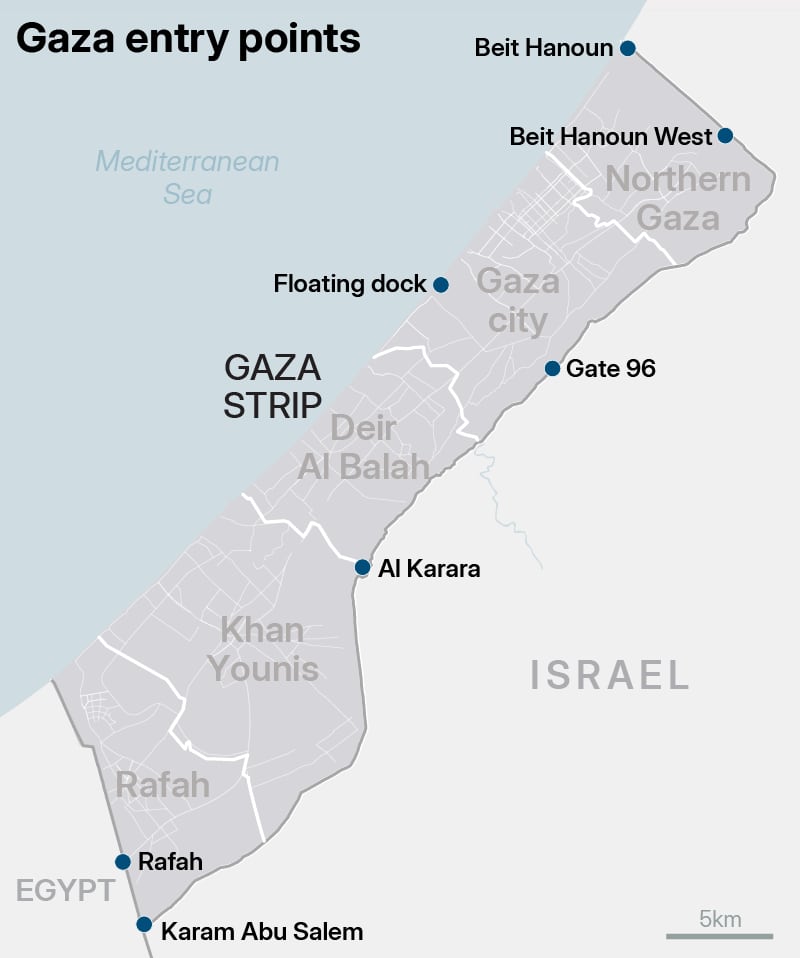
Beit Hanoun/Erez – closed
In the north of the Gaza Strip, the Beit Hanoun crossing, also known as Erez, is a civilian route fully controlled by Israel and is the only means for people to cross directly into the West Bank.
Passing through requires special permission by Israel, which means that many of those who submit requests, including people with medical emergencies, have to wait for weeks to be accepted, or are rejected altogether.
In May, Israel reopened East Erez crossing for cargo, allowing some aid lorries to come in, after US pressure and demands for Israel to do more to help the humanitarian situation.
Gate 96 – closed
The newly created Gate 96 was opened as an entry point for aid after the UN said that there was an imminent risk of famine in the north. However, Israel is only allowing a trickle of lorries to come in – a fraction of the 600 a day that are needed to sustain hungry Gazans.
The latest update from the UN shows it as being closed.
Al Karaka/Kissufim – open
This crossing was closed in 2005 and reopened in 2024 to bring in more aid, angering some Israelis.
Named after the kibbutz nearby, the Kissufim crossing into Gaza's Khan Younis is where Israeli settlers have been seen destroying aid meant for Gaza and blocking its delivery.
Karam Abu Salem – open
This has been the main source of arriving aid, and passage of people into Gaza, as it connects the strip to both Israel and Egypt.
Aid has been coming in through the crossing but not in the amounts required. Data from the UN shows it as one of the most frequently used entry points for food and shelter.
Only the Karam Abu Salem and Kissufim crossings in the southern half of the strip are currently open.

