

After heavy rain and biting wind battered Gaza in recent days, what might have been a passing winter storm elsewhere turned into a nightmare for Palestinians displaced by Israel's war.
Thousands of tents collapsed, leaving families shivering in the open. Their homes already destroyed by Israeli bombing, they face the prospect of a grim winter due to a lack of supplies and reconstruction.
“The situation is catastrophic, beyond description,” Gaza civil defence spokesman Mahmoud Basal told The National. “Rainwater has flooded entire camps, mixing with sewage due to the destroyed infrastructure. Thousands of tents have been ruined, families have been displaced again, and children and the elderly are suffering the most.”

In northern Gaza’s Joura Al Saftawi area, Mazen Al Shandaghli was left clutching a soaked blanket amid mud and debris after his tent flooded and collapsed on Friday morning. His family of eight has been sleeping outside since then.
“We’re still in the street. No one has helped us. No one has even looked at us for two days,” Mr Al Shandaghli, 43, told The National. “Before the war, we loved the rain. We used to sit by the fire, cook, and laugh. Now we hate it, it brings only fear and sickness.”

His four-year-old son Adham, who suffers from asthma, was taken to hospital after struggling to breathe in the cold and humidity. “He’s still there with his mother,” his father said. “He can’t handle this weather. None of us can.”
The family's two-storey house in Jabalia was destroyed in the war. “Winter is a disaster for the displaced,” he said. “If nothing changes, people will die from the cold and the filth.”
Mr Basal, the civil defence spokesman, said services and infrastructure in Gaza have completely collapsed. “We urgently need massive supplies of tents and shelter materials,” he said. “Diseases are spreading, and homes weakened by bombardment are collapsing over those who returned to them out of desperation.”
In Deir Al Balah, Ramez Al Wahidi, 38, spent the night awake under Gaza's relentless rain. His tent leaked despite his attempts to reinforce it with plastic sheets and wood.
The rain came suddenly, and his seven-month-old daughter was crying. “My wife panicked. I stood there, unable to help,” he said. “I wish we had died rather than live this life,” he said, his voice breaking.
Mr Al Wahidi sent his wife and the baby, Malak, to stay at a school-turned-shelter with his sister. He and his two young sons, Musab and Mahmoud, worked through the night to repair what they could. “They’re just children,” he said. “They should be dreaming, not holding broken tent poles in the rain.”
They did not sleep that night. The cold was too much to bear, and they had no winter clothes left, all of them lost when their home in Jabalia was bombed. “I built that house stone by stone,” he added. “Now I can’t even keep my family dry.”
Displaced Gazans struggle in flooded camps – in pictures
-

Displaced Palestinian children play in a puddle near their tents on a rainy day at a makeshift camp west of Gaza city. EPA -
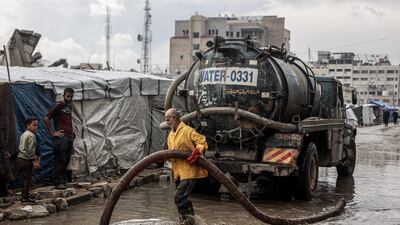
Stagnant water is cleared from the road near a displacement camp after this year's first winter rainfall in Gaza city. AFP -
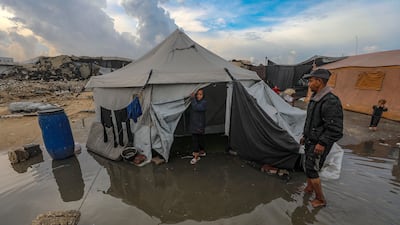
About 1. 9 million people in Gaza, nearly 90 per cent of the population, have been displaced at least once – but some many times – since the outbreak of the Israel-Hamas war October 2023, the UN says. EPA -
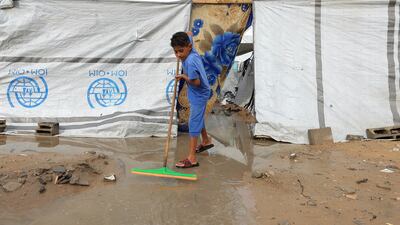
Water has swamped this camp in Gaza city, which is overcrowded with people who have fled the fighting or been forcibly evicted from their homes. Reuters -
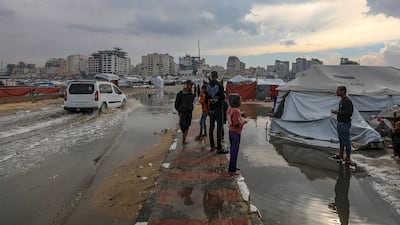
Tents housing Gazans who have already been forced to move several times have been washed away, with the worst-affected areas being Deir Al Balah, Khan Younis and Al Mawasi camp. EPA -
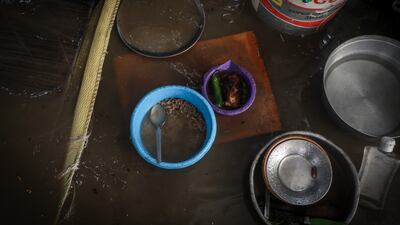
The bad weather has made life even more difficult for Palestinians who have endured a torrid two years. Getty Images -
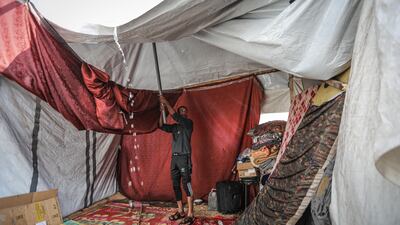
Makeshift tents offer little protection from heavy rain. Getty Images -
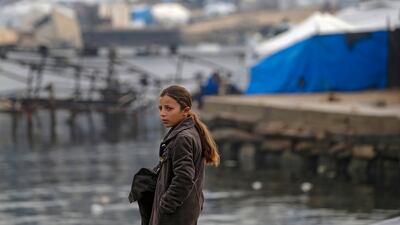
Meanwhile, strong winds have blown away some tents. But some families don't even have shelter, as there are not enough tarps and tents available to respond to the rising needs of displaced families. EPA


In Al Mawasi in the south, 28-year-old Nermin Al Souri has already spent one winter living in tents. “We prayed to God it wouldn’t happen again. But it did, and it’s worse,” she said.
Her new tent, bought before winter to shield her four children, collapsed during the first heavy storm. “Gaza is devastated,” she said. “The people in tents are the symbol of catastrophe, and the world just watches. The pain we live in could make a stone weep. The tents flood over our heads, and no one helps us. We’re invisible.”
Civil defence crews continue to respond to emergencies, pumping water, moving families, salvaging what remains. But as Mr Basal warns, without urgent international intervention, the next storm could bring even greater tragedy. “We’re watching a humanitarian disaster unfold in real time,” he said. “Gaza doesn’t just need aid, it needs rescue.”

