
Israel has said only seven aid packages were dropped from planes to Gaza’s two million people, a population it has been starving for months.
The army on Sunday also announced a 10-hour pause in three designated areas of Gaza as deaths from starvation and international condemnation were on the rise this week.
The army on Sunday said the pause will take place daily in Al Mawasi, Deir Al Balah, and Gaza city, from 10am (0700 GMT) to 8pm (1700 GMT) until further notice, the military said.
“This decision was co-ordinated with the UN and international organisations following discussions regarding the matter,” it said.
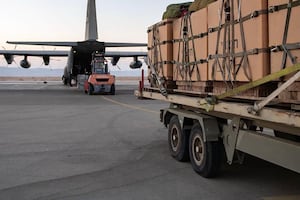
Israel said it began aid drops to Gaza on Saturday and that it would establish “humanitarian corridors” for UN convoys to deliver aid. This marks the first Israeli delivery of aid by air since the war began.
For more than four months, the Gaza Strip has endured a near-total blockade after the collapse of a ceasefire. The region has since descended into what organisations and residents describe as a deadly famine, with food, water, and medicine in short supply.
“Today, a quantity of aid will be allowed into the Gaza Strip,” Alaa Al Din Al Aklouk, a member of the Administrative Body of the National Gathering of Palestinian Tribes and Clans, told The National. “Our tribal teams will co-ordinate with others to ensure the lorries reach storage facilities safely. We’re also working to raise awareness among the public not to block these routes.”
UN agencies, including UNRWA, are expected to monitor distribution. Mr Al Aklouk said that tribal groups are not involved in allocation, only in helping delivery.
The Israeli military said in a statement that the drops were conducted in co-ordination with international aid organisations and included seven pallets of aid containing flour, sugar, and canned food – an amount insufficient to meet the needs in the enclave.
A security officer in the Gaza Police told The National that the humanitarian truce, if upheld, would allow local forces to safeguard aid routes and reassert some control over market pricing and law enforcement.
“There’s no guarantee Israel will respect this truce. Our officers have been targeted in the past,” he said. “But we’ll act where we can to protect the internal front and stabilise public life, especially in the markets.”
UN aid chief Tom Fletcher said they would step up efforts to feed Palestinians during the military pauses. “In contact with our teams on the ground who will do all we can to reach as many starving people as we can in this window,” he said in a post on X.
Ismail Al Thawabta, director of Gaza’s Government Media Office, said the entry of aid alone does not signal a turning point.
“Gaza needs at least 600 lorries per day for an extended period to even begin emerging from famine,” he told The National. “This latest decision is a small, positive step, but it cannot by itself end the widespread hunger.”
Six more deaths from malnutrition and starvation were recorded in the Gaza Strip in the past 24 hours, the enclave's Health Ministry said on Sunday. This takes the death toll from malnutrition and starvation to 133 during the conflict, including 87 children, the ministry said in a statement.
Dozens of lorries carrying tonnes of humanitarian aid that have been waiting for Israeli permission to enter the enclave where mass starvation has been on the rise moved towards the Karam Abu Salem crossing in southern Gaza, Egyptian state-affiliated Al Qahera News reported.

Mr Al Thawabta said that UNRWA should lead aid distribution, for its operational capacity. Amjad Al Shawa, director of the Palestinian NGO Network, said the UN was formally informed that aid entry from Egypt would begin. Yet, he warned about the scale of the problem.
“What’s being allowed in doesn’t come close to covering people’s needs. We must see unlimited daily lorry entries if we want to begin dismantling this famine.”
For families, the humanitarian truce and aid announcement represent a sliver of long-awaited hope.
“This is the best news we’ve had in months,” Kamal Wishah, 36, father of five from Nuseirat, told The National that “For weeks, we had nothing to feed our children. With this decision, we finally feel some hope that food, water, and aid might start coming back.”
International aid groups have been repeatedly warning for months that mass hunger was spreading among Gaza with food running out after Israel cut off all supplies in March. Most of the aid distribution has been handled by the controversial US and Israel-backed Gaza Humanitarian Foundation since May, the site of deadly violence.
Western countries have condemned Israel's “drip feeding of aid” and have called the Israeli aid delivery model dangerous. More than 1,000 aid seekers have been killed since May.
Humanitarian organisations say many warehouses filled with aid are just outside the territory and subject to Israeli entry controls. For warehouses inside Gaza, the NGOs are blocked from accessing and delivering the supplies, they say.
Israel has also denied the claims of large-scale starvation, accusing Hamas of looting aid and blocking its distribution. But the UN says Israel's restrictions and rejections of permits are the main reason for mounting stockpiles at border crossings.
“Bombings and death, we might endure them. But hunger? Especially our children's hunger? That’s something no parent can bear.” Mr Wishah added
An internal US government analysis found no evidence of systematic theft by Hamas of US-funded humanitarian supplies, challenging the main rationale that Israel and the US give for backing a new armed private aid operation.
Israel's announcement on drops and military pause came after indirect ceasefire talks in Doha with Hamas were broken off.
Israel said it would also allow the UAE and Jordan to resume dropping humanitarian supplies.
The UAE on Saturday also announced it would resume air drops of aid into Gaza as the humanitarian situation reaches a “critical and unprecedented level”, Sheikh Abdullah bin Zayed, Deputy Prime Minister and Minister of Foreign Affairs, said.
Up until last year, the UAE dropped thousands of tonnes of humanitarian aid, food and relief supplies into Gaza as part of the country’s Birds of Goodness operation.

