Israeli army tanks in a staging area in northern Israel near the border with Lebanon on Tuesday. AP

Israeli army orders Lebanese civilians to leave areas within 60km of border


  • English
  • Arabic

Live updates: Follow the latest on Israel-Gaza

The Israeli army warned residents of nearly 30 villages in south Lebanon to leave their homes immediately on Tuesday, amid preparations for ground invasion.

The eviction warning came as Israel claimed it had begun a ground invasion of Lebanon, escalating its weeks-long campaign against Hezbollah and increasing the risk of a wider regional conflict. But contradicting the Israeli claim, the UN peacekeeping force in Lebanon (Unifil) said there was “no ground incursion” in the south of the country on Tuesday morning.

Israeli army spokesman Avichay Adraee said in a post on X: “You must immediately head to the north of the Awali river, save your lives and evacuate your homes immediately.”

The Awali lies about 60km from the border, farther north than the Litani river, which defines the northern boundary of a UN-designated buffer zone established after the 2006 war between Israel and Hezbollah.

Residents who remained in their towns in south Lebanon said on Monday night that the roads were either unsafe or cut off. Others have nowhere else to go. “I will leave, but where would I go?,” a mother of three from the border town of Burj el Moulouk told The National over the phone.

Those who have left watch the latest developments at the border with anxiety and defiance. “Of course, we are scared; if someone tells you they're not, they're lying,” said a displaced woman from the border town of Ramiah.

She has been displaced twice – once at the start of the war in Gaza and when Israel launched a deadly air campaign on parts of Lebanon over a week ago.

“But I'm 100 per cent sure that Hezbollah won't let them in. They are fighting them back and I have no doubt we will return to our land,” she added.

For the past two weeks, the young woman, who wished not to be named, has been staying in a school with her family in the south suburb of Beirut. Like most displaced people in this makeshift shelter, she said she has lost her home in the relentless Israeli shelling.

“What are they trying to invade? They already destroyed our house but it's our land, we won't let them it,“ Sobieh Nassef, 65, another displaced person from Zbeqin, also near the border, told The National.

These families are among the million people displaced by Israeli air strikes, according to Lebanon's caretaker Prime Minister Najib Mikati, who said the country is facing “one of the most dangerous phases” in its history.

“Around a million of our people have been displaced because of the devastating war that Israel is waging on Lebanon,” Mr Mikati told a meeting with UN representatives, according to the National News Agency. “We urgently call for more aid to reinforce our continuing efforts to provide basic support to displaced civilians.”

Mr Mikati and Imran Riza, the UN humanitarian co-ordinator for Lebanon, began a $426 million appeal to mobilise urgent resources for civilians affected by the conflict. In the past two weeks, more than 1,000 people have been killed and more than 6,000 have been injured. Since October 2023, an estimated one million people have been directly affected or displaced, according to Lebanese authorities.

Israel and Lebanon cross-border strikes – in pictures

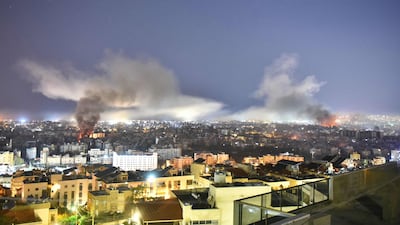
  • Damage in Beirut after an overnight Israeli strike. EPA
    Damage in Beirut after an overnight Israeli strike. EPA
  • Smoke rises from the site of an Israeli strike in the south of Lebanon's capital. AFP
    Smoke rises from the site of an Israeli strike in the south of Lebanon's capital. AFP
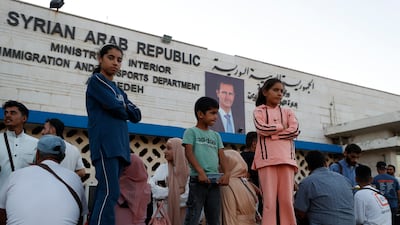
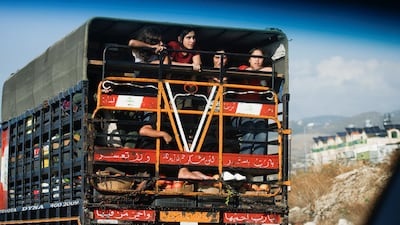
  • Displaced Syrians and Lebanese enter Syria from Lebanon at the Jusiyah border crossing. AFP
    Displaced Syrians and Lebanese enter Syria from Lebanon at the Jusiyah border crossing. AFP
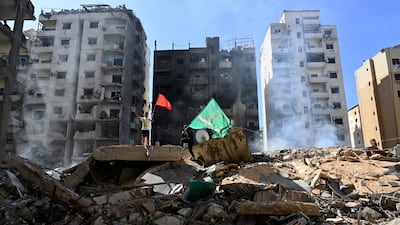
  • The site of the Israeli air strike that killed Hezbollah leader Hassan Nasrallah, in Beirut. AP
    The site of the Israeli air strike that killed Hezbollah leader Hassan Nasrallah, in Beirut. AP
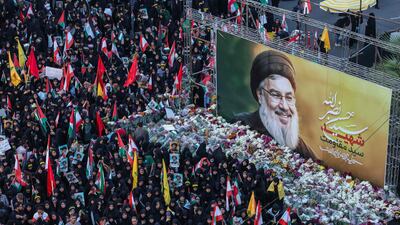
  • Iranians lay flowers before a portrait of Nasrallah. AFP
    Iranians lay flowers before a portrait of Nasrallah. AFP
  • Smoke billows over Tyre, southern Lebanon following an Israeli strike. Reuters
    Smoke billows over Tyre, southern Lebanon following an Israeli strike. Reuters
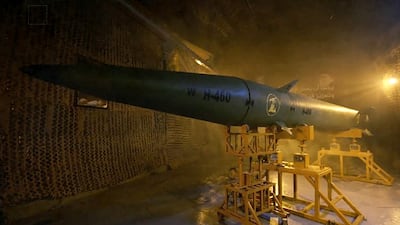
  • A Qader 1 ballistic missile from Hezbollah's arsenal. AFP
    A Qader 1 ballistic missile from Hezbollah's arsenal. AFP
  • Syrians fleeing the war in Lebanon arrive at the Syrian-Lebanese border crossing in Jdeidet Yabous. AP
    Syrians fleeing the war in Lebanon arrive at the Syrian-Lebanese border crossing in Jdeidet Yabous. AP
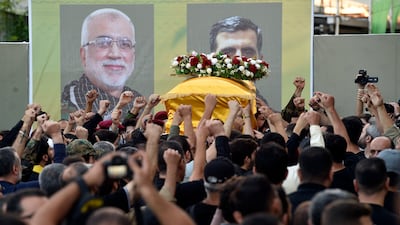
  • Hezbollah fighters carry the coffin of Hezbollah commander Ibrahim Qubaisi during his funeral in Beirut. EPA
    Hezbollah fighters carry the coffin of Hezbollah commander Ibrahim Qubaisi during his funeral in Beirut. EPA
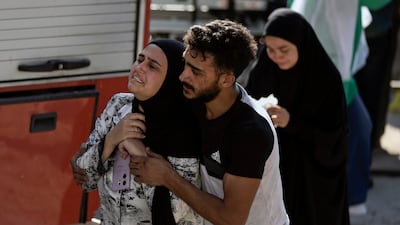
  • People react at the scene of an Israeli air strike in the town of Maisara, north of Beirut. AP
    People react at the scene of an Israeli air strike in the town of Maisara, north of Beirut. AP
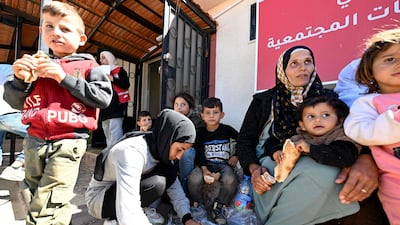
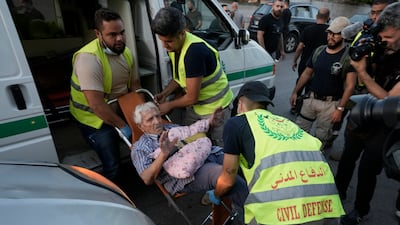
  • Civil defence workers carry an elderly man who fled from the south of Lebanon, as he arrives at a school turned into a displaced shelter in Beirut. AP
    Civil defence workers carry an elderly man who fled from the south of Lebanon, as he arrives at a school turned into a displaced shelter in Beirut. AP
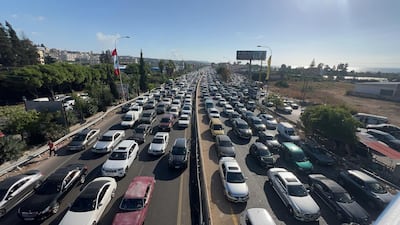
  • A traffic jam in Ghazieh as people fleeing from the south of Lebanon drive towards Sidon and Beirut. EPA
    A traffic jam in Ghazieh as people fleeing from the south of Lebanon drive towards Sidon and Beirut. EPA
  • People in heavy traffic drive north from Lebanon's southern coastal city of Sidon, as they flee Israeli bombardment. Reuters
    People in heavy traffic drive north from Lebanon's southern coastal city of Sidon, as they flee Israeli bombardment. Reuters
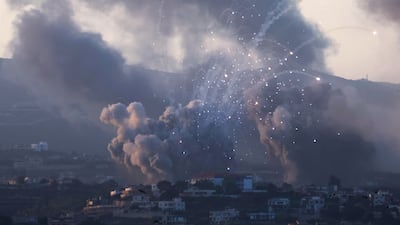
  • Smoke billows over southern Lebanon following Israeli strikes, as seen from Tyre. Reuters
    Smoke billows over southern Lebanon following Israeli strikes, as seen from Tyre. Reuters
  • Smoke billows over southern Lebanon following Israeli strikes, as seen from Tyre. Reuters
    Smoke billows over southern Lebanon following Israeli strikes, as seen from Tyre. Reuters
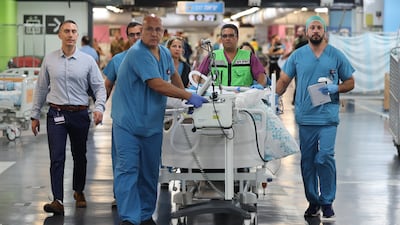
  • Medics move patients at Rambam Hospital's underground emergency centre, in Haifa, northern Israel. EPA
    Medics move patients at Rambam Hospital's underground emergency centre, in Haifa, northern Israel. EPA
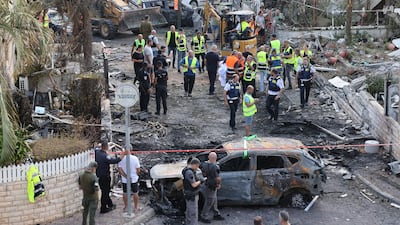
  • Israeli emergency teams work at the scene of a missile strike on a residential neighbourhood in Kiryat Bialik, northern Israel. EPA
    Israeli emergency teams work at the scene of a missile strike on a residential neighbourhood in Kiryat Bialik, northern Israel. EPA
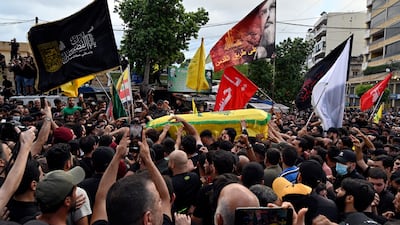
  • Hezbollah fighters carry the coffin of the group's senior commander Ibrahim Aqil, who was killed in an Israeli strike on September 20, in Beirut. EPA
    Hezbollah fighters carry the coffin of the group's senior commander Ibrahim Aqil, who was killed in an Israeli strike on September 20, in Beirut. EPA
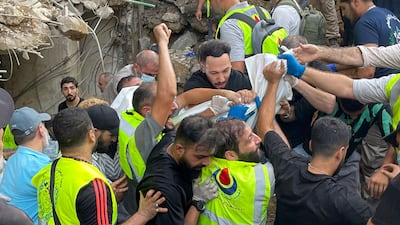
  • Rescuers carry a body at the scene of a missile strike in the southern suburbs of Beirut. AP
    Rescuers carry a body at the scene of a missile strike in the southern suburbs of Beirut. AP

The UN said: “These alarming figures only continue to rise, further exacerbating a crisis that has overwhelmed the nation’s already strained resources and infrastructure, particularly impacting vulnerable populations who lack access to essential services and basic necessities.”

Israeli troops began “targeted ground raids” shortly before midnight local time on Monday. Lebanese media reported heavy shelling in the villages of Kfar Kila, Odeisseh and Khiyam, just across the border. There were also explosions in the coastal town of Ras Naqoura, and the Israeli army said it carried out “targeted” air strikes in Beirut’s southern suburbs.

Israel's military said its ground raids into southern Lebanon were aimed at Hezbollah strongholds that threaten Israel, not a war against the Lebanese people.

“These localised ground raids will target Hezbollah strongholds that threaten Israeli towns, kibbutzim and communities along our border,” military spokesman Daniel Hagari said. “Hezbollah turned Lebanese villages next to Israeli villages into military bases ready for an attack on Israel.”

The incursions follow days of intense air strikes intended to eliminate Hezbollah’s leadership and degrade its weapons stockpiles. On Friday, Hezbollah's long-standing leader, Hassan Nasrallah, was killed in a strike on Beirut. The Israeli military thinks it has now eliminated all but one of Hezbollah’s top 11 commanders.

Hezbollah said that it had targeted Israeli troops across the border in Metula with artillery fire on Tuesday. Also, the group said it fired missiles at the headquarters of Israel's Mossad intelligence agency and at a military intelligence unit on the outskirts of Tel Aviv.

The Israeli army said three rockets were launched from Lebanon at northern Israel on Tuesday morning. Two rockets launched at the Upper Galilee were shot down by air defence, while the third was launched towards Bar'am and fell in an open area, according to the military.

The Lebanese army has denied reports that its forces have withdrawn from southern border posts for several kilometres.

“The army command would like to clarify that the military units deployed in the south are carrying out a repositioning of some front line observation points within their designated sectors of responsibility,” the army said.

US Defence Secretary Lloyd Austin has offered support to Israeli Defence Minister Yoav Gallant for “dismantling attack infrastructure” along the border with Lebanon, after Israel launched “targeted ground raids” on Hezbollah.

“We agreed on the necessity of dismantling attack infrastructure along the border to ensure that Lebanese [Hezbollah] cannot conduct October 7-style attacks on Israel’s northern communities,” Mr Austin said on X after he spoke to Mr Gallant.

He warned against “the serious consequences for Iran in the event Iran chooses to launch a direct military attack against Israel”.

In Syria, three people were killed and nine injured in Israeli strikes on the capital Damascus early on Tuesday, a military source said. “At 2.05am the Israeli enemy launched an aerial aggression with warplanes and drones from the direction of Golan Heights targeting a number of posts in the city of Damascus,” the source told the official Sana news agency.

Israel struck a highly secure area of Damascus overnight, according to pro-government sources, in an attack that state media said killed three civilians and damaged property. Syrian state television said one of its presenters was among the dead.

The attack occurred near a building belonging to the state’s telecom company in a district called the Mazzeh Villas, near the road from Damascus to Beirut.

The target of the attack was not immediately known, but Israel has struck the same area several times since the Gaza war began in October, killing Hezbollah and Iranian operatives, according to Syrian opposition sources. In recent years, residential buildings in the area, which is near the Iranian embassy, have been increasingly bought or rented by Iranian military personnel as well as members of Hezbollah and other militias loyal to Iran, residents said.

Khaled Yacoub Oweis contributed to this report from Amman

Dust and sand storms compared

Sand storm

  • Particle size: Larger, heavier sand grains
  • Visibility: Often dramatic with thick "walls" of sand
  • Duration: Short-lived, typically localised
  • Travel distance: Limited 
  • Source: Open desert areas with strong winds

Dust storm

  • Particle size: Much finer, lightweight particles
  • Visibility: Hazy skies but less intense
  • Duration: Can linger for days
  • Travel distance: Long-range, up to thousands of kilometres
  • Source: Can be carried from distant regions

Qosty Byogaani

Starring: Hani Razmzi, Maya Nasir and Hassan Hosny

Four stars

Specs

Engine: Dual-motor all-wheel-drive electric

Range: Up to 610km

Power: 905hp

Torque: 985Nm

Price: From Dh439,000

Available: Now

Fixtures
%3Cp%3E%3Cstrong%3EWednesday%2C%20April%203%3C%2Fstrong%3E%3C%2Fp%3E%0A%3Cp%3EArsenal%20v%20Luton%20Town%2C%2010.30pm%20(UAE)%3C%2Fp%3E%0A%3Cp%3EManchester%20City%20v%20Aston%20Villa%2C%2011.15pm%20(UAE)%3C%2Fp%3E%0A%3Cp%3E%3Cstrong%3EThursday%2C%20April%204%3C%2Fstrong%3E%3C%2Fp%3E%0A%3Cp%3ELiverpool%20v%20Sheffield%20United%2C%2010.30pm%20(UAE)%3C%2Fp%3E%0A
Ten tax points to be aware of in 2026

1. Domestic VAT refund amendments: request your refund within five years

If a business does not apply for the refund on time, they lose their credit.

2. E-invoicing in the UAE

Businesses should continue preparing for the implementation of e-invoicing in the UAE, with 2026 a preparation and transition period ahead of phased mandatory adoption. 

3. More tax audits

Tax authorities are increasingly using data already available across multiple filings to identify audit risks. 

4. More beneficial VAT and excise tax penalty regime

Tax disputes are expected to become more frequent and more structured, with clearer administrative objection and appeal processes. The UAE has adopted a new penalty regime for VAT and excise disputes, which now mirrors the penalty regime for corporate tax.

5. Greater emphasis on statutory audit

There is a greater need for the accuracy of financial statements. The International Financial Reporting Standards standards need to be strictly adhered to and, as a result, the quality of the audits will need to increase.

6. Further transfer pricing enforcement

Transfer pricing enforcement, which refers to the practice of establishing prices for internal transactions between related entities, is expected to broaden in scope. The UAE will shortly open the possibility to negotiate advance pricing agreements, or essentially rulings for transfer pricing purposes. 

7. Limited time periods for audits

Recent amendments also introduce a default five-year limitation period for tax audits and assessments, subject to specific statutory exceptions. While the standard audit and assessment period is five years, this may be extended to up to 15 years in cases involving fraud or tax evasion. 

8. Pillar 2 implementation 

Many multinational groups will begin to feel the practical effect of the Domestic Minimum Top-Up Tax (DMTT), the UAE's implementation of the OECD’s global minimum tax under Pillar 2. While the rules apply for financial years starting on or after January 1, 2025, it is 2026 that marks the transition to an operational phase.

9. Reduced compliance obligations for imported goods and services

Businesses that apply the reverse-charge mechanism for VAT purposes in the UAE may benefit from reduced compliance obligations. 

10. Substance and CbC reporting focus

Tax authorities are expected to continue strengthening the enforcement of economic substance and Country-by-Country (CbC) reporting frameworks. In the UAE, these regimes are increasingly being used as risk-assessment tools, providing tax authorities with a comprehensive view of multinational groups’ global footprints and enabling them to assess whether profits are aligned with real economic activity. 

Contributed by Thomas Vanhee and Hend Rashwan, Aurifer

Kathryn Hawkes of House of Hawkes on being a good guest (because we’ve all had bad ones)

  • Arrive with a thank you gift, or make sure you have one for your host by the time you leave. 
  • Offer to buy groceries, cook them a meal or take your hosts out for dinner.
  • Help out around the house.
  • Entertain yourself so that your hosts don’t feel that they constantly need to.
  • Leave no trace of your stay – if you’ve borrowed a book, return it to where you found it.
  • Offer to strip the bed before you go.
DRIVERS' CHAMPIONSHIP STANDINGS

1. Sebastian Vettel (Ferrari) 171 points
2. Lewis Hamilton (Mercedes-GP) 151
3. Valtteri Bottas (Mercedes-GP) 136
4. Daniel Ricciardo (Red Bull Racing) 107
5. Kimi Raikkonen (Ferrari) 83
6. Sergio Perez (Force India) 50
7. Max Verstappen (Red Bull Racing) 45
8. Esteban Ocon (Force India) 39
9. Carlos Sainz (Torro Rosso) 29
10. Felipe Massa (Williams) 22

Dubai Bling season three

Cast: Loujain Adada, Zeina Khoury, Farhana Bodi, Ebraheem Al Samadi, Mona Kattan, and couples Safa & Fahad Siddiqui and DJ Bliss & Danya Mohammed 

Rating: 1/5

Teri%20Baaton%20Mein%20Aisa%20Uljha%20Jiya
%3Cp%3E%3Cstrong%3EDirectors%3A%3C%2Fstrong%3E%20Amit%20Joshi%20and%20Aradhana%20Sah%3C%2Fp%3E%0A%3Cp%3E%3Cstrong%3ECast%3A%3C%2Fstrong%3E%20Shahid%20Kapoor%2C%20Kriti%20Sanon%2C%20Dharmendra%2C%20Dimple%20Kapadia%2C%20Rakesh%20Bedi%3C%2Fp%3E%0A%3Cp%3E%3Cstrong%3ERating%3A%3C%2Fstrong%3E%204%2F5%3C%2Fp%3E%0A
Key findings of Jenkins report
  • Founder of the Muslim Brotherhood, Hassan al Banna, "accepted the political utility of violence"
  • Views of key Muslim Brotherhood ideologue, Sayyid Qutb, have “consistently been understood” as permitting “the use of extreme violence in the pursuit of the perfect Islamic society” and “never been institutionally disowned” by the movement.
  • Muslim Brotherhood at all levels has repeatedly defended Hamas attacks against Israel, including the use of suicide bombers and the killing of civilians.
  • Laying out the report in the House of Commons, David Cameron told MPs: "The main findings of the review support the conclusion that membership of, association with, or influence by the Muslim Brotherhood should be considered as a possible indicator of extremism."
Destroyer

Director: Karyn Kusama

Cast: Nicole Kidman, Toby Kebbell, Sebastian Stan

Rating: 3/5 

UAE release: January 31 

Dr Amal Khalid Alias revealed a recent case of a woman with daughters, who specifically wanted a boy.

A semen analysis of the father showed abnormal sperm so the couple required IVF.

Out of 21 eggs collected, six were unused leaving 15 suitable for IVF.

A specific procedure was used, called intracytoplasmic sperm injection where a single sperm cell is inserted into the egg.

On day three of the process, 14 embryos were biopsied for gender selection.

The next day, a pre-implantation genetic report revealed four normal male embryos, three female and seven abnormal samples.

Day five of the treatment saw two male embryos transferred to the patient.

The woman recorded a positive pregnancy test two weeks later. 

Avatar: Fire and Ash

Director: James Cameron

Starring: Sam Worthington, Sigourney Weaver, Zoe Saldana

Rating: 4.5/5

MEYDAN CARD

6.30pm Al Maktoum Challenge Round-1 Group One (PA) US$65,000 (Dirt) 1,600m

7.05pm Handicap (TB) $175,000 (Turf) 1,200m

7.40pm UAE 2000 Guineas Trial Conditions (TB) $100,000 (D) 1,600m

8.15pm Singspiel Stakes Group Two (TB) $250,000 (T) 1,800m

8.50pm Handicap (TB) $135,000 (T) 1,600m

9.25pm Al Maktoum Challenge Round-1 Group Two (TB) $350,000 (D) 1,600m

10pm Dubai Trophy Conditions (TB) $100,000 (T) 1,200m

10.35pm Handicap (TB) $135,000 (T) 1,600m

The National selections:

6.30pm AF Alwajel

7.05pm Ekhtiyaar

7.40pm First View

8.15pm Benbatl

8.50pm Zakouski

9.25pm: Kimbear

10pm: Chasing Dreams

10.35pm: Good Fortune

Australia World Cup squad

Aaron Finch (capt), Usman Khawaja, David Warner, Steve Smith, Shaun Marsh, Glenn Maxwell, Marcus Stoinis, Alex Carey, Pat Cummins, Mitchell Starc, Jhye Richardson, Nathan Coulter-Nile, Jason Behrendorff, Nathan Lyon, Adam Zampa

match info

Southampton 0

Arsenal 2 (Nketiah 20', Willock 87')

Red card: Jack Stephens (Southampton)

Man of the match: Rob Holding (Arsenal)

57%20Seconds
%3Cp%3E%3Cstrong%3EDirector%3A%3C%2Fstrong%3E%20Rusty%20Cundieff%0D%3Cbr%3E%3Cstrong%3EStars%3A%20%3C%2Fstrong%3EJosh%20Hutcherson%2C%20Morgan%20Freeman%2C%20Greg%20Germann%2C%20Lovie%20Simone%0D%3Cbr%3E%3Cstrong%3ERating%3A%20%3C%2Fstrong%3E2%2F5%0D%3Cbr%3E%0D%3Cbr%3E%3C%2Fp%3E%0A
How to apply for a drone permit
  • Individuals must register on UAE Drone app or website using their UAE Pass
  • Add all their personal details, including name, nationality, passport number, Emiratis ID, email and phone number
  • Upload the training certificate from a centre accredited by the GCAA
  • Submit their request
What are the regulations?
  • Fly it within visual line of sight
  • Never over populated areas
  • Ensure maximum flying height of 400 feet (122 metres) above ground level is not crossed
  • Users must avoid flying over restricted areas listed on the UAE Drone app
  • Only fly the drone during the day, and never at night
  • Should have a live feed of the drone flight
  • Drones must weigh 5 kg or less
Generation Start-up: Awok company profile

Started: 2013

Founder: Ulugbek Yuldashev

Sector: e-commerce

Size: 600 plus

Stage: still in talks with VCs

Principal Investors: self-financed by founder

Who's who in Yemen conflict

Houthis: Iran-backed rebels who occupy Sanaa and run unrecognised government

Yemeni government: Exiled government in Aden led by eight-member Presidential Leadership Council

Southern Transitional Council: Faction in Yemeni government that seeks autonomy for the south

Habrish 'rebels': Tribal-backed forces feuding with STC over control of oil in government territory

COMPANY%20PROFILE
%3Cp%3E%3Cstrong%3EName%3A%20%3C%2Fstrong%3EQureos%0D%3Cbr%3E%3Cstrong%3EBased%3A%20%3C%2Fstrong%3EUAE%0D%3Cbr%3E%3Cstrong%3ELaunch%20year%3A%20%3C%2Fstrong%3E2021%0D%3Cbr%3E%3Cstrong%3ENumber%20of%20employees%3A%20%3C%2Fstrong%3E33%0D%3Cbr%3E%3Cstrong%3ESector%3A%20%3C%2Fstrong%3ESoftware%20and%20technology%0D%3Cbr%3E%3Cstrong%3EFunding%3A%20%3C%2Fstrong%3E%243%20million%0D%3Cbr%3E%3C%2Fp%3E%0A
Updated: October 01, 2024, 4:53 PM