

Live updates: Follow the latest on Israel-Gaza
The World Health Organisation has this week set out plans to administer 1.2 million polio vaccine doses in Gaza in an effort to prevent an outbreak that could exacerbate the current humanitarian crisis.
Two rounds of mass vaccination – targeting hundreds of thousands of children under the age of eight – are to begin this month after the detection of poliovirus in sewage.
Healthcare facilities and sewage systems in Gaza have suffered severe damage after months of bombardment by Israel following the attacks on October 7 last year, raising the dangers of disease spreading.
Here we consider the risks facing Gaza and ask experts whether there is a likelihood of people suffering paralysis as a result of the spread of polio.
What is polio and what has been found in Gaza?
Typically passed on through the faecal-oral route – such as by eating or drinking something contaminated with faeces – poliomyelitis is a viral condition that, in most cases, does not cause symptoms.
A minority of infected people have headaches and other mild effects, but about one in 200 suffers irreversible paralysis. Five to 10 per cent of such paralysis cases result in death when breathing becomes affected.
It was revealed last month that poliovirus had been detected in a number of sewage samples collected from two governorates in Gaza in June. The WHO says it could have been in circulation since last year.

This viral matter is not wild poliovirus, but instead is circulating vaccine-derived poliovirus (cVDPV), which appears to be spreading within the Gazan population.
With many areas in Gaza severely overcrowded, and with health facilities and sewerage damaged, conditions are ripe for the spread of polio.
cVDPV originates from the oral polio vaccine (OPV), which contains a weakened form of the virus that, in populations where immunisation rates are low, can spread between people.
"When vaccine-derived polio circulates unhindered, after a certain length of time there’s concern it would mutate back to become fully virulent," said Paul Hunter, a professor in medicine at the University of East Anglia in the UK.
"Then you would start to see a big rise in cases of paralytic poliomyelitis."
Vaccine-derived poliovirus can circulate even in developed nations when vaccination rates fall, such as in New York, where it caused the paralysis of a man in 2022.
Huge progress has been made against wild poliovirus, especially since the launch, in 1988, of the Global Polio Eradication Initiative, with cases having dropped by 99 per cent.
Only Pakistan and Afghanistan are still affected by the wild poliovirus, while in Africa, for example, cVDPV is the problem.
What vaccination programme is planned in Gaza?

The WHO aims to have two vaccination rounds of 600,000 doses for children under eight in Gaza, but has admitted that administering this could be difficult logistically.
The organisation is reportedly securing approvals to enter Gaza to undertake the programme and has called for a ceasefire so it can operate safely.
Prof Hunter, who helped to prepare a report for the WHO on infection control in Gaza during the conflict, said the situation there was "turning into one of the biggest humanitarian catastrophes" of the region in recent times.
Separate to the vaccination in Gaza, in May the Palestinian Ministry of Health announced it was carrying out a round of vaccinations using the OPV for children aged under five in Jerusalem and Bethlehem.
While there is a small risk with the OPV that it could mutate, become virulent again and spread in populations where vaccination rates are not high enough, it is easier to administer than the inactivated polio vaccine (IPV), which is given by injection. Also, the OPV offers stronger protection against the spread of the disease than the IPV does.
In developed nations the polio vaccine used is typically the IPV, which is given as an injection in the arm or leg.
In the US, for example, the IPV has been used since 2000, while the UK moved from the OPV to the IPV four years later.
Should other countries be worried?
Prof John Oxford, emeritus professor of virology at Queen Mary, University of London, said there was a danger that polio could spread outside Gaza.
"It’s very worrisome indeed," he said. "You cannot escape the fact it’s a risk to neighbours and even further afield. It’s a huge dilemma and humanitarian crisis. We don’t want polio coming back anywhere in the world."
Given the risks to Israel, Prof Hunter said the country should allow vaccination efforts to take place for reasons of self-interest, as well as for the sake of the Gazan population.
"If paralytic poliomyelitis started spreading in Gaza, the risk is that it spreads more regionally to Israel and Egypt," he said.
"If it happened in Gaza, it would be absolutely appalling for the Palestinians but it would present a risk for neighbouring countries, including Israel.
"Israel has a responsibility to allow this vaccination to go ahead not only for humanitarian reasons, but to protect its own population."
Separate to the WHO’s planned vaccination of Gazan children, the Israeli military last month announced it would give polio boosters to its soldiers in Gaza.
Dr Hamid Jafari, director of the WHO polio eradication programme, said a fast international response to contain the outbreak could reduce the risk of a wider health crisis.
“There is a clear and present danger and risk of spread internationally of this virus, and the sooner we can respond, the faster we can begin to reduce that risk,” Dr Jafari told The National.
Israel-Gaza war - in pictures
-
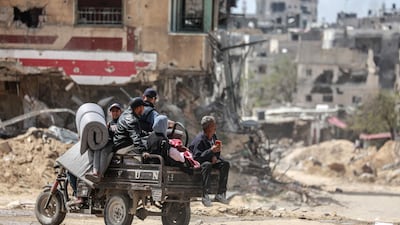
Palestinians move with their belongings on a road lined with destroyed buildings, in Khan Younis, in the south of the Gaza Strip, on April 22. AFP -
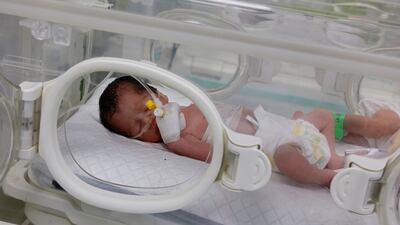
An infant saved from the womb of her mother Sabreen Al Sheikh, who was killed in an Israeli strike along with her husband Shokri and her daughter Malak, lies in an incubator at Al Emirati hospital in Rafah, on April 21. Reuters -

A man rides a bicycle, on April 2, past a damaged vehicle where employees from the World Central Kitchen non-profit, including foreigners, were killed in an Israeli air strike. Reuters -

A woman at the damaged Al Shifa Hospital, on April 1, after Israeli forces withdrew from the medical complex following a two-week siege. Reuters -
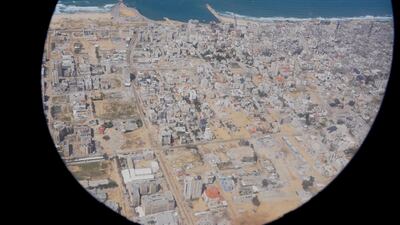
The view from a Jordanian flight dropping vital aid by parachute into Gaza, in March. Matthew Kynaston / The National -

Nozha Awad flees Al Shifa hospital with her triplet children, after an Israeli raid siege began at the medical complex, in March. Reuters -

Palestinians gather to receive aid outside a UNRWA warehouse, in March. Reuters -

A family end their fast amid the rubble of their destroyed home, during Ramadan in Rafah, in March. Reuters -

Wafaa Tabasi with her twin malnourished daughters, at Al Awda health centre in Rafah, in March. Reuters -

Palestinians carry bags of flour taken from an aid lorry near an Israeli checkpoint in Gaza City, in February. Reuters -

Fernando Simon Marman and Louis Hare, two Israeli hostages who, according to the Israeli military, were freed in a special forces operation in Rafah, reunite with loved ones at Sheba Medical Centre, in Ramat Gan, Israel, in February. Reuters -
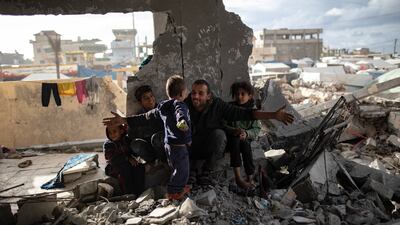
Palestinian Muhammad Al Durra with his children in the ruins of a house in Rafah where they sheltered on January 11, 2024. EPA -
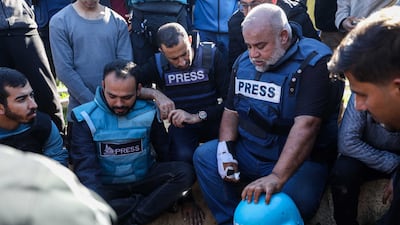
Family and friends at the funerals of journalists Hamza Al Dahdouh and Mustafa Thuraya on January 7, 2024 in Rafah, Gaza. Getty Images -
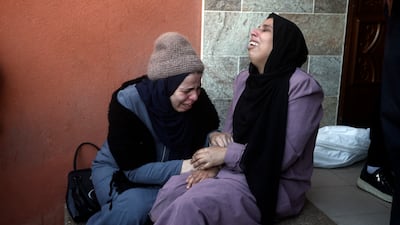
Palestinians mourn relatives killed by Israeli bombardment of the Gaza Strip outside a mortuary in Khan Younis January 4, 2024. AP Photo -
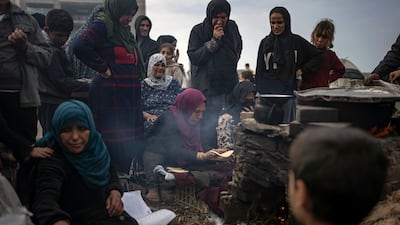
Displaced Palestinians queue to bake bread at a camp in the Muwasi area of Rafah, Gaza Strip, on December 23, 2023. AP Photo -
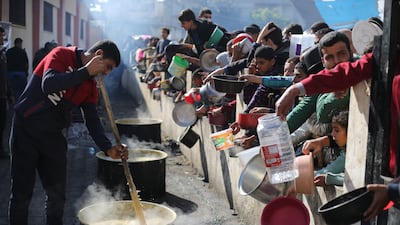
Palestinians queue for food in Rafah, the Gaza Strip, on December 20, 2023. AP Photo -

The ruins of Rafah on December 14, 2023. AFP -
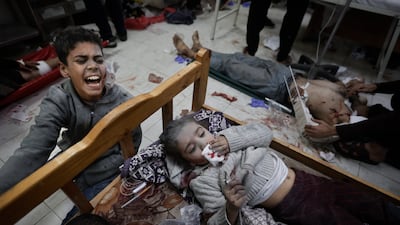
Palestinians wounded in the Israeli bombardment of the Gaza Strip arrive at a hospital in Khan Younis on December 8, 2023. AP Photo -
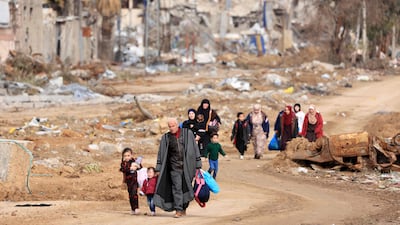
Palestinians flee Israeli bombing along the Salaheddine Road in the Zeitoun district of Gaza city on November 28, 2023. AFP -

A Red Cross vehicle takes Israeli hostages from the Gaza Strip into Egypt in Rafah on November 25, 2023. AP -
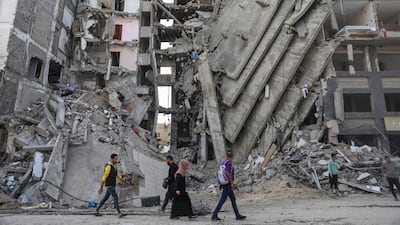
The ruins of buildings in Gaza city on November 24, 2023, as a temporary truce between Israel and Hamas took effect. AP Photo -
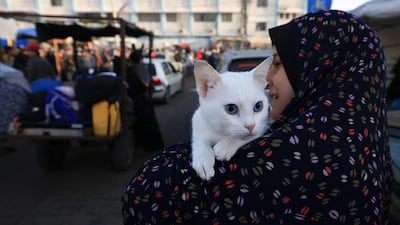
A woman and her cat return home to eastern Khan Younis in the southern Gaza Strip during the first hours of a four-day truce between Israel and Hamas forces on November 24, 2023. AFP -
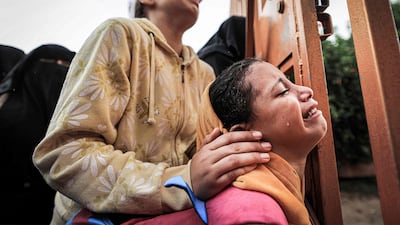
Mourning the dead of Israeli bombardment outside the mortuary at Nasser Hospital in Khan Younis on November 14, 2023. AFP -
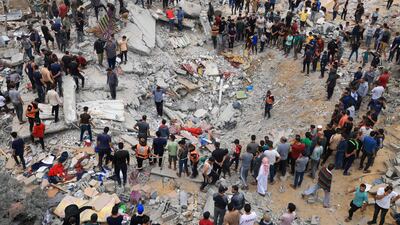
Civilians and rescuers look for survivors in the rubble of a building after Israeli bombing of Khan Younis in the southern Gaza Strip on November 12, 2023. AFP -

November 7, 2023, a month to the day after Hamas attacked Israel, a victim of an Israeli bombardment in Rafah is moved from the rubble. AFP -
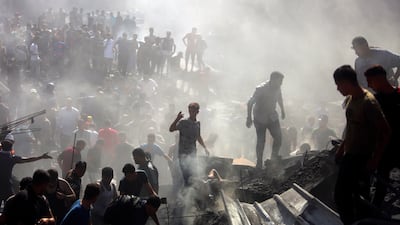
Searching the rubble after Israeli air strikes on the town of Khan Younis, southern Gaza Strip, on October 26, 2023. AP Photo -
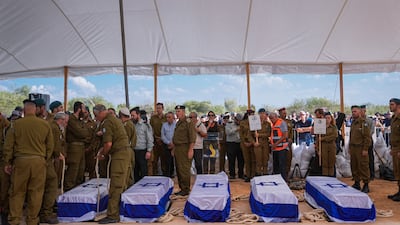
Mourning the Kotz family at their funeral in Gan Yavne, Israel, on October 17, 2023. AP Photo -
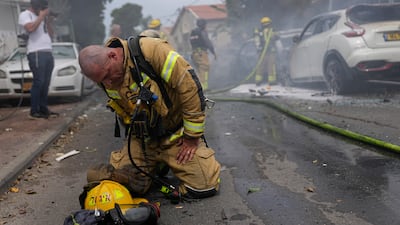
An Israeli firefighter composes himself after he and his colleagues extinguished cars set on fire by a rocket fired from the Gaza Strip in Ashkelon, Israel, on October 9, 2023. AP Photo -
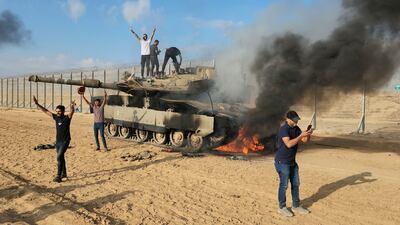
Palestinians with the wreckage of an Israeli tank at the Gaza Strip fence east of the city of Khan Younis on October 7, 2023, the day Hamas forces swept unopposed into Israel. AP Photo -
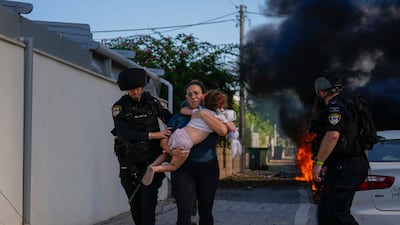
Israeli police officers evacuate a woman and a child from a site hit by a rocket fired from the Gaza Strip, in Ashkelon, southern Israel, on October 7, 2023. AP Photo


“Our risk assessment tells us there is a very high risk of spread to surrounding countries, particularly Egypt, Lebanon, Syria and Jordan.
“Under-vaccinated pockets are everywhere, including in Israel.
“It's very concerning. Polio is the only ongoing public health emergency of concern under the international health regulation.
“This requires a regional response and what that means is an initial focus on Gaza to stop the outbreak.”
Travel restrictions within the enclave have made it increasingly difficult for health workers to interact with communities in dire need of care.
The polio virus has been detected in sewage in two governates, from several sites in Deir al Balah and in Khan Younis.
The WHO and Unicef are working closely with the Ministry of Health to get the OPV programme up and running.
The initial plan was to start the campaign on August 17 but that has been delayed by another week to August 24.
Maintaining the cold chain storage required for the integrity of vaccine doses is another considerable challenge.
“Most likely polio has been circulating perhaps as long as since September last year,” said Dr Jafari.
“The conditions for polio virus transmission and the force of infection in the present situation in Gaza are extremely high.
“People are getting constantly displaced and they're coming into contact in crowded conditions.
“Gaza had very high immunisation rates and childhood immunisation, but they are falling.
“These conditions are perfect for the virus to circulate very efficiently and risk of spread to other parts of the occupied territories.
“The focus of our response is Gaza, but we are also preparing other countries of the region for a regional response, to increase their surveillance and preparedness.
“The only way to stop this outbreak is a series of mass vaccination campaigns.”

