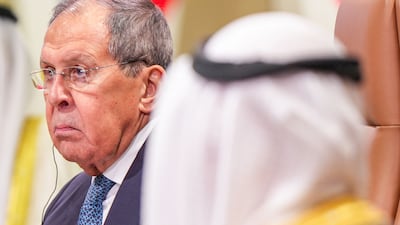

Russian Foreign Minister Sergey Lavrov is to visit Tehran on Monday after Gulf states urged Moscow to use its influence at the UN to press Iran to halt attacks on regional neighbours.
The visit comes as tension escalates over shipping security and the prospect of renewed war between Iran and the US, after President Donald Trump warned overnight that Washington could “soon finish the job” unless Tehran rapidly changes its behaviour.
Tehran condemned Mr Trump's threat.

“Last time you wanted to ‘finish the job’, Iran emerged even stronger,” Foreign Minister Abbas Araghchi wrote on X. “Want to try your luck again? Be our guest. But be careful; we have unfinished jobs too.”
Speeches hardened over the weekend. Iran’s new Defence Minister Mehrdad Ketabchi warned on Sunday that the country was ready to respond to any US attack involving the “Mother of All Bombs”.
On Monday, Brig Gen Mohammad Reza Naqdi, a senior adviser to the Islamic Revolutionary Guard Corps commander-in-chief, went further, saying Iran had the “father of missiles” ready to strike its enemy’s energy infrastructure and investments across the region if attacked.
In a meeting between Mr Lavrov and Gulf Co-operation Council foreign ministers in Manama on Sunday, the bloc called on Russia to play an active role in securing Iranian compliance with UN resolutions, ending attacks on Gulf states and pursuing serious dialogue.
Foreign Minister of Russia
Mr Lavrov has called for a diplomatic solution to the regional crisis, presenting an updated Russian plan for collective security in the Gulf that envisages direct dialogue among coastal states and neighbouring countries, including Iraq and Jordan.
“We all believe that it is important for all the Gulf states to have their own word in how to resolve this strategic crisis,” Mr Lavrov said.
He said Moscow supported direct dialogue between Gulf states and their neighbours, adding that Russia respected agreements reached so far.
“We focus on removing core reasons for conflict,” Mr Lavrov said. “We stand for absolute respect for agreements reached so far. Unfortunately, our western counterparts do not follow the same value.”
Undersea cable threat
At Sunday's meeting in the Bahraini capital, GCC Secretary General Jasem Al Budaiwi said member states had faced more than 7,000 ballistic missile and drone attacks since February 28, when the US and Israel began their war against Iran. He said strikes had hit airports, ports, power stations, water desalination plants and oil and gas terminals.
The bloc also warned that disruption to maritime navigation in the Strait of Hormuz, alongside threats to shipping in the Red Sea and Bab Al Mandeb strait, endangered global energy and food security and international supply chains. It called for maritime traffic through Hormuz to return to its prewar status.
Iran has stepped up attacks on tankers using a US-backed route through the Strait of Hormuz, a chokepoint for about one-fifth of global oil and liquefied natural gas supplies before the conflict.
On Monday, Iran's Islamic Revolutionary Guard Corps said an oil tanker struck a naval mine and caught fire in the Strait of Hormuz. The claim could not be independently verified.

The IRGC said the vessel’s crew had switched off its positioning and navigation systems and were attempting to leave the waterway through an “unauthorised” southern route.
It offered no evidence of a mine, and it is unclear whether the incident is linked to a US-backed shipping route along Oman’s coast, which Tehran may want to discourage companies from using.
Iran’s hardline Parliament Speaker, Mohammad Bagher Ghalibaf, meanwhile warned governments and businesses against funding AI and data companies he accuses of supporting US and Israeli military operations.
In a post on X, Mr Ghalibaf announced plans for a “Gulf Data Authority” and warned that companies providing finance, land or energy to such firms would face Iranian enforcement measures.
The post did not explain how the proposed authority would operate or explicitly threaten undersea cables. However, it follows a separate warning by Iran's security chief, Mohsen Rezaei, that regional undersea cables, data centres and AI facilities could be targeted if hostilities with the US resume.

