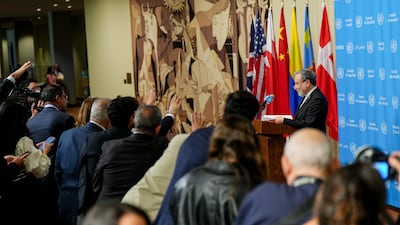

Despite hopes of a diplomatic breakthrough at the UN General Assembly, efforts in New York to end the seven-month US-Iran conflict produced no immediate result.
Three hours of talks on the sidelines of the General Assembly had raised hopes Tehran and Washington might find a way back to the negotiating table, but the two sides emerged without an agreement on the next steps needed.
Iranian Foreign Minister Abbas Araghchi proposed a road map under which the Strait of Hormuz would be reopened and negotiations restarted. US President Donald Trump flatly rejected the plan, however.

Mr Araghchi said the proposal had been delivered to Washington through Qatar and that the road map's seven-day timetable would begin once the US accepted it.
“The actions that the US should take are not new, they are all already in the MoU,” Mr Araghchi said, referring to the abandoned June 17 framework known as the Islamabad memorandum of understanding.
The core dispute
Iran has sought a return to an arrangement involving an end to military operations, the reopening of the Strait of Hormuz, sanctions relief and the release of its frozen assets, followed by renewed negotiations, with the nuclear issue to be addressed later.
The New York talks also exposed tension over the scope of Iran's diplomatic engagement. Mohsen Rezaei, secretary of the Supreme National Security Council, said President Masoud Pezeshkian and Mr Araghchi had gone to New York to communicate conditions already agreed inside Iran, rather than negotiate new ones, and that Washington had four or five days to meet them.
“If they do not fulfil the conditions, we will neither open the Strait of Hormuz nor is there any negotiation on the table,” he said.
Mr Trump's rejection of the latest proposal suggests his administration is seeking further concessions before agreeing to ease the pressure it has placed on Iran. The two sides have nevertheless continued communicating through intermediaries, including Qatar, allowing discussions to continue despite the absence of a new formal negotiating round.
Ali Vaez, the International Crisis Group's Iran project director, called the continued talking a positive development, though he noted the two sides had largely been “talking past each other”.
Robert Malley, the former US special envoy for Iran, argued that the economic and military pressure now squeezing Iran has eroded its leverage since June, meaning the original framework's trade-off no longer holds the same incentive for Washington.
Pressure at home
The Iranian delegation's proposal came against the backdrop of growing economic pressure at home. Mr Pezeshkian said last month that sanctions and the US naval blockade had reduced Iran's exports and imports by almost 35 per cent. At the same time, Iran has continued to resist putting substantive nuclear concessions at the forefront of a new agreement.
The two sides remain divided over what should happen first: whether Washington should ease military and economic pressure before negotiations resume, as Tehran has proposed, or whether Iran should make additional concessions before the US changes its position.
What happens next?
For now, the immediate focus remains on whether the mediators can produce a proposal acceptable to both sides. The General Assembly meetings did not produce the breakthrough some had hoped for, exposing the limits facing Iran's diplomatic track. Mr Araghchi has offered a defined route back to negotiations, while senior security officials insist Iran's conditions are fixed and that Washington must act first.
The US midterm elections in November loom over the time frame on both sides. Mr Araghchi said on Friday it “would be better” to reach an agreement before the vote, although those hopes appear to have faded for now. Adding a further complication, unnamed US officials cited by The Wall Street Journal suggested Mr Trump has told aides he expects to resume bombing Iran after the midterms.

