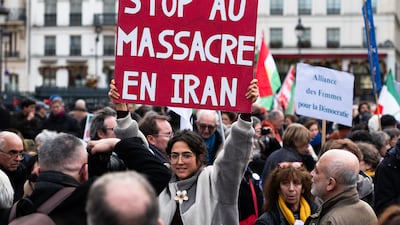

Iranian opposition parties in exile are coming together in an attempt to reassure Iranians that a change in regime can be managed peacefully without the country collapsing.
The representatives of 12 parties met on Friday in Oslo to agree on principles for a democratic transition in Iran.
The Sweden-based activist Duman Radmehr, who represented the Azerbaijan Democracy and Development Party at the meeting, hoped it would reassure Iranians that political groups in exile are committed to a peaceful transition.

“One of the things that stops the Iranian people from protesting is that the majority are not optimistic about the future after the Iranian regime,” Mr Radmehr told The National. “They’re afraid of a civil war and a vacuum like the one they saw in Syria. There are lots of armed groups in Iran, and groups talking about violence.”
“The importance of the document is that it shows we are committed to avoiding such a situation in the future,” he said. He said he hoped the signing would also send a signal to the US of the growing coalition of exiled political parties seeking a stake in the negotiations to end the US-Iran war.
Iran is under pressure to make concessions on its nuclear programme to revive ceasefire talks. Donald Trump rejected an Iranian proposal to reopen the Strait of Hormuz in seven days, but expects negotiators to resume talks this week.
“We are asking the US not just to negotiate with the Iranian regime. We want to be considered in the negotiations, as Iranian parties and people,” Mr Radmehr said. “It’s not just about reaching a nuclear agreement. It is about democracy, the freedom of the people, and the demands of the Iranian people.”

The 12 parties are mainly from the Iranian left wing as well as minority groups such as the Turks, Balochis, Ahwaz and Kurds, who seek better rights for their communities. The meeting was organised by the charity Iran Human Rights in the Norwegian capital.
The document calls for the release of political prisoners, guarantees of civil and political freedoms, and free and fair elections in any future government of Iran. The “minimum principles are proposed as a basis for initial understanding and consensus on human rights among political and civil movements and organisations opposed to the Islamic Republic of Iran”, the document said.

Heshmatollah Tabarzadi, the imprisoned leader of the Democratic Front of Iran, also expressed his endorsement from Evin prison. Other opposition figures inside Iran who supported the principles were not named for security reasons.
The country and its diaspora have become increasingly divided in the past nine months since a nationwide uprising against the regime was brutally quashed. This was followed by the outbreak of the US-Iran war, during which tens of thousands of bombs have been dropped on Iran.
While there has been vocal support for Reza Pahlavi, the exiled son of Iran’s last Shah, he remains a divisive figure supportive of a Persian nationalism that many fear will oppress Iran’s minority groups. The Iran Freedom Congress, which launched in London in March, sought to create a unifying platform for dissidents of all stripes, as well as academics and civil society groups.
“Until the regime collapses, we have the time to build trust among Iranian people,” Mr Radmehr said. Yet the grouping in Oslo is a small subset of those parties who took part in the IFC launch. Some groups declined to participate in the meeting, Mr Radmehr said.

Dissidents in exile continue to face threats from the Iranian authorities. Mr Radmehr said he lives with constant worry for he and his family’s safety. “My family and I are always worried about our safety. The (Iranian) intelligence services are very active here,” he said.
Sweden expelled an Iranian diplomat from the country earlier this month, with Swedish officials highlighting Iran’s willingness to co-operate with organised crime groups in the country to stage attacks on Israel and opposition groups.
His family in Iran have been regularly called in by Iranian authorities who have questions about his activities in Sweden. “They call them to ask about me. They threaten and say they can do what they want if necessary."
During the Women Life Freedom protests, he received a threatening call from an unknown number. “They said 'we know where you are'. I reported it to the police,” he said.

