


The Dutch government, led by a far right anti-immigration party, has announced a series of new asylum measures and border checks.
Authorities in the Netherlands will also declare parts of Syria safe, so asylum applications from that country can be rejected, while reducing the validity of refugee visas from five years to three “in line with nearby countries”.
The measures, condemned by refugee rights groups, will tighten border checks, scrap indefinite residency permits for refugees and expand detention centres for refused or undocumented asylum seekers.
The Netherlands has a four-party coalition, steered by Geert Wilders and his far-right Freedom Party (PVV), in government. “Today is a beautiful day,” the PVV leader said, hailing the measures as historic and “the toughest asylum policy ever".
Asylum and Migration Minister Marjolein Faber, a PVV member, said: “We want to make the Netherlands as unattractive as possible.”

The government's Syria policy will be “significantly tightened” with parts of the country being declared “safe” this year, Prime Minister Dick Schoof said.
Asylum seekers from safe areas could be sent back and those already in possession of a Dutch residency permit “could be considered” for return, he added.
Mr Schoof said the moves are aimed at “reducing the inflow, accelerating the outflow, returning those who are not lawfully staying and getting the asylum chain back in order and thus reducing the pressure on society”.
But the government has back-peddled on declaring an “asylum crisis” in the Netherlands, which would have set in motion emergency legislation allowing the cabinet to by-pass parliament.
The coalition formed after Mr Wilders led his party to victory last year came to office in July on a pledge to control migration, but partners have been wrangling over how to quickly implement changes.
-

An election poster for Geert Wilders, leader of the Freedom party (PVV) is removed near the Dutch parliament buildings in The Hague, a day after the general elections. EPA -

Mr Wilders speaks in The Hague after exit polls and early results predicted his PVV party would win the election with 37 seats. Reuters -
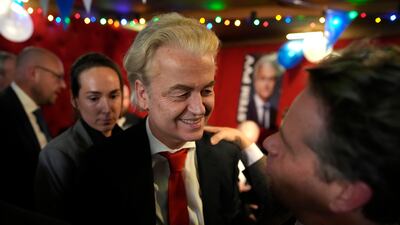
Mr Wilders talks to his supporters in The Hague. AP -
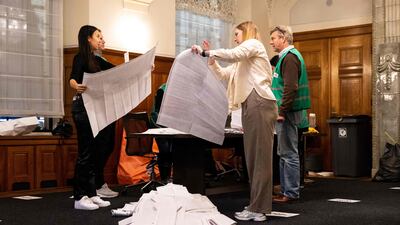
Election staff count the votes at a polling station in Rotterdam. AFP -
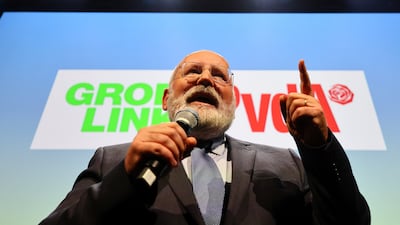
Frans Timmermans' GroenLinks-PvdA was nine seats behind Mr Wilders' party, according to the exit poll. Reuters -

Socialist Party leader Lilian Marijnissen speaks in Amersfoort. AFP -

Prime Minister of Netherlands Mark Rutte addresses the media in The Hague. His People's Party for Freedom and Democracy, or VVD, was in third place at 23 seats, according to the exit poll. AP -

CDA leader Henri Bontenbal responds to the results in The Hague. EPA -

Volt party leader Laurens Dassen follows the announcement of the first exit polls in Utrecht. AFP


“Today we have a comprehensive package of measures to implement our asylum policy quicker, and make it stricter and more streamlined,” Mr Schoof said.
The Dutch Council for Refugees said the plans would not solve the problems in the Netherlands.
“This ‘toughest-ever asylum policy’ is not a solution for anybody,” the council said, warning that the problems in the Netherlands were being caused by a slow asylum system and lack of accommodation for arrivals.
The government also will scrap a law that obliged municipalities to house migrants.
The association of Dutch municipalities said that the measures would “create chaos”. It said that “tasks should be fairly distributed among municipalities”.
Over the past 12 months, 51,000 people have applied for asylum in the Netherlands, according to figures from the country's immigration service. Last month, there were 4,026 arrivals, fewer than the 4,683 in September last year.
Critics include lawyers, opposition lawmakers and the New Social Contract party, a junior partner in the coalition.
They all questioned the legality of implementing crisis legislation to tackle long-standing problems in the migration system.
Germany, one of the Netherlands’ neighbours, also recently reintroduced some border checks and the new French government has also pledged a hardline approach to migration.

