

Divers searching the wreck of a superyacht that sank off Sicily have found the bodies of five people.
British technology tycoon Mike Lynch is among the missing but so far Italian authorities have not publicly identified the bodies recovered.
The Bayesian was moored about 700 metres off the coast of Porticello when it sank on Monday after the area was hit by a storm. Sicily's Civil Protection Agency sources said rescue operations led by scuba divers scouring the wreck of the yacht found the bodies on Wednesday.
Six people were believed to be trapped inside the yacht when it was hit by a waterspout. They were unable to escape, according to authorities.
Salvatore Cocina, the head of Sicily’s civil protection agency, told the PA news agency that searches have finished for the day on Wednesday and will resume on Thursday morning.
He confirmed that of the five bodies found, only four had been recovered, and the whereabouts of the missing sixth person remains unknown.
The identities of the victims were not immediately given by the authorities. Reports say two of the bodies are of Mike Lynch and his daughter Hannah, 18.
As the first three bodies were taken back to the port of Porticello, dozens of emergency services staff were waiting, and one was seen being put in the back of an ambulance. The fourth was seen being taken to land as evening set in.

He said there would be an investigation in due course, but the priority was to find those who are still missing. Pictures also showed emergency services staff bringing a green body bag to shore.
Fifteen people, including Mr Lynch's wife Angela Bacares, who owns the boat, were rescued after it capsized. It is not clear when all the bodies could be recovered as authorities work on the theory that all the missing are still inside the vessel.
“We think they are still inside the boat,” said Vincenzo Zagarola of the Italian coastguard. “Our search-and-rescue activity by sea and air has gone on for about 36 hours.
“Of course, we do not exclude [the possibility] that they are not inside the boat but we know the boat sank quickly. We suppose the six people missing may not have had time to get out of the boat.”
Morgan Stanley International bank chairman Jonathan Bloomer, his wife Judy, Clifford Chance lawyer Chris Morvillo and his wife Neda are all missing.
The wreckage of Bayesian rests on the seabed off the coast, 50 metres below the surface.

The depth requires special precautions, limiting divers to rotating 12-minute shifts, a measure that has slowed down their work.
British tech entrepreneur among missing after Bayesian yacht sinks off Sicily – in pictures
-
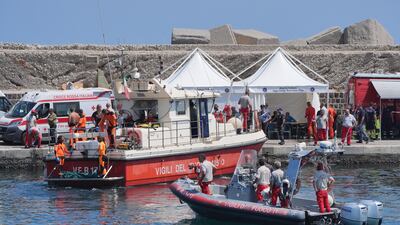
A body bag is brought ashore at Porticello on the fifth day of the search operation, after the luxury yacht Bayesian sank in a storm while moored off the Sicily coast. PA -
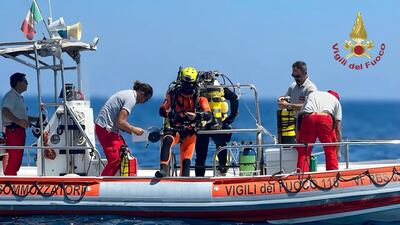
A diver prepares to reach the sunken superyacht. AP -
Mike Lynch and his daughter Hannah were among those who died. PA -

Rescuers test a decompression chamber at Porticello harbour. PA -
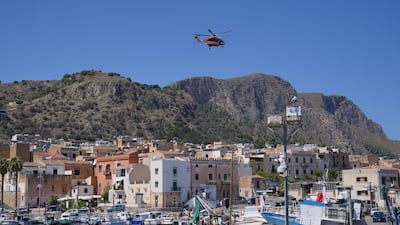
A fire service helicopter returns to port, after being used to aid search efforts at the site of the sunken yacht. AP -
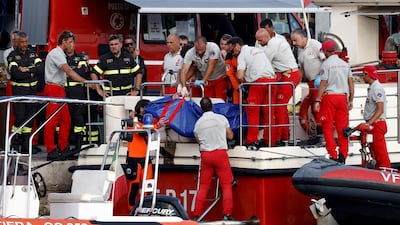
Rescue workers transport a body bag after a luxury yacht, which was carrying British entrepreneur Mike Lynch. Reuters -
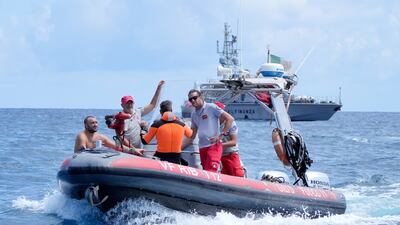
An Italian fire service diving crew returns to harbour on the third day of the search. PA -
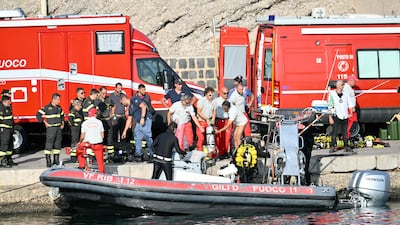
Rescue divers continue their search. AFP -
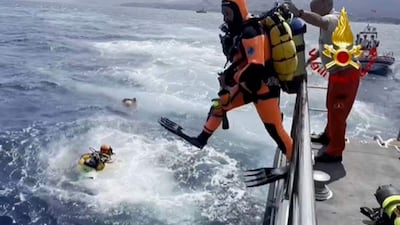
Divers off Porticello set out to inspect the site where the British-flagged luxury yacht Bayesian sank with 22 people onboard. AFP -
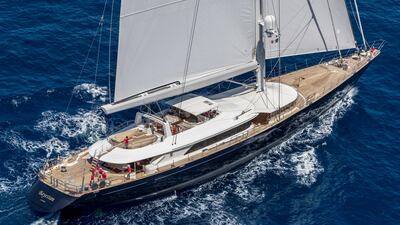
The yacht Bayesian in Palermo, Sicily. EPA -
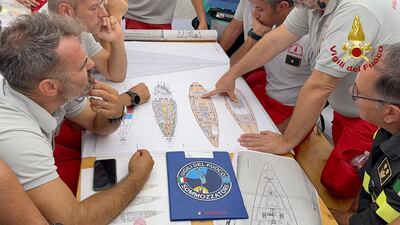
Rescuers at Porticello plan their dive on the site where the Bayesian sank. AFP -

A helicopter of the Italian Coast Guard above Porticello. AFP -
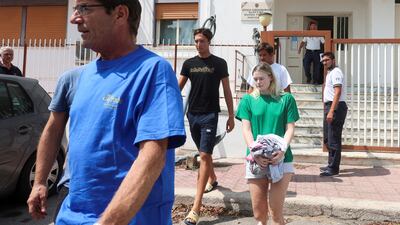
A survivor of Monday's incident leaves Italian Coast Guard headquarters in Porticello. Reuters -
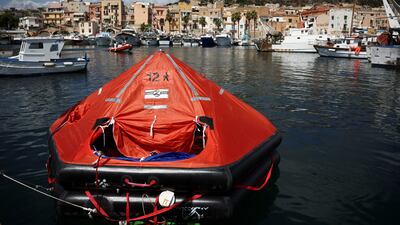
A life raft docked at the harbour near the port where emergency and rescue services are working. Reuters -
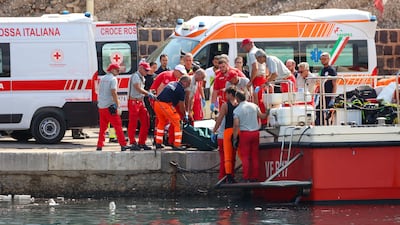
Health workers carry a body bag on the pier at Porticello. EPA


The search teams, each made up of two specialised cave divers, are working to open up access points to enter the wreck, which is still intact, at a depth far beyond what most recreational divers are certified to reach.
Earlier, search crews carried out further inspections of the yacht's internal hull on Wednesday morning.
Fire crews from the Vigili del Fuoco said they had been accessing the vessel through natural entrances, without making openings.
Remotely controlled underwater vehicles are being used, with naval units and cave divers also taking part in the search, the Italian Coastguard has said.
Luca Cari, a spokesman for the rescue teams, has said the search was slower than a “much simpler” shipwreck operation in Italy, involving the Costa Concordia cruise ship that flipped on its side off Tuscany's coast in 2012, because of the depth of the wreck and the limited space divers have to manoeuvre. “Here everything is more tight,” he said.

The passengers had been invited on the luxury yacht trip to celebrate Mr Lynch’s recent acquittal of fraud charges in the US linked to the sale of Autonomy to Hewlett-Packard for $11 billion in 2011, which quickly turned sour after HP wrote down the value of the company – co-founded by the tech tycoon – by $8.8 billion.
Mr Lynch said he was “elated to be cleared” in the criminal trial, during which he took the stand in his own defence, denying to jurors any wrongdoing and blaming HP for botching the integration of the two companies.
One expert at the scene of the disaster, who declined to be named, said an early focus of the official investigation would be whether the yacht's crew had closed access hatches into the vessel before the storm struck.
The tragedy came only days after the death of Stephen Chamberlain, Mr Lynch's former colleague and co-defendant. The former vice president of finance at Autonomy was hit by a car in Cambridgeshire, eastern England, while out running on Saturday. He was placed on life support but later died.
Although there had been warnings of possible thunderstorms, there had been no indication they would be so violent on Monday morning.
The boat was thought to have been caught in a waterspout. Tornadic waterspouts share the same characteristics as land tornadoes and are associated with severe thunderstorms, often accompanied by high winds and seas, large hailstones and lightning, according to the US National Ocean Service.
They are not out of the ordinary for Italy, which experiences about 100 tornadoes a year, according to AtmosphericG2, a company that provides weather data to traders.
About 70 of these are “marine spouts,” occurring off the coast.
The captain of a yacht who helped to rescue 15 people from the stricken boat has described how his crew saw the distress flare set off from a life raft.
Karsten Borner said his vessel, the Sir Robert BP, was about 150 to 200 metres from the Bayesian when the “extreme” weather hit.
He said his boat was using its engine to stay in position and the crew noticed the Bayesian had disappeared before a passenger on his yacht saw the flare.
Mr Borner said they sent their dinghy, which found the life raft and took the occupants back to his yacht.
“We couldn’t see them any more and they disappeared from the radar. We were busy keeping our own ship sailing," he told Sky News.
“We couldn’t see the ship again so we were aware something was very wrong.”
Mr Borner said it was only when the dinghy set out that they found the life raft.
“It turned out to be the life raft, a 12-person life raft with 15 people inside, including one baby," he said.
“They stepped over to our tender and we brought them back to our ship. There we took good care of them, gave them dry clothes, towels, blankets, tea and coffee and so on and took care of them.”
Mr Borner said he helped the coastguard to launch its search-and-rescue mission for the other occupants of the Bayesian.
He said the captain of the Bayesian told him the yacht had sunk in two minutes but he had since seen a video that showed it go down in 60 seconds.
“The engineer and captain had no explanation why she sank so quickly," Mr Borner said. “My personal opinion is it shouldn’t tip like this. It goes against any logic.”
He also questioned the safety of the Bayesian’s 75-metre mast and added: “I think it’s not safe to build the masts.”
Describing the strength of the storm and sea spouts that hit his yacht and the Bayesian, Mr Borner said: “They were very close and we were hit very hard, very strong and they had the same.
“It was extreme, it was extremely strong.”

