


Germany was being urged on Monday not to freeze military aid to Ukraine, as coalition horse-trading in Berlin puts its future support in doubt.
Chancellor Olaf Scholz faces dismay from his own party over the prospect of budget cuts as he returns from a summer holiday on Monday.
Ukraine said any cuts would put Europe’s security at risk just as its troops make surprise advances into Russia's Kursk region. President Volodymyr Zelenskyy has said Kyiv wants to create a cordon within Russia as its forces destroy strategic bridges over the Seym River in Russia's Kursk region, limiting the supply capacity of a Russian group opposing the Ukrainian advance.
German budget plans finalised last week call for cutting the deficit by €6.5 billion ($7.17 billion) in 2025, with no promises of new funds for Ukraine.
European defence stocks slid on Monday amid reports of a freeze, with Germany's Rheinmetall AG falling as much as 5.1 per cent in Frankfurt.

Fiscal conservatives in Mr Scholz's three-party coalition say future aid for Ukraine will have to come from interest on frozen Russian assets.
After being criticised for a slow start, Germany has provided an estimated $11.26 billion of aid since Russia invaded Ukraine, the second-biggest sum after the US.
Europe’s stamina is being closely watched as it braces for a potential US retreat if Donald Trump wins back the White House in November.
“If we want a breakthrough, if we want to force Russia into constructive negotiations, we need funds to be replenished and not cut,” said Ukraine's ambassador to Germany, Oleksii Makeiev.
“Freedom, security and peace are priceless. You cannot make savings on them.”
Russian presidential aide Yuri Ushakov said on Monday that Moscow was not yet ready to hold peace talks with Ukraine given the attack on the Kursk region.
Allies of German Finance Minister Christian Lindner played down suggestions that no new funds will be available at all, saying it will be up to parliament.
But Kyiv is asking for more than the $4.41 billion envisaged in next year's budget, a cut of almost half, which Ukrainian officials have already priced into their plans.
Mr Lindner's fiscally hawkish party has insisted on a return to balanced budgets in Germany after several years of exceptional spending due to pandemic and war.
Debt brake

A so-called debt brake in Germany's constitution means the government cannot normally run a deficit of more than 0.35 per cent of GDP.
“We cannot sacrifice Ukraine's fate on the altar of the debt brake,” said Michael Roth, the head of the foreign affairs committee in the German parliament and a member of Mr Scholz's party.
He warned in a radio interview on Monday that it was unclear whether a plan to raise money via frozen Russian assets will ever work.
Budget cuts would be “the wrong signal at the wrong time” and make Germany more dependent on Washington, he said. “Germany must continue to stand by Ukraine’s side.”
The EU plans to send Ukraine more than $2 billion in interest gained on Russian central bank funds idling in European accounts.
-
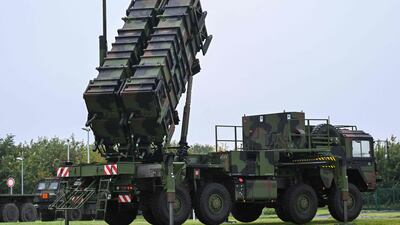
Air defence: Ukraine’s air defence largely depends on the Patriot system. AFP -
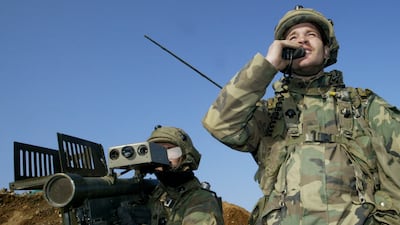
Air: Stinger short-range surface-to-air missile. Reuters -
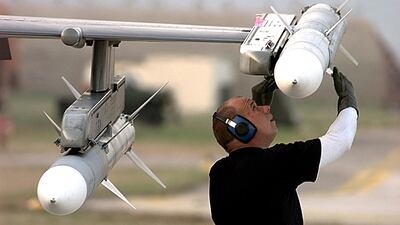
Air: Aim-120 air-to-air missiles. More than 14,000 of the missiles, that have a range exceeding 120km, have been produced with their accuracy so good that they have been nicknamed “Slammer”. Getty Images -
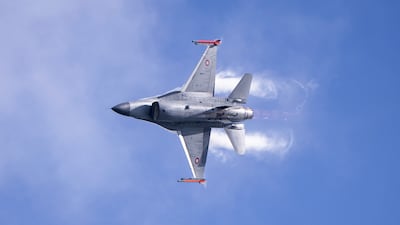
Air: F-16s will provide greater surveillance and the ability to attack high-value targets behind Russian lines in occupied Ukraine. EPA -
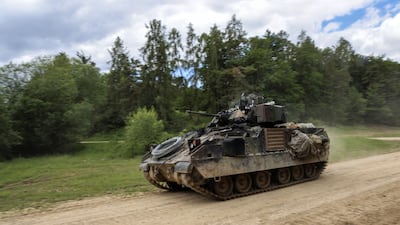
Armour: Bradley IFV. The Ukrainians have found the Bradley infantry fighting vehicle, with its 25mm cannon, very useful in protecting troops and providing decent firepower. Bloomberg -
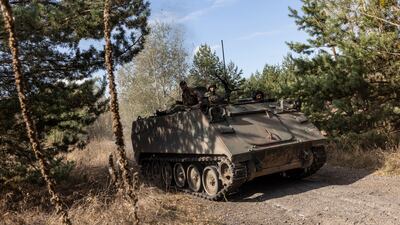
Armour: M113. The 1960s-designed versatile M113 armoured personnel carrier has proven effective in protecting troops against minefields. Getty Images -
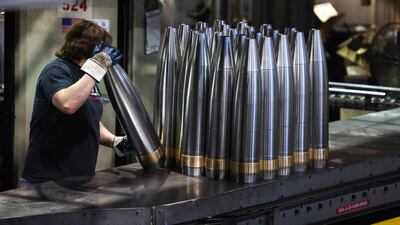
Artillery: 155mm artillery rounds. A massive delivery of 155mm rounds could prove crucial in preventing further Russian advances, particularly in its expected summer offensive. AFP -
Artillery: ATACMs long-range precision missiles. The ATACMS have a range of 300km with the ability to land within a few metres of a target. Getty Images -
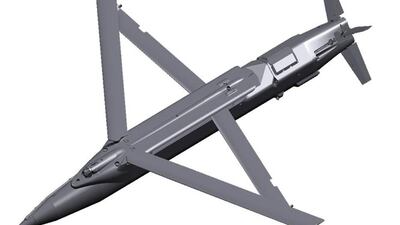
Artillery: Ground-Launched Small Diameter Bomb (GLSDB). It can be fired from the HIMARS system. Photo: Wikimedia Commons -

Artillery: M777 guns and replacement barrels. The Ukrainians need many M777 howitzer barrels to replace those worn down by extensive use. Getty Images


Officials are queasy about touching the underlying Russian assets, worth about $200 billion, for fear of legal challenges and the reputation of the eurozone.
German weapons aid to date has included Leopard battle tanks, Marder fighting vehicles, Iris air defence missiles and Patriot missile launchers.
Berlin also pays into a European Union fund made available to Ukraine to buy weapons directly from manufacturers.
Nato countries meanwhile agreed at a July summit to provide more than $44 billion annually for Ukraine in what was seen as an attempt to “Trump-proof” long-term support.

