Norwegian Foreign Minister Espen Barth Eide. EPA

Norway’s Foreign Minister: Gaza ceasefire is the 'starting point' rather than 'endpoint'


Mina Al-Oraibi
  • English
  • Arabic

Norway’s Foreign Minister Espen Barth Eide has said the ceasefire in Gaza must be a “starting point” rather than an “endpoint”. Speaking to The National in Davos where he attended the World Economic Forum’s annual meeting, he said “we know very well from experience in Gaza, in Palestine, in the Middle East and in the whole world that ceasefires are not peace … in order to make ceasefires into a peace agreement, you need to do much more work”.

He called on countries “to use that momentum to start a course that leads to something that can actually last”.

While the minister said he was “obviously very relieved that there is a ceasefire”, he stressed that “what is tragic is that this ceasefire comes only now because it’s literally the same proposal as [former US president Joe] Biden put on the table in May”. He added that “of course this whole war shouldn’t have happened but at least everything that happened after May is a little bit in vain because now we have the same proposal … same dates, same number of people and refugees and hostages and prisoners”.

The first images of the Israeli hostages being released showed Hamas fighters in uniforms and organised, which raised questions as to their current status. Mr Eide said “Hamas has been severely degraded, but they're still there, as we could see”. He also referred to “Antony Blinken, while he was still secretary of state, saying that you have killed or eliminated many fighters, but you also recruited new fighters because the hatred goes on”.

Mr Eide spoke of how “the outgoing and the incoming US administration actually joined forces” to deliver the ceasefire. He singled out the new US Middle East Envoy Steve Witkoff for being “very helpful in underlining that also the new president really wanted this” ceasefire. Mr Eide explained that “the fact that it was communicated so clearly from the Trump administration that he wanted this off the table before he became president, through Steve Witkoff, this is public knowledge … they've been very clear, clearly communicating that,” which helped bring the deal to a close.

However, whether the new US President Donald Trump will equally want a peace deal that establishes a two state solution is not clear. What is clear is that 75 per cent of UN member states now recognise Palestine and there is now a global alliance, led by Saudi Arabia and Norway, advocating for the two state solution. Oslo was holding the third international meeting of the global coalition to bring about a two state solution when the ceasefire was announced, which “inspired the meeting”, Mr Eide said.

“This is, in many ways, the moment we have been preparing for. That's the work of Qatar, of Egypt, of the United States, and, of course, the parties. But now starts the hard work of not only implementing the ceasefire, but also how can we take it into something meaningful … how the two state solution comes into being is not yet clear.”

While the ultimate contours of any agreement for a two state solution should be based on UN Security Council resolutions and the 1967 borders of Palestine, there is much resistance within the Israeli political class, and disarray among Palestinian leadership. “We need to move forward to something that we haven't yet seen … this is so important to say in this moment of little hope, in order to make into a big hope, we need to move in that direction,” according to Mr Eide.

On Mr Trump’s approach to a two state solution, Mr Eide expressed optimism, explaining: “I have to say that what we have seen so far, and this is really early days, but so far, has made me rather more optimistic than more pessimistic around the change of [US] president”. Mr Trump had overseen the Abraham Accords which established ties between the UAE, Bahrain and Morocco with Israel. Mr Eide said there is “a strong commitment from President Trump to complete the Abraham Accords, Saudi Arabia in particular, as you know, leading those Arab states that have not normalised and have been very clear that they want to work with Trump and Israel towards normalisation, but only with Palestine involved this time”.

He added that in his inauguration speech on Monday, “President Donald Trump was very clearly messaging desire to stop wars and to be a peacemaker … He actually wants to bring lasting peace to more than one place. One of those places is probably Ukraine, but I dare to hope that it also includes the Middle East, based on what we've heard so far.”

Espen Barth Eide optimistic about Donald Trump

There is a clear sense of “new energy” with Mr Trump’s election that Mr Eide and other diplomats seek to build upon. The ceasefire itself has also created a positive dynamic. The release of hostages and detainees “creates a sense of progress in society … this creates a positive dynamic that might supersede the more negative dynamics that led to the continuation of the fighting. But it has to be implemented”.

The ceasefire in Gaza is of major significance but so is the one in Lebanon. Mr Eide said the region is witnessing a moment of possibility, saying “there is hope, with all caveats, in Gaza and in Palestine. There is hope in Lebanon. There's hope in Syria and let all these hopes reinforce each other.”

Mr Eide visited both Lebanon and Syria before heading to Davos. He said the fact that a president and prime minister were now in place in Lebanon was promising but “it is very important that the parties to the Lebanon ceasefire, Israel and Hezbollah, doing what they promised to do”. He added “everyone should allow the Lebanese army to establish themselves in the South”, as mandated in the agreement and by UN Security Resolution 1701.

Mr Eide then went on to Syria where he met officials, including Syrian interim leader Ahmed Al Sharaa, who has a “colourful background” and is part of this “extremely complex puzzle of fighters in Syria”. He expressed his admiration for Mr Al Sharaa, saying “I have to say, I was very impressed by Al Sharaa, he came across as highly intelligent, knowledgeable and genuine and at least what I can testify is that he says the right things”. He added that ''most of what he has done is what I would think is the right things, and if he's done something not so right, he also recognises that”.

Espen Barth Eide calls for end of Syria sanctions

Mr Eide did not hide his optimism for Syria, stating “there is a new light of hope in Syria … but it's not an experienced administration, they still have to bring in a lot of other groups”. Mr Eide stressed the importance of having a “national reconciliation process or a national process of state building”.

The issue of state building is one that Mr Eide focused on, explaining: “They still have to build a state. Syria is a people, a population. It's a country. It has borders, but it's not really a state right now … So you have to build that state and then make sure that that state is established in line with international principles”.

He added that the international community must support Syria. “I think it can work. And I think that if people like me and all my colleagues just say it will not work, we might soon be right. So let's this time give it a chance, and also because it is part of this regional development.”

He stressed the importance of a Syrian-owned process: “Syria has to be fixed by Syrians. So my advice would be to other countries not to try to fix it on their behalf. That was tried in Iraq, it was, I think it's a broad consensus that was not very smart, including firing everyone who knew anything” in reference to de-Baathification in Iraq.

However, there is room to help Syria from the outside, “the first thing we should do is to look at the sanctions regime. There are many different sanctions, but those sanctions that were imposed on Syria as a country because of [former Syrian president Bashar Al Assad, I happen to think it's rather strange to keep those sanctions when Assad is gone. The whole purpose was to punish the Assad regime. It's over. It's gone”. He added that while the new authorities in Syria should be monitored and called out if they do something wrong, they should not be under sanctions now.

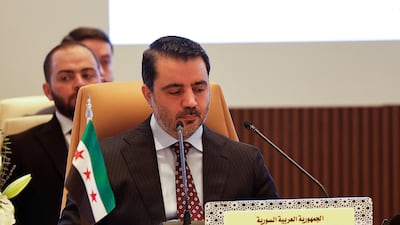
  • Syrian Foreign Minister Asaad Al Shibani during talks on Syria in Riyadh. Reuters
    Syrian Foreign Minister Asaad Al Shibani during talks on Syria in Riyadh. Reuters
  • Sheikh Abdullah bin Zayed, Deputy Prime Minister and Minister of Foreign Affairs arrives at an Arab officials' meeting in Riyadh. AFP
    Sheikh Abdullah bin Zayed, Deputy Prime Minister and Minister of Foreign Affairs arrives at an Arab officials' meeting in Riyadh. AFP
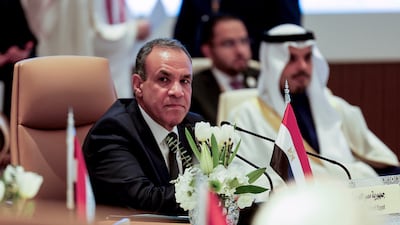
  • Egypt's Foreign Minister Badr Abdelatty attends a meeting on Syria in Riyadh. Reuters
    Egypt's Foreign Minister Badr Abdelatty attends a meeting on Syria in Riyadh. Reuters
  • Saudi Foreign Minister Prince Faisal bin Farhan welcomes Oman's Foreign Minister Sayyid Badr Albusaidi in Riyadh. AFP
    Saudi Foreign Minister Prince Faisal bin Farhan welcomes Oman's Foreign Minister Sayyid Badr Albusaidi in Riyadh. AFP
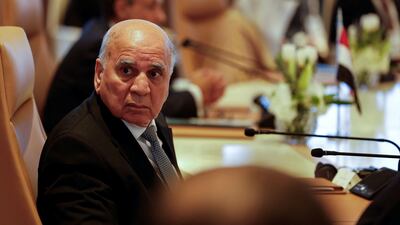
  • Iraq's Foreign Minister Fuad Hussein during the meeting to discuss Syria. Reuters
    Iraq's Foreign Minister Fuad Hussein during the meeting to discuss Syria. Reuters
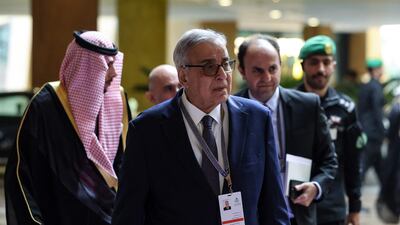
  • Lebanon's Foreign Minister Abdallah Bou Habib arriving in Riyadh. AFP
    Lebanon's Foreign Minister Abdallah Bou Habib arriving in Riyadh. AFP
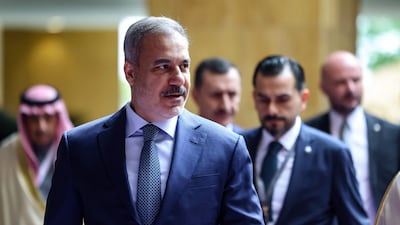
  • Turkey's Foreign Minister Hakan Fidan arrives before the meeting of top diplomats from the Middle East and Europe to discuss Syria. AFP
    Turkey's Foreign Minister Hakan Fidan arrives before the meeting of top diplomats from the Middle East and Europe to discuss Syria. AFP
  • Jordan's Foreign Minister Ayman Safadi arrives to attend an Arab officials' meeting in Riyadh. AFP
    Jordan's Foreign Minister Ayman Safadi arrives to attend an Arab officials' meeting in Riyadh. AFP
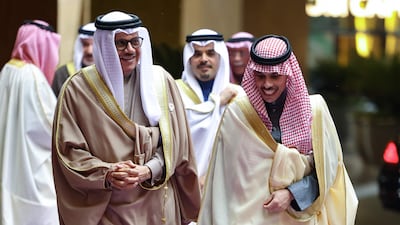
  • Saudi Foreign Minister Prince Faisal bin Farhan with Bahrain's Foreign Minister Abdullatif Al Zayani, before the Arab officials' meeting. AFP
    Saudi Foreign Minister Prince Faisal bin Farhan with Bahrain's Foreign Minister Abdullatif Al Zayani, before the Arab officials' meeting. AFP
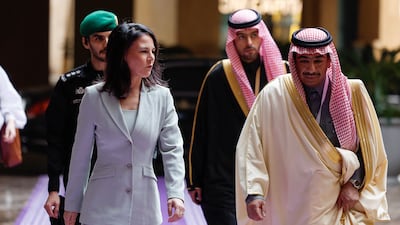
  • German Foreign Minister Annalena Baerbock arrives for the meeting on Syria. Reuters
    German Foreign Minister Annalena Baerbock arrives for the meeting on Syria. Reuters

While Mr Eide is heavily involved in peace efforts in the Middle East, he is also of course concerned about the war in Ukraine and how it can be resolved. Mr Eide noted that the Ukrainian Foreign Minister Andrii Sybiha went to Syria “as one of the first [visitors] because he recognises the connection between the weakening of Russia and that he would like to see in his own country, of course, and what's happening in Syria, because Russia did not fare well in what happened in these changes in Syria”. He added that “most people, including most of the Ukrainians, would like peace to come”. Mr Eide said there is “ no purpose in itself to make wars last longer than necessary. So if the advent of Trump can lead to a new impulse to look for a settlement that can bring peace to Ukraine, to Europe, in principle, is welcome”.

There was a general agreement among officials in Davos of the need for a settlement in Ukraine and an end to the war the started by Russia almost three years ago. Mr Eide said that how the war ends is important as “we need to shape the postwar order, the post-Ukraine war order in Europe, in such a way that is not just a pause” of the war, adding it would be good if it came about quickly if the right conditions were met. Mr Eide said he expected change to come on several fronts. “I think we will see a difference when we meet again at the next Davos. Things will be different, in Europe and hopefully in the Middle East”.


The specs

Engine: 2.0-litre 4-cylturbo

Transmission: seven-speed DSG automatic

Power: 242bhp

Torque: 370Nm

Price: Dh136,814

Timeline

2012-2015

The company offers payments/bribes to win key contracts in the Middle East

May 2017

The UK SFO officially opens investigation into Petrofac’s use of agents, corruption, and potential bribery to secure contracts

September 2021

Petrofac pleads guilty to seven counts of failing to prevent bribery under the UK Bribery Act

October 2021

Court fines Petrofac £77 million for bribery. Former executive receives a two-year suspended sentence 

December 2024

Petrofac enters into comprehensive restructuring to strengthen the financial position of the group

May 2025

The High Court of England and Wales approves the company’s restructuring plan

July 2025

The Court of Appeal issues a judgment challenging parts of the restructuring plan

August 2025

Petrofac issues a business update to execute the restructuring and confirms it will appeal the Court of Appeal decision

October 2025

Petrofac loses a major TenneT offshore wind contract worth €13 billion. Holding company files for administration in the UK. Petrofac delisted from the London Stock Exchange

November 2025

180 Petrofac employees laid off in the UAE

Company profile

Name: Infinite8

Based: Dubai

Launch year: 2017

Number of employees: 90

Sector: Online gaming industry

Funding: $1.2m from a UAE angel investor

UAE currency: the story behind the money in your pockets
MOUNTAINHEAD REVIEW

Starring: Ramy Youssef, Steve Carell, Jason Schwartzman

Director: Jesse Armstrong

Rating: 3.5/5

Mercer, the investment consulting arm of US services company Marsh & McLennan, expects its wealth division to at least double its assets under management (AUM) in the Middle East as wealth in the region continues to grow despite economic headwinds, a company official said.

Mercer Wealth, which globally has $160 billion in AUM, plans to boost its AUM in the region to $2-$3bn in the next 2-3 years from the present $1bn, said Yasir AbuShaban, a Dubai-based principal with Mercer Wealth.

Within the next two to three years, we are looking at reaching $2 to $3 billion as a conservative estimate and we do see an opportunity to do so,” said Mr AbuShaban.

Mercer does not directly make investments, but allocates clients’ money they have discretion to, to professional asset managers. They also provide advice to clients.

“We have buying power. We can negotiate on their (client’s) behalf with asset managers to provide them lower fees than they otherwise would have to get on their own,” he added.

Mercer Wealth’s clients include sovereign wealth funds, family offices, and insurance companies among others.

From its office in Dubai, Mercer also looks after Africa, India and Turkey, where they also see opportunity for growth.

Wealth creation in Middle East and Africa (MEA) grew 8.5 per cent to $8.1 trillion last year from $7.5tn in 2015, higher than last year’s global average of 6 per cent and the second-highest growth in a region after Asia-Pacific which grew 9.9 per cent, according to consultancy Boston Consulting Group (BCG). In the region, where wealth grew just 1.9 per cent in 2015 compared with 2014, a pickup in oil prices has helped in wealth generation.

BCG is forecasting MEA wealth will rise to $12tn by 2021, growing at an annual average of 8 per cent.

Drivers of wealth generation in the region will be split evenly between new wealth creation and growth of performance of existing assets, according to BCG.

Another general trend in the region is clients’ looking for a comprehensive approach to investing, according to Mr AbuShaban.

“Institutional investors or some of the families are seeing a slowdown in the available capital they have to invest and in that sense they are looking at optimizing the way they manage their portfolios and making sure they are not investing haphazardly and different parts of their investment are working together,” said Mr AbuShaban.

Some clients also have a higher appetite for risk, given the low interest-rate environment that does not provide enough yield for some institutional investors. These clients are keen to invest in illiquid assets, such as private equity and infrastructure.

“What we have seen is a desire for higher returns in what has been a low-return environment specifically in various fixed income or bonds,” he said.

“In this environment, we have seen a de facto increase in the risk that clients are taking in things like illiquid investments, private equity investments, infrastructure and private debt, those kind of investments were higher illiquidity results in incrementally higher returns.”

The Abu Dhabi Investment Authority, one of the largest sovereign wealth funds, said in its 2016 report that has gradually increased its exposure in direct private equity and private credit transactions, mainly in Asian markets and especially in China and India. The authority’s private equity department focused on structured equities owing to “their defensive characteristics.”

Results

2.15pm: Handicap Dh80,000 1,950m

Winner: Hello, Tadhg O’Shea (jockey), Ali Rashid Al Raihi (trainer).

2.45pm: Handicap Dh90,000 1,800m

Winner: Right Flank, Pat Dobbs, Doug Watson.

3.15pm: Handicap Dh115,000 1,000m

Winner: Leading Spirit, Richard Mullen, Satish Seemar.

3.45pm: Jebel Ali Mile Group 3 Dh575,000 1,600m

Winner: Chiefdom, Royston Ffrench, Salem bin Ghadayer.

4.15pm: Handicap Dh105,000 1,400m

Winner: Ode To Autumn, Patrick Cosgrave, Satish Seemar.

4.45pm: Shadwell Farm Conditions Dh125,000 1,200m

Winner: Last Surprise, James Doyle, Simon Crisford.

5.15pm: Handicap Dh85,000 1,200m

Winner: Daltrey, Sandro Paiva, Ali Rashid Al Raihi.

Name: Colm McLoughlin

Country: Galway, Ireland

Job: Executive vice chairman and chief executive of Dubai Duty Free

Favourite golf course: Dubai Creek Golf and Yacht Club

Favourite part of Dubai: Palm Jumeirah


COMPANY%20PROFILE
%3Cp%3E%3Cstrong%3ECompany%20name%3A%3C%2Fstrong%3E%20Clinicy%3Cbr%3E%3Cstrong%3EStarted%3A%3C%2Fstrong%3E%202017%3Cbr%3E%3Cstrong%3EFounders%3A%3C%2Fstrong%3E%20Prince%20Mohammed%20Bin%20Abdulrahman%2C%20Abdullah%20bin%20Sulaiman%20Alobaid%20and%20Saud%20bin%20Sulaiman%20Alobaid%3Cbr%3E%3Cstrong%3EBased%3A%3C%2Fstrong%3E%20Riyadh%3Cbr%3E%3Cstrong%3ENumber%20of%20staff%3A%3C%2Fstrong%3E%2025%3Cbr%3E%3Cstrong%3ESector%3A%3C%2Fstrong%3E%20HealthTech%3Cbr%3E%3Cstrong%3ETotal%20funding%20raised%3A%3C%2Fstrong%3E%20More%20than%20%2410%20million%3Cbr%3E%3Cstrong%3EInvestors%3A%3C%2Fstrong%3E%20Middle%20East%20Venture%20Partners%2C%20Gate%20Capital%2C%20Kafou%20Group%20and%20Fadeed%20Investment%3C%2Fp%3E%0A

Anna and the Apocalypse

Director: John McPhail

Starring: Ella Hunt, Malcolm Cumming, Mark Benton

Three stars

Points about the fast fashion industry Celine Hajjar wants everyone to know
  • Fast fashion is responsible for up to 10 per cent of global carbon emissions
  • Fast fashion is responsible for 24 per cent of the world's insecticides
  • Synthetic fibres that make up the average garment can take hundreds of years to biodegrade
  • Fast fashion labour workers make 80 per cent less than the required salary to live
  • 27 million fast fashion workers worldwide suffer from work-related illnesses and diseases
  • Hundreds of thousands of fast fashion labourers work without rights or protection and 80 per cent of them are women
Maestro
%3Cp%3E%3Cstrong%3EDirector%3A%20%3C%2Fstrong%3EBradley%20Cooper%3C%2Fp%3E%0A%3Cp%3E%3Cstrong%3EStarring%3A%20%3C%2Fstrong%3EBradley%20Cooper%2C%20Carey%20Mulligan%2C%20Maya%20Hawke%3C%2Fp%3E%0A%3Cp%3E%3Cstrong%3ERating%3A%3C%2Fstrong%3E%203%2F5%3C%2Fp%3E%0A
If you go

The flights 

Emirates flies from Dubai to Funchal via Lisbon, with a connecting flight with Air Portugal. Economy class returns cost from Dh3,845 return including taxes.

The trip

The WalkMe app can be downloaded from the usual sources. If you don’t fancy doing the trip yourself, then Explore  offers an eight-day levada trails tour from Dh3,050, not including flights.

The hotel

There isn’t another hotel anywhere in Madeira that matches the history and luxury of the Belmond Reid's Palace in Funchal. Doubles from Dh1,400 per night including taxes.


How to apply for a drone permit
  • Individuals must register on UAE Drone app or website using their UAE Pass
  • Add all their personal details, including name, nationality, passport number, Emiratis ID, email and phone number
  • Upload the training certificate from a centre accredited by the GCAA
  • Submit their request
What are the regulations?
  • Fly it within visual line of sight
  • Never over populated areas
  • Ensure maximum flying height of 400 feet (122 metres) above ground level is not crossed
  • Users must avoid flying over restricted areas listed on the UAE Drone app
  • Only fly the drone during the day, and never at night
  • Should have a live feed of the drone flight
  • Drones must weigh 5 kg or less
Real estate tokenisation project

Dubai launched the pilot phase of its real estate tokenisation project last month.

The initiative focuses on converting real estate assets into digital tokens recorded on blockchain technology and helps in streamlining the process of buying, selling and investing, the Dubai Land Department said.

Dubai’s real estate tokenisation market is projected to reach Dh60 billion ($16.33 billion) by 2033, representing 7 per cent of the emirate’s total property transactions, according to the DLD.

COMPANY PROFILE

Name: Cofe

Year started: 2018

Based: UAE

Employees: 80-100

Amount raised: $13m

Investors: KISP ventures, Cedar Mundi, Towell Holding International, Takamul Capital, Dividend Gate Capital, Nizar AlNusif Sons Holding, Arab Investment Company and Al Imtiaz Investment Group 

Updated: January 24, 2025, 11:22 PM