


Weather data and state-of the-art computational models have enabled researchers at the University of Cambridge in England to discover a new method to predict where swarms of locusts will strike next, so they can be dealt with before the problem gets out of hand.
Desert locusts typically lead solitary lives until extreme forms of weather – such as intense rainfall – prompts them to swarm in vast numbers, often with devastating consequences.
The migratory pest can reach plague proportions and a swarm covering 1 sq km can consume enough food in only a day to feed 35,000 people. This extensive crop destruction pushes up food prices and can lead to riots and mass starvation.
Fight against locusts
How social distancing for locusts could save crops
In the skies with Kenya's locust hunters
Kebabs or cannibalism: Novel ways to stop the East African locust swarm
This new model predicts where swarms will go as they search for new feeding and breeding grounds. It takes into account the insects’ life cycle and can forecast locust swarm movements short and long term. The areas likely to be affected can then be sprayed with pesticides.
'Hit and miss'
Until now, predicting and controlling locust swarms has been ‘hit and miss’, the researchers said. The model, published on Thursday in the journal PLOS Computational Biology, will enable a quick response to a developing threat.
Desert locust control is a top priority for food security as it is the biggest migratory pest for smallholder farmers in many regions of Africa and Asia, capable of long-distance travel across national boundaries.
Climate change is expected to drive more frequent desert locust swarms, by causing trigger events such as cyclones and intense rain. These bring moisture to desert regions that allows plants to thrive, providing food for locusts that prompts breeding.
Locusts in Yemen - in pictures
-
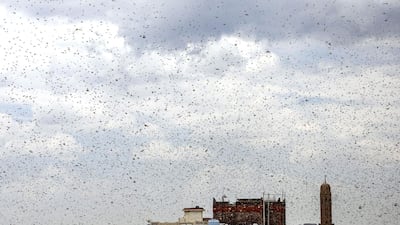
Locusts swarm the sky over the Huthi rebel-held Yemeni capital Sanaa on July 28, 2019. / AFP / Mohammed HUWAIS -
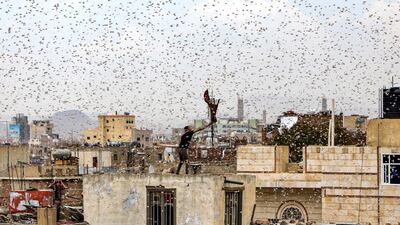
A man tries to catch locusts while standing on a rooftop as they swarm over the Huthi rebel-held Yemeni capital Sanaa on July 28, 2019. / AFP / Mohammed HUWAIS -

A boy holds desert locusts caught while swarming the sky over the Huthi rebel-held Yemeni capital Sanaa on July 28, 2019. / AFP / Mohammed HUWAIS -

TOPSHOT - Children try to catch locusts while standing on a rooftop as they swarm over the Huthi rebel-held Yemeni capital Sanaa on July 28, 2019. / AFP / Mohammed HUWAIS -
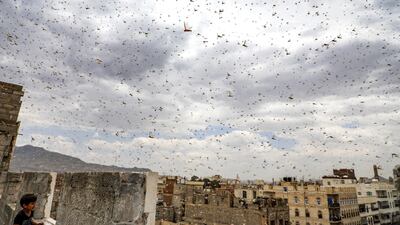
Locusts swarm the sky over the Huthi rebel-held Yemeni capital Sanaa on July 28, 2019. / AFP / Mohammed HUWAIS -
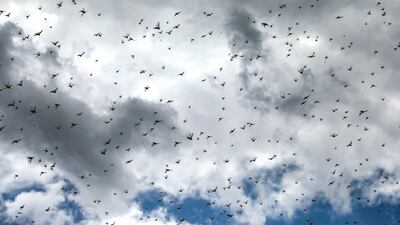
Locusts swarm the sky over the Huthi-rebel-held Yemeni capital Sanaa on July 28, 2019. / AFP / Mohammed HUWAIS -

A boy holds desert locusts caught while swarming the sky over the Huthi rebel-held Yemeni capital Sanaa on July 28, 2019. / AFP / Mohammed HUWAIS -

A man tries to catch locusts while standing on a rooftop as they swarm over the Huthi rebel-held Yemeni capital Sanaa on July 28, 2019. / AFP / Mohammed HUWAIS -

epaselect epa07738624 Yemeni children seek to catch desert locusts flying over a neighborhood in Sana'a, Yemen, 24 July 2019. Swarms of desert locusts are spreading throughout several Yemen cities, including Sana'a. Traditionally, many Yemenis roast locusts and eat them. EPA/YAHYA ARHAB -
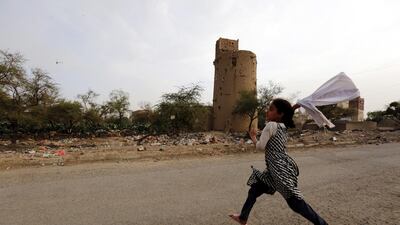
epa07738627 A Yemeni girl attempts to catch desert locusts flying over a neighborhood in Sana'a, Yemen, 24 July 2019. Swarms of desert locusts are spreading throughout several Yemen cities, including Sana'a. Traditionally, many Yemenis roast locusts and eat them. EPA/YAHYA ARHAB -
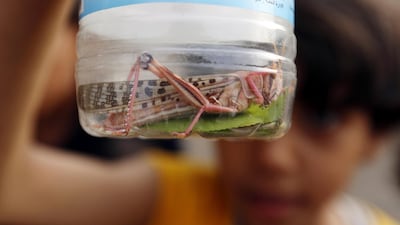
epaselect epa07738621 A Yemeni child shows a desert locust in a plastic bottle as swarms of desert locusts fly over a neighborhood in Sana'a, Yemen, 24 July 2019. Swarms of desert locusts are spreading throughout several Yemen cities, including Sana'a. Traditionally, many Yemenis roast locusts and eat them. EPA/YAHYA ARHAB


“During a desert locust outbreak we can now predict where swarms will go several days in advance, so we can control them at particular sites,” said Dr Renata Retkute, researcher in the University of Cambridge’s department of plant sciences and first author of the paper. "And if they’re not controlled at those sites, we can predict where they’ll go next so preparations can be made there."
Prof Chris Gilligan, of the same department and senior author of the paper, added: “The important thing is to respond quickly if there’s likely to be a big locust upsurge before it causes a major crop loss. Huge swarms can lead to really desperate situations where people could starve.
“Our model will allow us to hit the ground running in future, rather than starting from scratch as has historically been the case."
Locusts in Kenya - in pictures
-
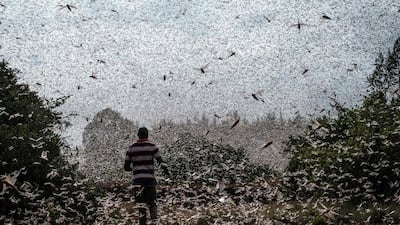
A farmer walks through a swarm of desert locust in the eastern Kenyan city of Meru. The infestations devastated 23 countries across East Africa, the Middle East and South Asia in 2020, with Kenya suffering its worst locust swarms in 70 years. AFP -

A swarm of desert locusts flies after an aircraft sprayed pesticide in the eastern Kenyan city of Meru. The UN's Food and Agricultural Organisation is working closely with several Kenyan agencies before teams are sent to targeted areas to spray pesticides to prevent damage to crops and grazing areas. AFP -

Cyril Ferrand, Team Leader for East Africa at the UN's Food and Agricultural Organisation walks past a swarm of desert locusts in the eastern Kenyan city of Meru. It has been more than a year since the worst desert locust infestation in decades hit the region. AFP -
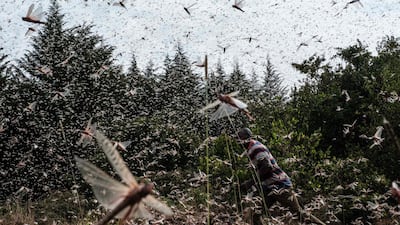
A local farmer walks through a swarm of desert locusts in the eastern Kenyan city of Meru. The East African country is battling another wave of infestations along with its neighbours Somalia and Ethiopia, the use of cutting-edge technology and improved co-ordination is helping to crush the menace. AFP -
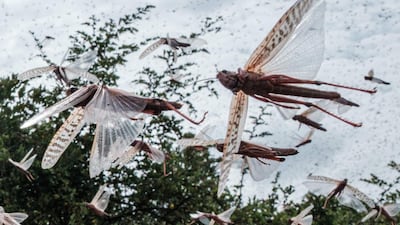
A swarm of desert locusts fly after an aircraft sprayed pesticide in the eastern Kenyan city of Meru. The use of cutting-edge technology and improved co-ordination across East Africa is helping to crush the ravenous swarms and protect the livelihoods of thousands of farmers. AFP -
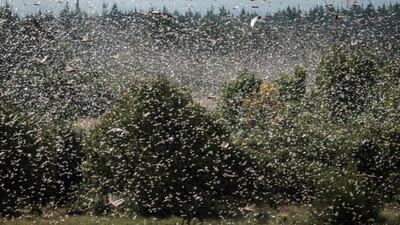
Locusts fly after an aircraft sprayed pesticide in the eastern Kenyan city of Meru. The country is suffering its worst locust swarms in 70 years. AFP -

A farmer chases away desert locusts at maze field in the eastern Kenyan city of Meru. The country is suffering its worst locust swarms in 70 years. AFP -

A swarm of desert locust flies after an aircraft sprayed pesticide in the eastern Kenyan city of Meru. Desert locusts belong to the grasshopper family, which form massive swarms when breeding is spurred by good rains. AFP -
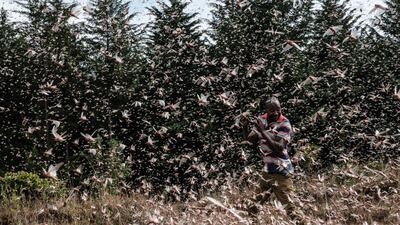
A farmer walks through a swarm of desert locust in the eastern Kenyan city of Meru. The use of cutting edge technology and improved co-ordination across East Africa is helping to crush the swarms and protect the livelihoods of thousands of farmers. AFP -
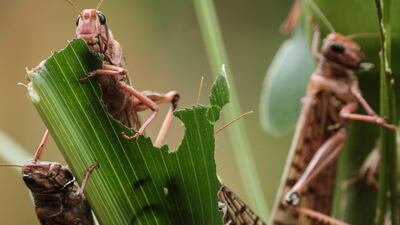
Desert locusts are seen at maze field in the eastern Kenyan city of Meru. A series of new measures to combat a second wave of the pests has improved control and co-operation in Kenya, Ethiopia and parts of Somalia. AFP -

An aircraft sprays pesticide over the trees covered by desert locusts in eastern Kenyan city of Meru. Each locust eats its weight in vegetation daily and multiplies twenty-fold every three months. AFP -
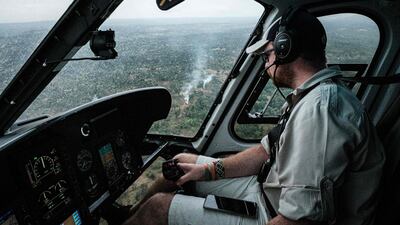
A pilot follows a swarm of desert locusts during a surveillance flight as farmers set fires to create smoke in their attempt to chase away the insects from fields in Meru, Kenya. AFP


Kenya to India
The team noticed the need for a comprehensive model of desert locust behaviour during the response to a an upsurge over 2019-2021, which extended from Kenya to India and put huge strain on wheat production in these regions. Infestations destroyed sugar cane, sorghum, maize and root crops. The researchers say the scientific response was hampered by the need to gather and integrate information from disparate sources.
“The response to the last locust upsurge was very ad hoc and less efficient than it could have been,” said Dr Retkute. "We’ve created a comprehensive model that can be used next time to control this devastating pest."
The new model will inform surveillance, early warning, and management of desert locust swarms by national governments and international organisations such as the UN's Food and Agriculture Organisation.
The researchers say countries that have not experienced a locust upsurge in many years are often ill-prepared to respond, lacking the necessary surveillance teams, aircraft and pesticides.
As climate change alters the movement and spread of major swarms, better planning is needed, making the new model a timely development, they added.

