-
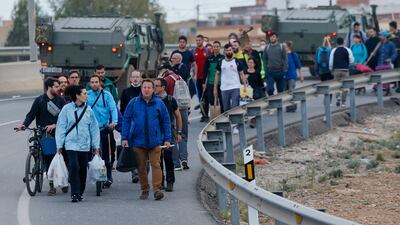
Volunteers head for Paiporta from Valencia city to join the cleaning and reconstruction works in the flooded areas, in Valencia, Spain, 03 November 2024. The number of volunteers going to the dana-affected villages to help with the clean-up has visibly decreased on 03 November. According to the Integrated Operational Coordination Center (CECOPI), more than 200 people have died in Valencia and neighboring provinces after floods caused by a DANA (high-altitude isolated depression) weather phenomenon hit the east of the country. According to Spain's national weather agency (AEMET), on 29 October 2024 Valencia received a year's worth of rain, causing flash floods that destroyed homes and swept away vehicles. EPA / BIEL ALINO -
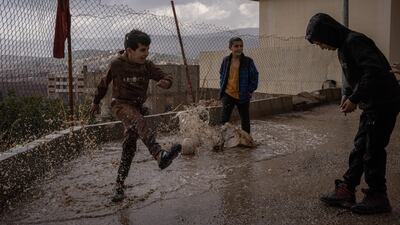
Children play in the rain next to a school housing people displaced from the city of Baalbek in Deir Al-Ahmar, Lebanon. Getty Images -
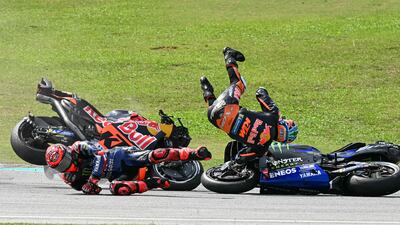
Fabio Quartararo, left, and Brad Binder fall after a collision during the MotoGP Malaysian Grand Prix at the Sepang International Circuit in Sepang. AFP -
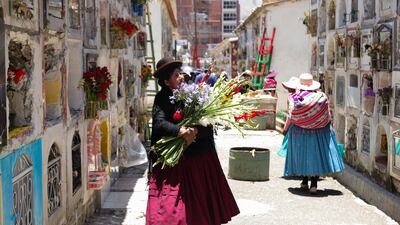
Bolivian women visit the Central Cemetry during the traditional celebration of Day of the Dead in La Paz, Bolivia. EPA -
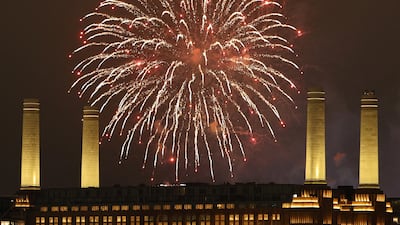
Fireworks, to mark bonfire night and the anniversary of the Guy Fawkes gunpowder plot of 1605 to blow up the Houses of Parliament, explode behind Battersea Power Station in London. Reuters -
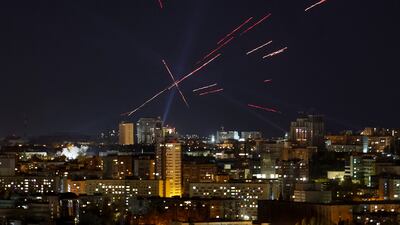
Tracers and searchlights are seen in the night sky as Ukrainian servicemen search and fire during a Russian drone strike, amid Russia's attack on Ukraine, in Kyiv. Reuters -

A man walks on the track as qualifying for the Sao Paulo Grand Prix in Brazil is postponed due to bad weather. Reuters -

US Vice President and Democratic presidential candidate Kamala Harris, right, and US actress Maya Rudolph take part in a Saturday Night Live comedy sketch at NBC studios in New York City. AFP


Best photos of November 3: Volunteers in Valencia to Kamala Harris on SNL
The National picks the most striking images from around the world

Updated: November 03, 2024, 10:42 AM
Most popular today

