


One of Egypt’s oldest pyramids may have been built with a lift that used water to raise heavy stones high above ground.
Researchers say the giant blocks used to build the Pyramid of Djoser 4,700 years ago could have been moved into place using a hydraulic lift system.
That allowed water from a dam to flow into two shafts, enabling workers to raise and lower a float carrying the stones.
The technology explains how ancient Egyptians managed to build their pyramids out of stones, some of which weigh several tonnes each, bolstering recent research that suggested workers may have used a lost arm of the Nile to transport huge limestone and granite blocks to construct the Giza complex.
Lead author Xavier Landreau, chief executive of new research institute Paleotechnic, told The National the study opens up a new line of research for the scientific community: the use of hydraulic power to build the pyramids of Egypt.
"It not only piques curiosity about the level of technical knowledge possessed by the architects of these structures, surpassing previous estimations, but also challenges the established historical narrative," Mr Landreau said.
"Whether the Meidum, Dashur and Giza pyramids were constructed with a similar hydraulic lift mechanism is uncertain but still possible. Further investigation is warranted, as it may hold the key to uncovering the mystery of how the largest monoliths, found in pyramids like Khufu or Khephren, were raised.
"These monoliths weigh tens of tonnes, making it seemingly impossible for them to be hauled using manpower alone. Conversely, a moderate-sized hydraulic lift can raise 50 to 100 tonnes. Exploring concealed shafts within these pyramids could be a promising avenue for research."
Djoser, also known as the Step Pyramid, is believed to have been built about 2680 BCE as a funerary complex for the Third Dynasty pharaoh of the same name.
The complex, which is a Unesco world heritage site, is considered the earliest known example of the ancient Egyptian custom of pharaohs being buried in pyramid-shaped tombs.
It is believed to have been built by Imhotep, a notable ancient Egyptian architect who was Pharaoh Djoser’s vizier – a high-ranking political adviser.
The pyramid, which was once covered in bright white limestone, held statues of the Egyptian gods and of Djoser and his family, including a life-size sculpture of the king on his throne.
A huge underground structure sat beneath it, featuring galleries and as many as 400 rooms. The structure reopened to the public in 2021, following a 15-year restoration.
Researchers said the nearby Gisr el-Mudir enclosure – which researchers could not previously explain – may have functioned as a “check dam” to capture water and sediment, representing advanced tech for the time.
Tomb of King Djoser reopens after 15-year restoration – in pictures
-
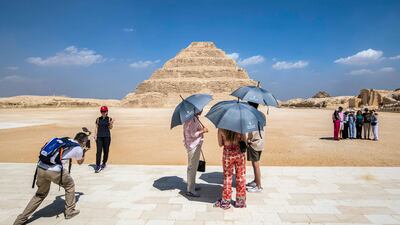
Visitors stand near the step pyramid of the third dynasty Ancient Egyptian Pharaoh Djoser (27th century BC) at the Saqqara Necropolis, south of Egypt's capital Cairo. AFP -
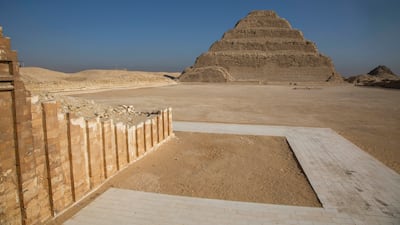
The famed Step Pyramid is situated near the southern cemetery of King Djoser. AP Photo -
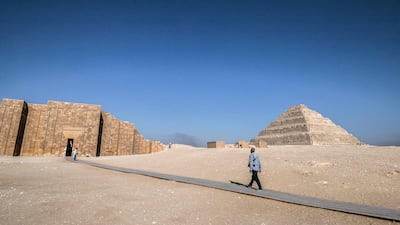
A security guard carries an assault rifle near the step pyramid. AFP -
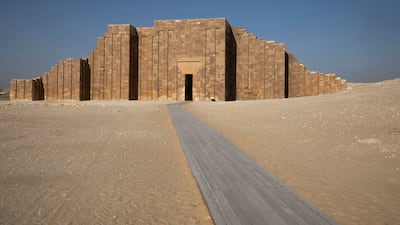
A path leads to the entrance of the southern cemetery of King Djoser, following its restoration. AP Photo -
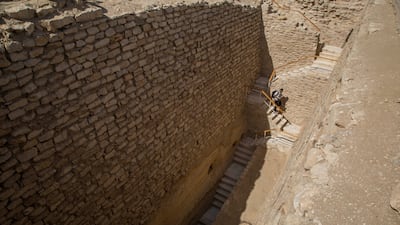
A man walks down the stairs towards the southern cemetery of King Djoser. AP Photo -
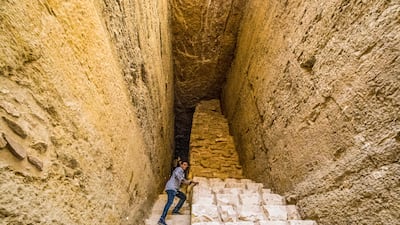
The Ministry of Tourism & Antiques describes the Saqqara pyramid, as being 'the oldest stone building of the ancient world'. AFP -
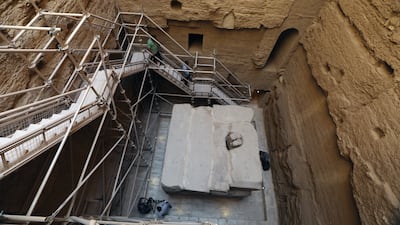
Tourists visit the burial chamber in the Tomb of King Djoser. EPA -
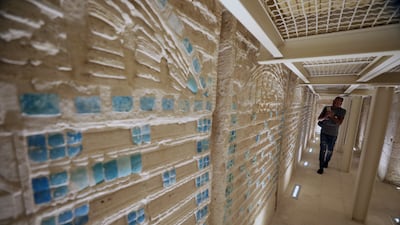
The Saqqara pyramid was discovered by the English archaeologist Cecil Malaby Firth in 1928. EPA


Compartments dug into the ground outside the pyramid may have served as a water treatment facility, allowing sediment to settle as water passed through each subsequent compartment, enabling water to flow into the pyramid shafts themselves, where the force of its rise could help carry the building stones.
“A collaborative effort between the newly established research institute, Paleotechnic, and several national laboratories (INRAE, University of Orléans) has led to the discovery of a dam, a water treatment facility, and a hydraulic lift, which would have enabled the construction of the Step Pyramid of Saqqara," wrote researchers in the study, which appeared in the PLOS ONE journal.
"This work opens a new research line for the scientific community: the use of hydraulic power to build the pyramids of Egypt.”
However, they said more work is required to understand how water might have flowed through the shafts, and how much water was available at the time.
A recent study discovered how the Nile may have been used to transport the huge limestone and granite blocks used to build the Great Pyramids.
The largest pyramid field in Egypt, which includes the Giza complex, is today far from the Nile in a narrow desert strip.
But researchers long suspected that millions of blocks, which each weigh about 2.3 tonnes, were moved using the river.
A team of researchers used satellite imagery to find the possible location of a former branch running along the foothills of the Western Desert plateau, close to the pyramid fields.
By studying geophysical surveys, they discovered river sediments and lost channels beneath the modern land surface, indicating the presence of a major former branch, which they propose naming Ahramat, which means “pyramids” in Arabic.
Many of the pyramids had causeways, which experts believe ended at the banks of the Ahramat branch, suggesting the Nile was used for moving construction materials.

