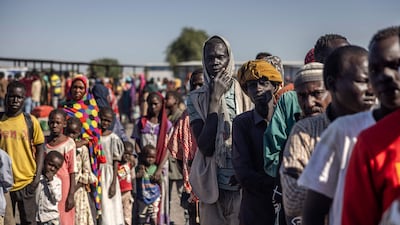
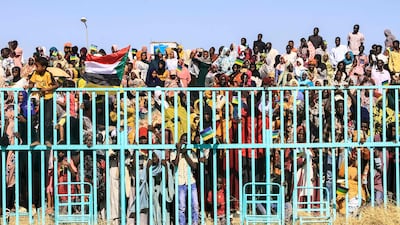
A member of the Sudanese armed forces patrols a street in Omdurman. Reuters

US calls for regional powers to stop supporting Sudanese warring parties


Adla Massoud
  • English
  • Arabic

The US on Monday called on regional powers to stop supporting Sudan's warring parties, and warned that an expected attack on El Fasher in Darfur would be a “disaster” for the city's 800,000 inhabitants.

The paramilitary Rapid Support Forces, which have been locked in a bloody conflict with Sudan's military for more than a year, have encircled El Fasher.

The UN last week said an attack on the city could be imminent, as the Sudanese army also appeared to be positioning itself.

“We do know that both sides are receiving support – both weapons and other support – to fuel their efforts to continue to destroy Sudan,” Linda Thomas-Greenfield, the US ambassador to the UN, told reporters in New York.

“All regional powers must stop providing weapons to both parties in accordance with the UN arms embargo.”

El Fasher is the last major city in the vast, western Darfur region not under the control of the RSF.

War in Sudan one year on - in pictures

  • Rapid Support Forces commander Gen Mohamed Dagalo, then deputy head of Sudan's sovereign council, gives a media briefing in Khartoum in February last year. Reuters
    Rapid Support Forces commander Gen Mohamed Dagalo, then deputy head of Sudan's sovereign council, gives a media briefing in Khartoum in February last year. Reuters
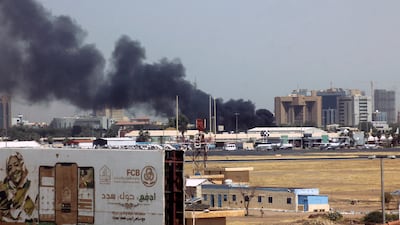
  • Smoke rises after blasts in Khartoum amid clashes between the Sudanese Army and the Rapid Support Forces paramilitary on April 15 last year. AFP
    Smoke rises after blasts in Khartoum amid clashes between the Sudanese Army and the Rapid Support Forces paramilitary on April 15 last year. AFP
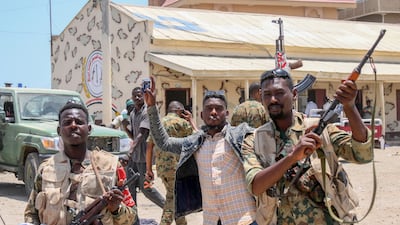
  • Sudanese Army soldiers at the Rapid Support Forces base in Port Sudan on April 16 last year. AFP
    Sudanese Army soldiers at the Rapid Support Forces base in Port Sudan on April 16 last year. AFP
  • Black smoke covers the sky over Khartoum as clashes continued on April 19. AFP
    Black smoke covers the sky over Khartoum as clashes continued on April 19. AFP
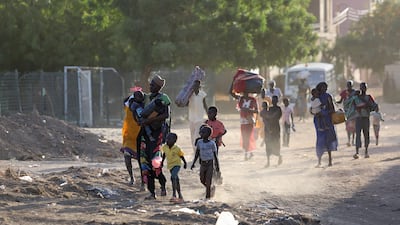
  • Displaced Khartoum residents flee the city after a 24-hour truce collapsed on April 19. AFP
    Displaced Khartoum residents flee the city after a 24-hour truce collapsed on April 19. AFP
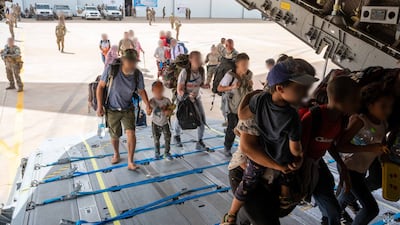
  • Foreign citizens board a plane at a French military air base in Khartoum to leave Sudan on April 23. AFP
    Foreign citizens board a plane at a French military air base in Khartoum to leave Sudan on April 23. AFP
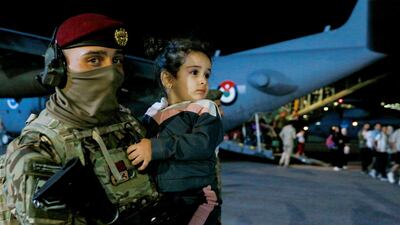
  • A soldier carries a child as people evacuated from Sudan disembark from a plain at a military airport in Amman on April 24. AFP
    A soldier carries a child as people evacuated from Sudan disembark from a plain at a military airport in Amman on April 24. AFP
  • Evacuees from Sudan sit in a military plane as they wait to be processed by Kenyan troops in Nairobi on April 24. Reuters
    Evacuees from Sudan sit in a military plane as they wait to be processed by Kenyan troops in Nairobi on April 24. Reuters
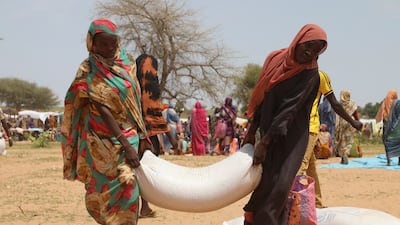
  • Sudanese refugees gather to receive humanitarian aid in Koufroun, Chad, on April 30. AFP
    Sudanese refugees gather to receive humanitarian aid in Koufroun, Chad, on April 30. AFP
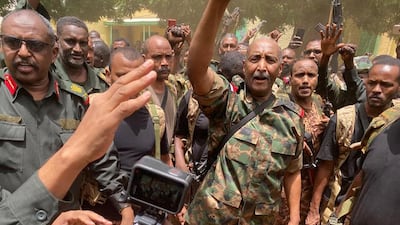
  • Sudanese Army chief Gen Abdel Fattah Al Burhan visits troop positions in Khartoum on May 30. AFP
    Sudanese Army chief Gen Abdel Fattah Al Burhan visits troop positions in Khartoum on May 30. AFP
  • Sudanese refugees at the Zabout camp in Goz Beida, Chad, on July 1. AP
    Sudanese refugees at the Zabout camp in Goz Beida, Chad, on July 1. AP
  • Smoke rises from a fire at a lumber warehouse in southern Khartoum on June 7. AFP
    Smoke rises from a fire at a lumber warehouse in southern Khartoum on June 7. AFP
  • People prepare to leave Khartoum during a ceasefire on June 19. AP
    People prepare to leave Khartoum during a ceasefire on June 19. AP
  • People sit on top of a lorry carrying furniture on the road between Khartoum and Wad Madani, Al Gezirah state, on July 18. AFP
    People sit on top of a lorry carrying furniture on the road between Khartoum and Wad Madani, Al Gezirah state, on July 18. AFP
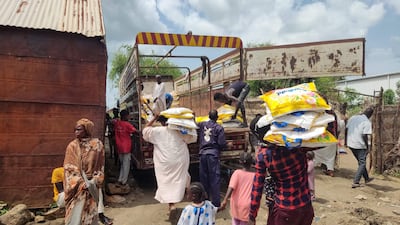
  • Men load goods from Ethiopia on to a lorry in the border town of Gallabat on August 2. AFP
    Men load goods from Ethiopia on to a lorry in the border town of Gallabat on August 2. AFP
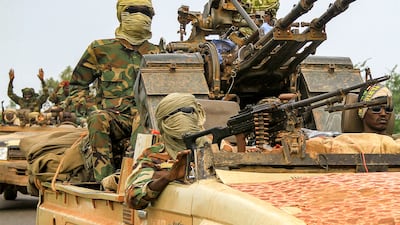
  • Sudanese Army troops ride in a military convoy accompanying the governor of Darfur State in the eastern city of Gedaref on August 30. AFP
    Sudanese Army troops ride in a military convoy accompanying the governor of Darfur State in the eastern city of Gedaref on August 30. AFP
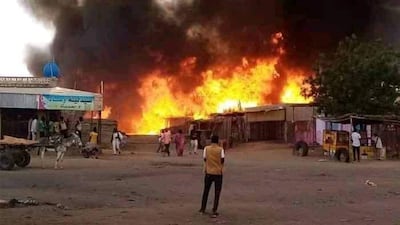
  • A fire rages at a livestock market after RSF bombardment in Al Fasher, the capital of North Darfur state, on September 1. AFP
    A fire rages at a livestock market after RSF bombardment in Al Fasher, the capital of North Darfur state, on September 1. AFP
  • People cook on a campfire at a school that has been turned into a shelter for displaced Sudanese in the northern border town of Wadi Halfa, near Egypt, on September 11. AFP
    People cook on a campfire at a school that has been turned into a shelter for displaced Sudanese in the northern border town of Wadi Halfa, near Egypt, on September 11. AFP
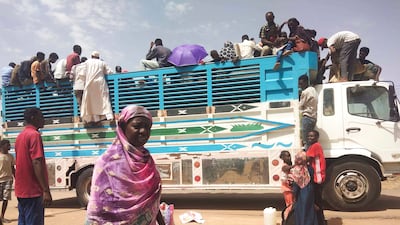
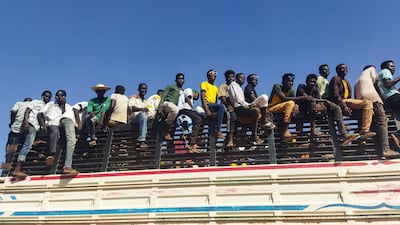
  • Displaced Sudanese ride on top of a lorry in Wad Madani on December 16. AFP
    Displaced Sudanese ride on top of a lorry in Wad Madani on December 16. AFP
  • Sudanese refugees queue to board a lorry to go to a transit centre after crossing the border into South Sudan on February 14. AFP
    Sudanese refugees queue to board a lorry to go to a transit centre after crossing the border into South Sudan on February 14. AFP
  • People watch as fighters from the army-aligned Sudan Liberation Movement attend a graduation ceremony in the south-eastern Gedaref state on March 28. AFP
    People watch as fighters from the army-aligned Sudan Liberation Movement attend a graduation ceremony in the south-eastern Gedaref state on March 28. AFP
  • Fighters from the SLM attend a graduation ceremony in Gedaref state on March 28. AFP
    Fighters from the SLM attend a graduation ceremony in Gedaref state on March 28. AFP

“As I've said before, history is repeating itself in Darfur in the worst possible way, and an attack on El Fasher would be a disaster on top of a disaster, with 500,000 internally displaced persons at risk,” Ms Thomas-Greenfield said.

“Every single member state must speak out. The entire international community must speak out.”

The UN estimates between 10,000 and 15,000 people have been killed since the civil war started, with about eight million displaced and the impoverished country pushed to the brink of famine.

Ms Thomas-Greenfield urged both the RSF and the Sudanese military to engage in direct negotiations in Jeddah.

International efforts led by the US and Saudi Arabia to broker a truce have failed, and the two sides have refused to return to the negotiating table.

James Kariuki, Britain's UN deputy ambassador, told reporters that the Security Council is concerned about the humanitarian crisis.

“We heard, in particular, how troubling the problem of humanitarian access is given the barriers imposed by both sides to the conflict on this,” he said after a closed-door meeting on the situation in Sudan.


Islamophobia definition

A widely accepted definition was made by the All Party Parliamentary Group on British Muslims in 2019: “Islamophobia is rooted in racism and is a type of racism that targets expressions of Muslimness or perceived Muslimness.” It further defines it as “inciting hatred or violence against Muslims”.

Red flags
  • Promises of high, fixed or 'guaranteed' returns.
  • Unregulated structured products or complex investments often used to bypass traditional safeguards.
  • Lack of clear information, vague language, no access to audited financials.
  • Overseas companies targeting investors in other jurisdictions - this can make legal recovery difficult.
  • Hard-selling tactics - creating urgency, offering 'exclusive' deals.

Courtesy: Carol Glynn, founder of Conscious Finance Coaching

Tree of Hell

Starring: Raed Zeno, Hadi Awada, Dr Mohammad Abdalla

Director: Raed Zeno

Rating: 4/5

The Florida Project

Director: Sean Baker

Starring: Bria Vinaite, Brooklynn Prince, Willem Dafoe

Four stars

How to apply for a drone permit
  • Individuals must register on UAE Drone app or website using their UAE Pass
  • Add all their personal details, including name, nationality, passport number, Emiratis ID, email and phone number
  • Upload the training certificate from a centre accredited by the GCAA
  • Submit their request
What are the regulations?
  • Fly it within visual line of sight
  • Never over populated areas
  • Ensure maximum flying height of 400 feet (122 metres) above ground level is not crossed
  • Users must avoid flying over restricted areas listed on the UAE Drone app
  • Only fly the drone during the day, and never at night
  • Should have a live feed of the drone flight
  • Drones must weigh 5 kg or less
UAE currency: the story behind the money in your pockets
Avatar: Fire and Ash

Director: James Cameron

Starring: Sam Worthington, Sigourney Weaver, Zoe Saldana

Rating: 4.5/5

End of free parking

- paid-for parking will be rolled across Abu Dhabi island on August 18

- drivers will have three working weeks leeway before fines are issued

- areas that are currently free to park - around Sheikh Zayed Bridge, Maqta Bridge, Mussaffah Bridge and the Corniche - will now require a ticket

- villa residents will need a permit to park outside their home. One vehicle is Dh800 and a second is Dh1,200. 

- The penalty for failing to pay for a ticket after 10 minutes will be Dh200

- Parking on a patch of sand will incur a fine of Dh300

THE BIO

Bio Box

Role Model: Sheikh Zayed, God bless his soul

Favorite book: Zayed Biography of the leader

Favorite quote: To be or not to be, that is the question, from William Shakespeare's Hamlet

Favorite food: seafood

Favorite place to travel: Lebanon

Favorite movie: Braveheart

Trump v Khan

2016: Feud begins after Khan criticised Trump’s proposed Muslim travel ban to US

2017: Trump criticises Khan’s ‘no reason to be alarmed’ response to London Bridge terror attacks

2019: Trump calls Khan a “stone cold loser” before first state visit

2019: Trump tweets about “Khan’s Londonistan”, calling him “a national disgrace”

2022:  Khan’s office attributes rise in Islamophobic abuse against the major to hostility stoked during Trump’s presidency

July 2025 During a golfing trip to Scotland, Trump calls Khan “a nasty person”

Sept 2025 Trump blames Khan for London’s “stabbings and the dirt and the filth”.

Dec 2025 Trump suggests migrants got Khan elected, calls him a “horrible, vicious, disgusting mayor”

Mercer, the investment consulting arm of US services company Marsh & McLennan, expects its wealth division to at least double its assets under management (AUM) in the Middle East as wealth in the region continues to grow despite economic headwinds, a company official said.

Mercer Wealth, which globally has $160 billion in AUM, plans to boost its AUM in the region to $2-$3bn in the next 2-3 years from the present $1bn, said Yasir AbuShaban, a Dubai-based principal with Mercer Wealth.

Within the next two to three years, we are looking at reaching $2 to $3 billion as a conservative estimate and we do see an opportunity to do so,” said Mr AbuShaban.

Mercer does not directly make investments, but allocates clients’ money they have discretion to, to professional asset managers. They also provide advice to clients.

“We have buying power. We can negotiate on their (client’s) behalf with asset managers to provide them lower fees than they otherwise would have to get on their own,” he added.

Mercer Wealth’s clients include sovereign wealth funds, family offices, and insurance companies among others.

From its office in Dubai, Mercer also looks after Africa, India and Turkey, where they also see opportunity for growth.

Wealth creation in Middle East and Africa (MEA) grew 8.5 per cent to $8.1 trillion last year from $7.5tn in 2015, higher than last year’s global average of 6 per cent and the second-highest growth in a region after Asia-Pacific which grew 9.9 per cent, according to consultancy Boston Consulting Group (BCG). In the region, where wealth grew just 1.9 per cent in 2015 compared with 2014, a pickup in oil prices has helped in wealth generation.

BCG is forecasting MEA wealth will rise to $12tn by 2021, growing at an annual average of 8 per cent.

Drivers of wealth generation in the region will be split evenly between new wealth creation and growth of performance of existing assets, according to BCG.

Another general trend in the region is clients’ looking for a comprehensive approach to investing, according to Mr AbuShaban.

“Institutional investors or some of the families are seeing a slowdown in the available capital they have to invest and in that sense they are looking at optimizing the way they manage their portfolios and making sure they are not investing haphazardly and different parts of their investment are working together,” said Mr AbuShaban.

Some clients also have a higher appetite for risk, given the low interest-rate environment that does not provide enough yield for some institutional investors. These clients are keen to invest in illiquid assets, such as private equity and infrastructure.

“What we have seen is a desire for higher returns in what has been a low-return environment specifically in various fixed income or bonds,” he said.

“In this environment, we have seen a de facto increase in the risk that clients are taking in things like illiquid investments, private equity investments, infrastructure and private debt, those kind of investments were higher illiquidity results in incrementally higher returns.”

The Abu Dhabi Investment Authority, one of the largest sovereign wealth funds, said in its 2016 report that has gradually increased its exposure in direct private equity and private credit transactions, mainly in Asian markets and especially in China and India. The authority’s private equity department focused on structured equities owing to “their defensive characteristics.”

Top 10 most polluted cities
  1. Bhiwadi, India
  2. Ghaziabad, India
  3. Hotan, China
  4. Delhi, India
  5. Jaunpur, India
  6. Faisalabad, Pakistan
  7. Noida, India
  8. Bahawalpur, Pakistan
  9. Peshawar, Pakistan
  10. Bagpat, India
Updated: April 29, 2024, 7:19 PM