

A UN survey on attitudes about whether climate change is fact or fiction found 64 per cent of people in Arab countries say it is an emergency.
The UN Development Programme and the University of Oxford found people in Algeria, Djibouti, Egypt, Iraq, Jordan, Morocco, Sudan and Tunisia broadly accept what scientists say about the threat of climate change.
A UN-backed scientific panel has repeatedly stated that man-made climate change is sending temperatures soaring and causing more droughts, forest fires and other disasters, but many sceptics still question the science.
-
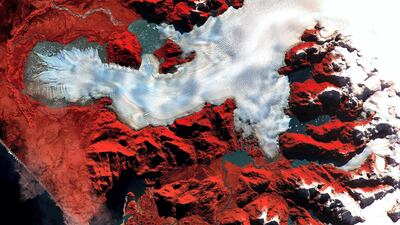
An image captured by Nasa's Terra satellite on May 2, 2000, shows the North Patagonia Ice Sheet in Chile. A single large glacier covered with crevasses is visible, while a semi-circular terminal moraine indicates that the glacier was once more extensive. Nasa -

A firefighter drags a hose closer to battle a grass fire in Knightsen, California. -
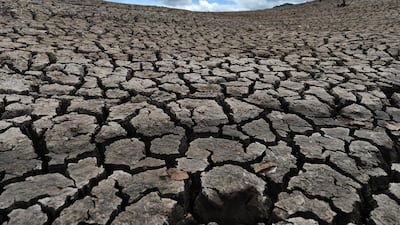
La Concepcion reservoir, which supplies 30 per cent of the Honduran capital of Tegucigalpa, during a severe drought caused by climate change. AFP -
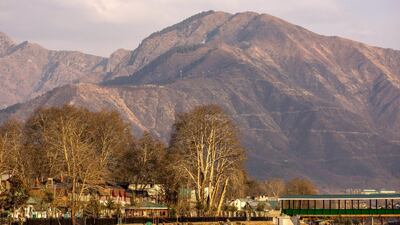
A view of mountains that used to be covered by snow, during a warm winter day in Srinagar, the summer capital of Indian-administered Kashmir. Getty -
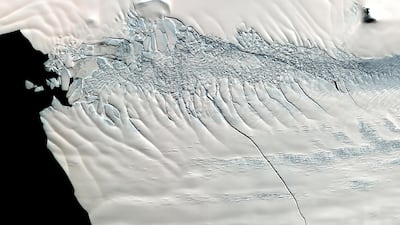
An image captured from Nasa's Terra spacecraft shows a vast crack across the Pine Island Glacier, a major ice stream that drains the West Antarctic Ice Sheet. Eventually, the crack will extend all the way across the glacier. -
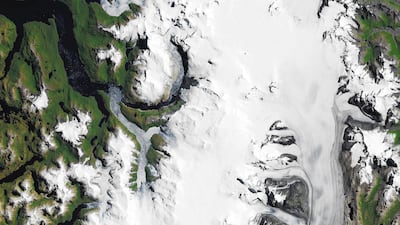
In this Landsat 8 image, glacial retreat is revealed in the rugged wilderness region of Patagonia, site of the largest contiguous areas of ice cover outside Antarctica. USGS -
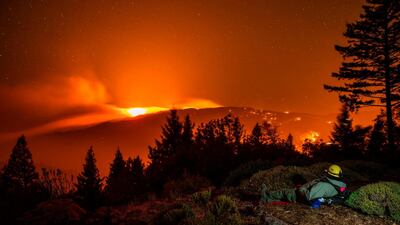
Destructive fires have raged in California and strong winds could spark new blazes. AFP -
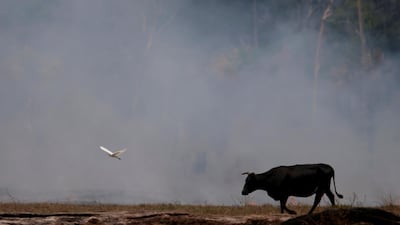
A bird flies next to an ox walking on a smouldering field after a fire burnt a tract of the Amazon rainforest as it was cleared by farmers in Brazil. Reuters -
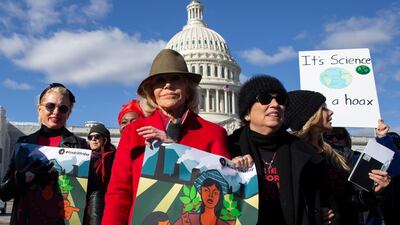
US actress Jane Fonda, centre, participates in a climate change protest before being arrested by US Capitol Police in Washington. EPA -
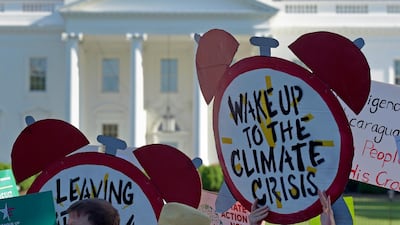
Protesters gather outside the White House in Washington to protest against Donald Trump's decision to withdraw the US from the Paris climate change accord. AP


Almost half of the survey respondents in Arab countries said they supported cleaner farming techniques, renewable energy, stronger conservation efforts on forests and land, and electric cars as ways out of the crisis.
The results reflect changing attitudes in the Arab region, which depends heavily on oil and gas exports, but where solar farms and clean transport feature in such developments as Neom in Saudi Arabia and Masdar City in the UAE.
Figures in Arab countries were comparable with those of other regions. In Europe and North America, 73 per cent of respondents said climate change was an emergency, whereas in sub-Saharan Africa that figure fell to 61 per cent.
“The results of the survey clearly illustrate that urgent climate action has broad support among people around the globe, across nationalities, age, gender and education level,” UNDP administrator Achim Steiner said.
The UN called its Peoples' Climate Vote the "largest survey of public opinion on climate change ever conducted", with 1.2 million people questioned about whether mankind was headed for a climate catastrophe.
Respondents were asked to take part via mobile gaming apps such as Words with Friends, Angry Birds and Temple Run, meaning results came from 50 countries and displayed a “unique, and random sample of people of all genders, ages and educational backgrounds”, the UN said.
Of those who said climate change was an emergency, 59 per cent said leaders should urgently do everything necessary in response. Another 20 per cent called for a slow response and 10 per cent said politicians were doing enough already.

