

Huge underfunding of Syria aid programmes is limiting recovery from last year’s earthquake that compounded an already dire humanitarian crisis in the country, NGO workers, first responders and UN officials said.
Donor nations are diverting money to other crises as they cut back globally, aid officials told The National.
Cuts in funding have come as humanitarian needs in the country are greater than ever and fighting that has lasted for 13 years continues with no long-term solution in sight.
Even before the earthquake, north-western Syria was home to more than three million people internally displaced by the civil war, most of them women and children.
More than 5,900 people in Syria were killed, with countless homes and businesses destroyed, compounding violence, disease and widespread poverty.
But without sufficient financing, so-called early-recovery efforts are struggling to gain traction and funds for day-to-day survival remain inadequate.
'It's not enough'
“Early-recovery efforts from the earthquake by the UN in Syria are very limited – things like basic housing, repairing basic infrastructure and community facilities – because of funding limitations,” said Ziad Ayoubi, Syria's senior field co-ordinator for the United Nations' High Commissioner for Refugees (UNHCR).
“What is being provided in terms of the humanitarian response is making a difference to thousands of households but the scale is not large enough.”
Last year's $5.4 billion UN humanitarian response plan for Syria ended up being only one-third funded – far less than in 2022, which was half-funded.
This year's target, about $4.4 billion, is also unlikely to be reached.
The World Food Programme was forced to end its assistance programme for Syria in December due to a lack of financing, increasing the chances of people going hungry.
A year on from the earthquake and several major aftershocks, many of the 450,000 displaced Syrians have yet to return home, often because they have no place to return to.
With destruction so widespread, at least 43,500 people forced to flee parts of north-western Syria under rebel control remained displaced as of late 2023, according to the most recent figures available.
“We are still working to rehabilitate the infrastructure and repair public facilities that were destroyed by earthquakes and aerial and artillery bombardment,” said a Syrian first responder. He requested anonymity because he was not authorised to speak to media.
In areas controlled by President Bashar Al Assad’s government, people who fled their homes are living in rented accommodation or with relatives, rather than in camps, making numbers harder to verify, but at least 200,000 are believed to remain displaced in these areas.
"One year since the earthquake, hardly any reconstruction has started," said Nour Al Agha, media co-ordinator at the Bahar organisation, which works in earthquake-affected parts of the north-west.

"The rehabilitation or building of houses that were massively damaged by the earthquakes has not started."
For those living in tents – about 800,000 people – winter is particularly harsh and is made more so by dwindling funding.
Under pressure
Civil defence workers in opposition-held areas have restored water and sewage networks and rebuilt some medical infrastructure by way of about 50 projects – but much is still to be achieved, especially the provision health care to a displaced and sick population living in makeshift accommodation.
Aid workers said many died of disease following the earthquake because of dire living conditions in which viruses and waterborne illnesses spread easily.
“Decreased access to clean drinking water and the spread of waterborne illnesses contributed to an increase in the rate of death and sickness, and the catastrophe put further pressure on an already exhausted health system,” said Ahmed Yazji, director at the White Helmets civil defence group, which operates in opposition-controlled areas of Syria.
“Many health workers have been forced to work under great pressure and worry about their own families’ health.”
In a country whose economy has already been ravaged by war, loss and damage from the earthquake exceeded $5 billion, the World Bank estimated.
Across the earthquake zone, people are struggling to pay their rent or make a living, because so many small businesses were destroyed and have not been rebuilt, said Mr Ayoubi of UNHCR, who co-ordinated the agency’s earthquake emergency response. Many families also lost their main breadwinner to death or injury in the disaster.
“People in public-sector jobs in Syria are on very low wages – around the equivalent of $15-20 a month. This does not even cover the cost of transport to work,” he said.
“So having extra people live with them [displaced by the earthquake] is an extra burden – in terms of food security, for example. And they cannot afford repairs to their homes, from the earthquake or otherwise. They are waiting for aid to come to them for such repairs.”

While Syrians are asking for jobs and support to help them make a living, the funding gap means aid organisations are often unable to meet their needs.
“We’ve repeatedly heard that what people want above all else is jobs and livelihood support,” said David Carden, a UN humanitarian co-ordinator who helps organise the cross-border operation from Turkey. “But without adequate funding, the humanitarian community is forced to make painful decisions about prioritising lives.”
Fractured politics
Continuing violence and political divisions also complicate the recovery process.
The tremors struck areas under the control of three different groups – the militant Hayat Tahrir in Idlib province, a Turkish-backed opposition force in northern Aleppo and the Syrian government in the province’s north. Latakia, Tartous and Hama were also badly affected.
Syria’s fractured political landscape complicates cross-border aid delivery from Turkey.
While lorries cross three border points relatively smoothly, the process relies on the Syrian government extending permission every six months, after a previous UN Security Council mechanism lapsed last year.
The next renewal is expected on February 13.
Tanya Evans, of the International Rescue Committee, said this could be problematic.
“Since the failure of the UN Security Council to renew the resolution guaranteeing humanitarian access to the north-west of Syria, the six-month renewal cycle for consent between the government of Syria and the UN has raised questions about how local partners can effectively plan long-term responses and be assured of respect for humanitarian principles.”
-

Ammar Bardoush is one of a number of physiotherapists providing free treatment to earthquake survivors in north-west Syria. All photos: Moawia Atrash for The National -
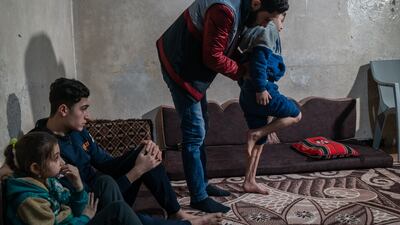
Young patient Mustafa Al Ghanam, whose feet were crushed in the February 6, 2023 quake, performs exercises under guidance of the physio, in Azmarin village, Idlib province. ‘I felt great pain at the beginning after the injury, but I adapted and began to improve with the physical therapy services,’ said Mustafa -

Among other patients in Azmarin is Mustafa's sister Alaa, whose leg was seriously injured in the earthquake. The free physiotherapy service is provided by non-governmental organisation the Specialised Centre for Physical Therapy and Rehabilitation, in Idlib -
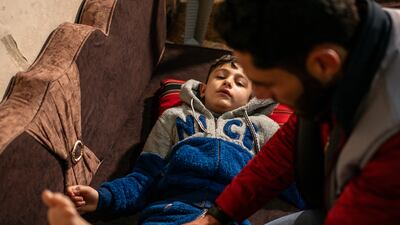
Mr Bardoush also helps Mustafa and Alaa's brother Muhammad with his exercises. The earthquake killed about 60,000 people in Syria and Turkey and left 130,000 injured -

Mustafa performs strength-building exercises under the guidance of Mr Bardoush. He lost a brother in the earthquake and has undergone many operations -

Mustafa receives therapy. Areas outside the control of President Bashar Al Assad in north-west Syria were hardest hit by the earthquake -

Alaa practises exercises to strengthen her legs. ‘I suffered great pain because of this injury and had two operations, but I have improved after a year,’ she told The National. ‘However, I am still afraid and remember the moments of the earthquake.’ -

Muhammad, Alaa and Mustafa, with their father, Mudathir Al Ghanam, in their Azmarin home. ‘I have suffered a lot, as I lost one of my sons and my brother,’ said Mr Al Ghanam. He said his children had undergone many operations ’but they have benefitted greatly from the services of this centre’ -
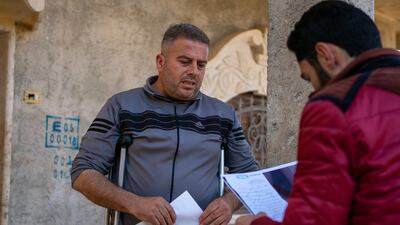
Also benefiting from the NGO's services is Ibrahim Al Sheikh, 45, from the village of Bithynia, Iblib province. He too was injured in the earthquake. ‘The memory is extremely painful for me, because I suffered a severe injury to my feet and treatment continues now, a year on,’ he told The National -
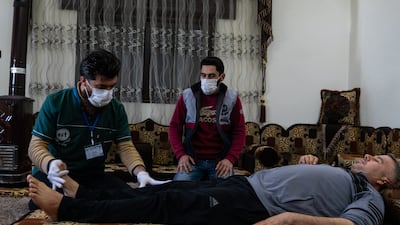
Physiotherapist Ahmed Dani provides treatment for Mr Al Sheikh in Bithynia, as colleague Mr Bardoush looks on. Mr Dani said the centre’s physios make regular tours of the area to ensure patients are not forgotten


Again, funding cuts are hampering the amount of basic aid humanitarian organisations are able to send across the border.
The number of UN aid lorries that entered north-western Syria from Turkey last year was about 400 a month, the lowest figure since 2018.
"Cross-border aid restrictions are making planning for long-term projects of early recovery almost impossible," said Ms Agha of the Bahar organisation.
"Normally, we need at least 18 months for early-recovery projects that will have an impact on changing people's lives."
There are other political challenges when it comes to Syria recovering from the earthquake.
Some donor countries are reluctant to allow aid money to be used for the sort of long-term reconstruction in Syrian government-controlled areas that might be construed as normalisation with Damascus, which remains a pariah state in much of the world.
“Some donor countries have red lines that the UN cannot cross in what we can do in terms of reconstruction, for example, because of not wanting to normalise with the Syrian government – even if damage has been caused by the earthquakes,” said a senior UN official on condition of anonymity.
“We need to depoliticise the humanitarian process and donors’ red lines need to be reconsidered to allow the UN to do early-recovery work in Syria.”

