

Syrians are being faced with little choice but to drink contaminated water during a cholera outbreak that has killed at least 23 people and sickened hundreds of others, the worst outbreak of the disease since 2009.
Hospitals in Deir Ezzor have been overwhelmed with patients, local health authorities say, after the collapse of the municipal water supply and treatment systems during a decade of civil war that has left much of the country’s infrastructure in ruins.
Nearly two thirds of water treatment plants, half of pumping stations and a third of the water towers have been damaged by war, according to the United Nations.
The current outbreak is centred around Aleppo, which is largely under Syrian government control but suffered some of the worst violence in the decade-long conflict.
Cholera can spread rapidly when leaking or destroyed sewage treatment infrastructure contaminates local water supply ― often because the latter is also in a state of disrepair. Once an outbreak takes root, the disease spreads easily, even contaminating food.
In the latest outbreak, the Euphrates ― Syria’s main source of fresh water for domestic use and farming irrigation, has been heavily contaminated with untreated sewage. The river water is pumped into tankers to take to communities for drinking, as well as being used by farmers to grow crops.
In a Syria hospital crowded with women and wailing children, Ahmad Al Mohammad writhed in pain beside his wife after they contracted cholera, which is resurging for the first time in years.
During his six days of treatment, Mr Al Mohammad has watched patients stream into the Al Kasrah hospital in the eastern province of Deir Ezzor.
"We have suffered from diarrhoea, vomiting and pain ... because we drink directly from the Euphrates river," the 45-year-old told AFP from the hospital.
"The waters of the Euphrates are polluted but we have no other choice."
The World Health Organisation, which called the latest outbreak a “threat to the region”, says the disease kills more than 140,000 people a year.
The semi-autonomous Kurdish administration that runs north-east Syria and parts of Deir Ezzor has recorded 16 deaths and 78 cases in areas under its control, including 43 cases in western Deir Ezzor, health official Juan Mustafa said on Wednesday.
He said water testing of the Euphrates proved the presence of bacteria responsible for cholera ― a spread he said was caused by reduced water flow.
The Syrian government has long accused Turkey of holding back more water than necessary in its dams.
The reduced water flow compounds the problem of river pollution, largely from sewage, but also from oil in hydrocarbon-rich regions, including Deir Ezzor.
Despite the contamination, more than five million of Syria's about 18 million people rely on the Euphrates for their drinking water, according to the UN.
-
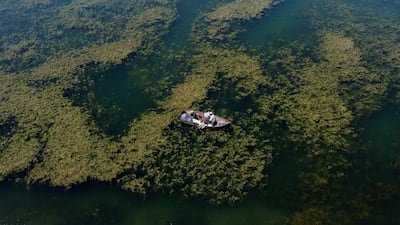
Fishermen in the Euphrates river, in western Raqqa, Syria. All photos: AFP -
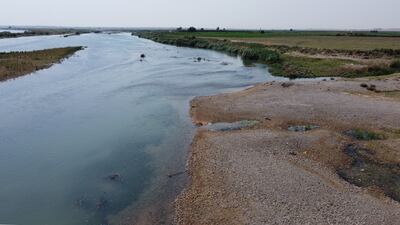
The Euphrates is the longest river in Syria and one of the most important in the Middle East. -
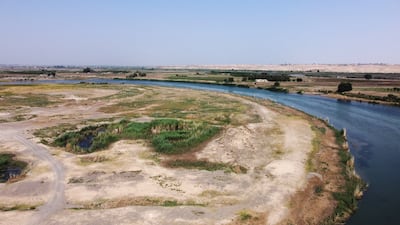
It flows from Turkey through Syria and Iraq, joining the Tigris river in Shatt Al Arab. -

In 1987, Turkey and Syria signed an agreement that the former would send 500 cubic metres of water per second down the Euphrates river. -

The volume is now down to 200 cubic metres per second. -
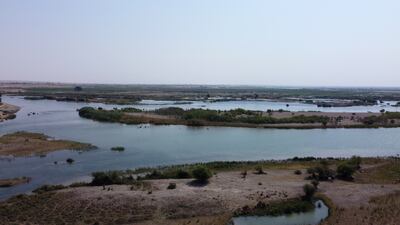
Low water levels in the river are largely being caused by rising temperatures, low rainfall and drought. -
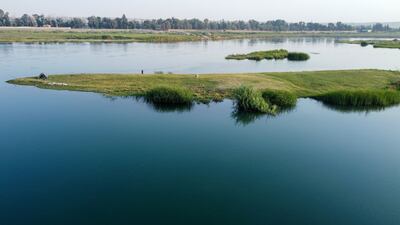
The decrease in the volume of water affects the supply for drinking water, agriculture and electricity being produced by hydroelectric dams. -

More than five million people in the country depend on the Euphrates river. -
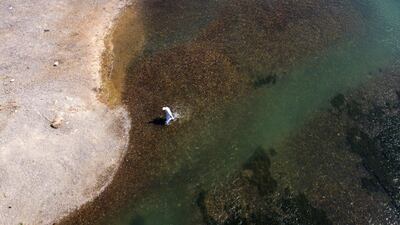
A man walks on the banks of the Euphrates.


The cost of this reliance was visible in Al Kasrah hospital, where a man cradled his infant, an intravenous tube piercing the child's tiny hand.
Hospital director Tarek Alaeddine said the facility admits dozens of suspected cholera cases every day and has counted hundreds of cases over the past three weeks.
"The patients were all drinking water delivered by trucks that extract it directly from the Euphrates river, without filtering or sterilisation," Mr Alaeddine said.
"We appeal to all international organisations working on health and the environment to act quickly and urgently," he said.
The Kurdish administration, which controls parts of Deir Ezzor including Al Kasrah, said they have resumed distribution after the outbreak.
They also announced assistance to Al Kasrah and other medical facilities in the region to help contain the number of cases.
But the main source of the problem is largely unresolved.
"We know the water is polluted ... but we drink it anyway," Rashid said. "We have no other option."
Near by, a young boy splashed river water on his face to cool down in the summer heat while Sobha Hamid Ali, 60, sat in the shade cleaning spinach leaves.
She too is aware of the dangers but said there is little she can do.
"We are forced to eat contaminated vegetables," Ms Ali said in a soft voice. "We must live, after all."

