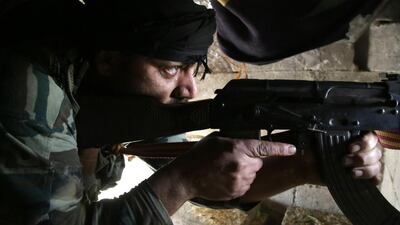
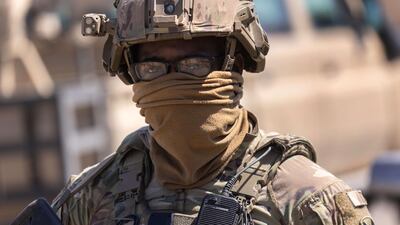
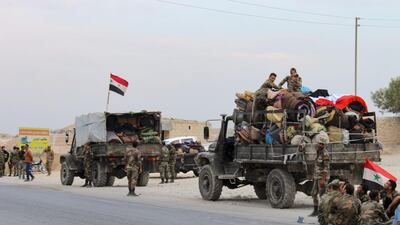
Turkey-backed Syrian opposition fighters in Al Bab in Aleppo. Proxies backed by outside powers are active in different regions of Syria. Photo: AFP

Big-power rivalries deepen Syria’s fragmentation


Khaled Yacoub Oweis
  • English
  • Arabic

When Farhad, a Syrian-Kurdish aid worker, tried to reach his Aleppo village this week to visit his mother, Turkish intelligence agents stopped and interrogated him.

Since 2017, the rural region has been part of the sphere of influence Turkey has carved out in northern Syria, after taking territory from Kurdish militias and ISIS.

Thousands of Arab refugees, many of whom had fled areas recaptured by the Syrian regime in the civil war, have moved to the region, near the city of Al Bab, in the past five years.

A cluster of Kurdish villages is now surrounded by Arab encampments. Among them is Farhad's home village.

“There is lots of lawlessness but the Turkish security presence is keeping a lid on things,” says Farhad, who manages a western-funded aid project in north-eastern Syria, which is in the US sphere of influence.

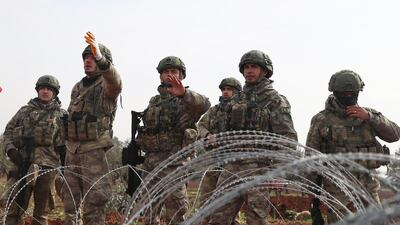
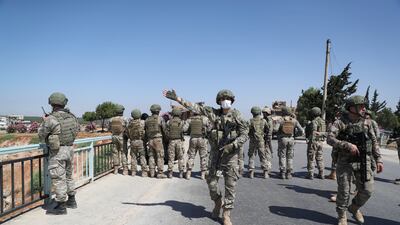
  • Turkish soldiers at an observation post in the town of Binnish, Idlib. AFP
    Turkish soldiers at an observation post in the town of Binnish, Idlib. AFP
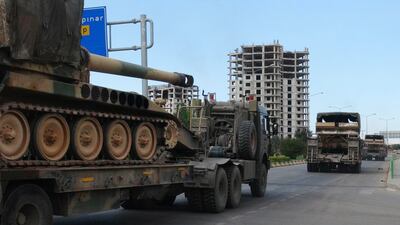
  • A convoy of Turkish vehicles carrying tanks destined for Syria, near the town of Kilis in Turkey. AP
    A convoy of Turkish vehicles carrying tanks destined for Syria, near the town of Kilis in Turkey. AP
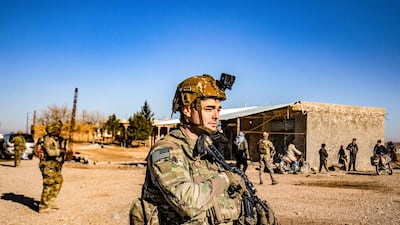
  • US soldiers patrol the front line between areas held by the Syrian Democratic Forces and Turkey-backed fighters near the village of Dardara in Syria's north-east Hasakeh province on December 26, 2021. AFP
    US soldiers patrol the front line between areas held by the Syrian Democratic Forces and Turkey-backed fighters near the village of Dardara in Syria's north-east Hasakeh province on December 26, 2021. AFP
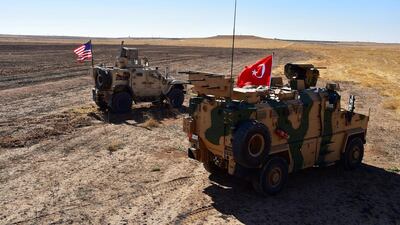
  • Turkish and US military vehicles on patrol along the Syrian-Turkish border near Tel Abyad, Syria. Reuters
    Turkish and US military vehicles on patrol along the Syrian-Turkish border near Tel Abyad, Syria. Reuters
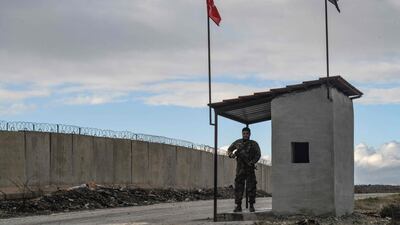
  • A Free Syrian Army oldier at a checkpoint near the Syrian village of Jandaris in the countryside of Afrin, along the wall on the northern border with Turkey, on December 18, 2021. AFP
    A Free Syrian Army oldier at a checkpoint near the Syrian village of Jandaris in the countryside of Afrin, along the wall on the northern border with Turkey, on December 18, 2021. AFP
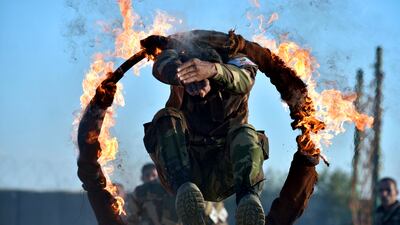
  • Syrian opposition fighters during training at a camp in the Turkish-controlled north-west city of Azaz, Syria. AP Photo
    Syrian opposition fighters during training at a camp in the Turkish-controlled north-west city of Azaz, Syria. AP Photo
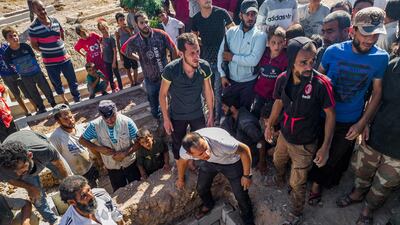
  • Mourners prepare a grave for a fighter from the pro-Turkish Hamza Division Syrian rebel group killed in a Russian air raid. The strikes hit a school used as a military base outside the north Syria town of Afrin. AFP
    Mourners prepare a grave for a fighter from the pro-Turkish Hamza Division Syrian rebel group killed in a Russian air raid. The strikes hit a school used as a military base outside the north Syria town of Afrin. AFP
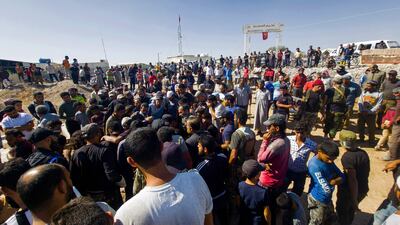
  • Mourners at the funeral and burial of fighters from the Hamza Division Syrian rebel group who were killed in the air raids. AFP
    Mourners at the funeral and burial of fighters from the Hamza Division Syrian rebel group who were killed in the air raids. AFP
  • A Syrian fighter near the town of Tal Hajar in northern Aleppo province, a few kilometres from areas controlled by a Kurdish-led coalition. AFP
    A Syrian fighter near the town of Tal Hajar in northern Aleppo province, a few kilometres from areas controlled by a Kurdish-led coalition. AFP
  • US forces are co-ordinating with the Kurdish-led Syrian Democratic Forces to combat ISIS extremists and deter pro-Iran militias. AFP
    US forces are co-ordinating with the Kurdish-led Syrian Democratic Forces to combat ISIS extremists and deter pro-Iran militias. AFP
  • Turkish soldiers on a bridge overlooking a section of the M4 motorway that links the northern Syrian provinces of Aleppo and Latakia. AFP
    Turkish soldiers on a bridge overlooking a section of the M4 motorway that links the northern Syrian provinces of Aleppo and Latakia. AFP
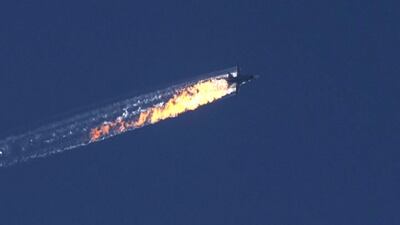
  • A Russian fighter jet after being shot down near the Turkish-Syrian border. The Sukhoi Su-24 was reportedly downed by Turkish forces, Turkish state news agency Anadolu reported, after the jet encroached into Turkish airspace and ignored warnings. EPA
    A Russian fighter jet after being shot down near the Turkish-Syrian border. The Sukhoi Su-24 was reportedly downed by Turkish forces, Turkish state news agency Anadolu reported, after the jet encroached into Turkish airspace and ignored warnings. EPA
  • Syrian regime troops on the outskirts of the northern Syrian border town of Kobane after a deal struck with Kurdish authorities during a Turkish offensive. AFP
    Syrian regime troops on the outskirts of the northern Syrian border town of Kobane after a deal struck with Kurdish authorities during a Turkish offensive. AFP
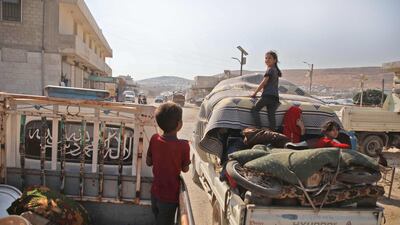
  • Syrian civilians in Idlib who fled Russian and regime bombardment south of the governorate to areas nearer to the Turkish border to the north, which are considered relatively safer. AFP
    Syrian civilians in Idlib who fled Russian and regime bombardment south of the governorate to areas nearer to the Turkish border to the north, which are considered relatively safer. AFP

With the Syrian conflict entering its 11th year in March, the international powers that have played a major role in shaping the civil war have been consolidating large zones under their control.

The Turkish, Iranian, Russian and US zones have been used by each power to checkmate each other. This unresolved international scramble has frustrated the regime of President Bashar Al Assad's stated aim of regaining control of the country.

These zones experienced major socio-economic shifts as different forces took control and expelled local populations, deepening Syria's fragmentation and undermining the chances of a political solution.

A UN process to find a resolution has been officially ongoing since the US, Russia and other countries agreed on a vaguely defined political transition in July 2012.

The conflict started in March 2011 with peaceful protests in the southern city of Deraa against five decades of Assad family rule.

Rival statelets

Farhad is one of the few Syrians with permission to travel from the US zone to the Turkish zone. The American sphere is mostly in the Euphrates basin and is run by Kurdish militias.

He crossed to northern Iraq, took a plane to Turkey and went by car from southern Turkey to Al Bab, where he had to apply for a civil ID from the local administration.

It is controlled by the Sultan Murad Brigade, a proxy force for Turkey comprising anti-Assad fighters.

“There are local councils and civil departments but without a security clearance from Sultan Murad I would not have gotten my papers,” Farhad says.

He said the nominal administrative set-up in Turkish-held Aleppo is similar to the one in the US zone in the north-east.

There, local power lies with the People’s Protection Units (YPG), a Syrian-Kurdish militia, and its ally, the Kurdistan Workers' Party (PKK), the military backbone of the Kurdish presence in the region

Both the Kurdish militias and Turkey's Sunni proxies have been undermined by their patrons for geopolitical gains.

But they have little choice but to stick with their backers.

Turkey has made tacit deals with Russia that led to the Syrian regime retaking territory in the north. This was in exchange for Turkey taking nearby territory in Aleppo and Idlib governorates from Kurdish militias.

The YPG and PKK had hoped to capture enough land with US and Russian support to form a continuous fief along the border with Turkey, stretching from the edge of Iraq to the Mediterranean coast.

Iranian gains

The changed map has been accompanied by population expulsions along sectarian lines that could maintain the conflict regardless of any UN deal.

Syrian Sunnis fear that Iran is creating a so-called "southern suburb" in its zone of influence on the outskirts of Damascus by buying Sunni land and populating the area with Shiite militias from Iraq, and their families.

Many in the opposition to the Assad regime said the area is beginning to resemble Hezbollah's stronghold in southern Beirut, a de facto statelet financed by Iran.

Tehran has also attracted Sunni tribes in its sphere of influence in the Deir Ezzor governorate in eastern Syria. This was done by recruiting them to guard parts of a supply line from Iran to Hezbollah in Lebanon that runs through Syria.

Between 2008 and 2010, proselytising led by Iran converted at least 20,000 Sunnis in Deir Ezzor to Shia Islam, as Iran distributed food aid and cash handouts in the poverty stricken area.

Most of the 20,000 converted back to Sunnism when anti-Assad rebels captured the area in 2012-2013, highlighting the vulnerability of local forces when their patrons disappear.

A Syrian officer who defected from the regime’s military and operates from an Arab country said Iran “is playing it smarter”.

He is comparing the Iranian approach to its policies before 2011, which fuelled resentment against Tehran among Syria's Sunni majority

“They are using more money, and legitimate means such as land purchases, with less outright focus on pushing their ideology,” the former officer said.

Russia's image

In some cases, the Iranian drive for influence has contradicted Russian interests, although the two countries are allies when it comes to Syria.

Arab security officials said pro-Iranian militias in southern Syria, a Russian sphere of influence, are the main actors in the production and smuggling of Captagon into Jordan and the Arabian Peninsula.

Russia has sought in the past decade to boost ties with Jordan and the Gulf countries, which regard the Captagon trade as a threat to their security. Moscow's forces moved into southern Syria in 2018 after a tacit deal with Israel and the US that centred on curbing pro-Iranian forces in the region.

In September last year, pressure by Moscow forced rebels in the southern provincial capital of Deraa to surrender to the regime.

But tit-for-tat killings between the regime and rebels, who had given up most of their weapons, have reignited.

This instability is undermining Russia's image as the ultimate power in Syria since its intervention in 2015 on the side of the regime.

Uncertainty among US allies

During his short stay in his home village, Farhad was afraid of being kidnapped by gangs for ransom – not because he is a Kurd.

In the nearby Kurdish region of Afrin, almost all of the region’s population fled when Turkey overran the rural area in 2017 and installed the Syrian National Army, another of its Sunni proxies.

Support for anti-Turkey Kurdish militias ran strong in Afrin, unlike the more mercantile region of Al Bab, where Kurds constitute a minority, Farhad says.

He says Turkey has a political interest in shielding Kurds in Al Bab “to show that its safe zone model can be inclusive”.

Masses of Sunnis have been displaced from the north-east since the Kurdish militias took over the region in 2012.

But some Sunni tribes have co-operated with the new rulers, and joined the Syrian Democratic Forces, a military formation dominated by the YPG and PKK.

Speculation increased after the US withdrawal from Afghanistan this year that Washington could also pull out from Syria, weakening its Kurdish allies.

Brett McGurk, White House co-ordinator for the Middle East and North Africa, told The National last month that “we intend to stay”.

But Mr McGurk would not be drawn on the future of the region, beyond saying that the American forces would continue to fight ISIS in Syria.

Since the US withdrawal from Afghanistan in August, Kurdish militias have been seeking more talks with Assad representatives about a long-term accommodation with the regime, western diplomats said.

They have also opened power-sharing negotiations with the National Kurdish Council, a pro-Turkish grouping of Kurdish parties. The group is also supported by Masoud Barzani, the Iraqi Kurdish leader who controls his own fief in northern Iraq.

A Syrian opposition figure who works with Turkish intelligence said the pragmatism shown by Kurdish militias since 2011 "will not save them" if the US ultimately withdraws from Syria.

“The regime will renege on any deal, and a deal with the Kurdish National Council means ceding to Turkey," the opposition figure said from Istanbul.

He said Sunnis in the north-east, even those who joined the Syrian Democratic Forces, also "have a scores to settle" with the Kurdish militias.

“None of the options available to the Kurds look good," he said.

Mercer, the investment consulting arm of US services company Marsh & McLennan, expects its wealth division to at least double its assets under management (AUM) in the Middle East as wealth in the region continues to grow despite economic headwinds, a company official said.

Mercer Wealth, which globally has $160 billion in AUM, plans to boost its AUM in the region to $2-$3bn in the next 2-3 years from the present $1bn, said Yasir AbuShaban, a Dubai-based principal with Mercer Wealth.

Within the next two to three years, we are looking at reaching $2 to $3 billion as a conservative estimate and we do see an opportunity to do so,” said Mr AbuShaban.

Mercer does not directly make investments, but allocates clients’ money they have discretion to, to professional asset managers. They also provide advice to clients.

“We have buying power. We can negotiate on their (client’s) behalf with asset managers to provide them lower fees than they otherwise would have to get on their own,” he added.

Mercer Wealth’s clients include sovereign wealth funds, family offices, and insurance companies among others.

From its office in Dubai, Mercer also looks after Africa, India and Turkey, where they also see opportunity for growth.

Wealth creation in Middle East and Africa (MEA) grew 8.5 per cent to $8.1 trillion last year from $7.5tn in 2015, higher than last year’s global average of 6 per cent and the second-highest growth in a region after Asia-Pacific which grew 9.9 per cent, according to consultancy Boston Consulting Group (BCG). In the region, where wealth grew just 1.9 per cent in 2015 compared with 2014, a pickup in oil prices has helped in wealth generation.

BCG is forecasting MEA wealth will rise to $12tn by 2021, growing at an annual average of 8 per cent.

Drivers of wealth generation in the region will be split evenly between new wealth creation and growth of performance of existing assets, according to BCG.

Another general trend in the region is clients’ looking for a comprehensive approach to investing, according to Mr AbuShaban.

“Institutional investors or some of the families are seeing a slowdown in the available capital they have to invest and in that sense they are looking at optimizing the way they manage their portfolios and making sure they are not investing haphazardly and different parts of their investment are working together,” said Mr AbuShaban.

Some clients also have a higher appetite for risk, given the low interest-rate environment that does not provide enough yield for some institutional investors. These clients are keen to invest in illiquid assets, such as private equity and infrastructure.

“What we have seen is a desire for higher returns in what has been a low-return environment specifically in various fixed income or bonds,” he said.

“In this environment, we have seen a de facto increase in the risk that clients are taking in things like illiquid investments, private equity investments, infrastructure and private debt, those kind of investments were higher illiquidity results in incrementally higher returns.”

The Abu Dhabi Investment Authority, one of the largest sovereign wealth funds, said in its 2016 report that has gradually increased its exposure in direct private equity and private credit transactions, mainly in Asian markets and especially in China and India. The authority’s private equity department focused on structured equities owing to “their defensive characteristics.”

Cinco in numbers

Dh3.7 million

The estimated cost of Victoria Swarovski’s gem-encrusted Michael Cinco wedding gown

46

The number, in kilograms, that Swarovski’s wedding gown weighed.

1,000

The hours it took to create Cinco’s vermillion petal gown, as seen in his atelier [note, is the one he’s playing with in the corner of a room]

50

How many looks Cinco has created in a new collection to celebrate Ballet Philippines’ 50th birthday

3,000

The hours needed to create the butterfly gown worn by Aishwarya Rai to the 2018 Cannes Film Festival.

1.1 million

The number of followers that Michael Cinco’s Instagram account has garnered.

The specs

Engine: 2.0-litre 4cyl turbo

Power: 261hp at 5,500rpm

Torque: 405Nm at 1,750-3,500rpm

Transmission: 9-speed auto

Fuel consumption: 6.9L/100km

On sale: Now

Price: From Dh117,059

Scoreline

Abu Dhabi Harlequins 17

Jebel Ali Dragons 20

Harlequins Tries: Kinivilliame, Stevenson; Cons: Stevenson 2; Pen: Stevenson

Dragons Tries: Naisau, Fourie; Cons: Love 2; Pens: Love 2

UAE currency: the story behind the money in your pockets
AI traffic lights to ease congestion at seven points to Sheikh Zayed bin Sultan Street

The seven points are:

Shakhbout bin Sultan Street

Dhafeer Street

Hadbat Al Ghubainah Street (outbound)

Salama bint Butti Street

Al Dhafra Street

Rabdan Street

Umm Yifina Street exit (inbound)

Tax authority targets shisha levy evasion

The Federal Tax Authority will track shisha imports with electronic markers to protect customers and ensure levies have been paid.

Khalid Ali Al Bustani, director of the tax authority, on Sunday said the move is to "prevent tax evasion and support the authority’s tax collection efforts".

The scheme’s first phase, which came into effect on 1st January, 2019, covers all types of imported and domestically produced and distributed cigarettes. As of May 1, importing any type of cigarettes without the digital marks will be prohibited.

He said the latest phase will see imported and locally produced shisha tobacco tracked by the final quarter of this year.

"The FTA also maintains ongoing communication with concerned companies, to help them adapt their systems to meet our requirements and coordinate between all parties involved," he said.

As with cigarettes, shisha was hit with a 100 per cent tax in October 2017, though manufacturers and cafes absorbed some of the costs to prevent prices doubling.

UPI facts

More than 2.2 million Indian tourists arrived in UAE in 2023
More than 3.5 million Indians reside in UAE
Indian tourists can make purchases in UAE using rupee accounts in India through QR-code-based UPI real-time payment systems
Indian residents in UAE can use their non-resident NRO and NRE accounts held in Indian banks linked to a UAE mobile number for UPI transactions

The specs

Engine: 1.4-litre 4-cylinder turbo

Power: 180hp at 5,500rpm

Torque: 250Nm at 3,00rpm

Transmission: 5-speed sequential auto

Price: From Dh139,995

On sale: now

Company%20profile
%3Cp%3E%3Cstrong%3ECompany%20name%3A%20%3C%2Fstrong%3EHakbah%0D%3Cbr%3E%3Cstrong%3EStarted%3A%20%3C%2Fstrong%3E2018%0D%3Cbr%3E%3Cstrong%3EFounder%3A%20%3C%2Fstrong%3ENaif%20AbuSaida%0D%3Cbr%3E%3Cstrong%3EBased%3A%20%3C%2Fstrong%3ESaudi%20Arabia%0D%3Cbr%3E%3Cstrong%3ESector%3A%20%3C%2Fstrong%3EFinTech%0D%3Cbr%3E%3Cstrong%3ECurrent%20number%20of%20staff%3A%20%3C%2Fstrong%3E22%20%0D%3Cbr%3E%3Cstrong%3EInitial%20investment%3A%20%3C%2Fstrong%3E%24200%2C000%0D%3Cbr%3E%3Cstrong%3EInvestment%20stage%3A%20%3C%2Fstrong%3Epre-Series%20A%0D%3Cbr%3E%3Cstrong%3EInvestors%3A%20%3C%2Fstrong%3EGlobal%20Ventures%20and%20Aditum%20Investment%20Management%0D%3Cbr%3E%3Cbr%3E%3C%2Fp%3E%0A
Asia Cup Qualifier

Final
UAE v Hong Kong

Live on OSN Cricket HD. Coverage starts at 5.30am

PAKISTAN v SRI LANKA

Twenty20 International series
Thu Oct 26, 1st T20I, Abu Dhabi
Fri Oct 27, 2nd T20I, Abu Dhabi
Sun Oct 29, 3rd T20I, Lahore

Tickets are available at www.q-tickets.com

Ad Astra

Director: James Gray

Stars: Brad Pitt, Tommy Lee Jones

Five out of five stars 

Top tips

Create and maintain a strong bond between yourself and your child, through sensitivity, responsiveness, touch, talk and play. “The bond you have with your kids is the blueprint for the relationships they will have later on in life,” says Dr Sarah Rasmi, a psychologist.
Set a good example. Practise what you preach, so if you want to raise kind children, they need to see you being kind and hear you explaining to them what kindness is. So, “narrate your behaviour”.
Praise the positive rather than focusing on the negative. Catch them when they’re being good and acknowledge it.
Show empathy towards your child’s needs as well as your own. Take care of yourself so that you can be calm, loving and respectful, rather than angry and frustrated.
Be open to communication, goal-setting and problem-solving, says Dr Thoraiya Kanafani. “It is important to recognise that there is a fine line between positive parenting and becoming parents who overanalyse their children and provide more emotional context than what is in the child’s emotional development to understand.”
 

Avatar: Fire and Ash

Director: James Cameron

Starring: Sam Worthington, Sigourney Weaver, Zoe Saldana

Rating: 4.5/5

Skoda Superb Specs

Engine: 2-litre TSI petrol

Power: 190hp

Torque: 320Nm

Price: From Dh147,000

Available: Now

Updated: January 06, 2022, 7:02 AM