
The first 2,000 doses of the Covid-19 vaccine were sent to Hamas-ruled Gaza, the Palestinian Authority said, after being delayed by two days in Israel.
Palestinian Health Minister Mai AlKaila said the 2,000 doses of the Russian Sputnik V vaccine were sent through the Beitunia crossing between the occupied West Bank and Israel and are en route to Gaza.
She said they would go to frontline medical workers.
An Israeli defence official confirmed that the vaccines were on their way to Gaza after approval, saying it was "not in Israel's interest to have a Gaza health crisis". .
Israeli politicians had debated whether to allow the delivery of vaccines into Gaza, which has been under an Israeli-Egyptian blockade since Hamas, a militant group, seized power from rival Palestinian forces in 2007.
The Palestinian Authority administers parts of the West Bank and co-ordinates with Israel on security and other matters.
Some legislators said the delivery should be linked to progress on the release of two Israeli captives held by Hamas and the remains of two Israeli soldiers killed in 2014.
They also expressed concern that the first batch of vaccines would go to Hamas members rather than medical personnel.
Gaza is home to more than two million Palestinians, many of whom live in close confines, and has yet to receive any vaccines.
Authorities have reported more than 53,000 cases and at least 538 deaths since the start of the pandemic.
Israel launched one of the world's most successful vaccination programmes, inoculating more than a third of its population of 9.3 million since December.
Rights groups say it has an obligation as an occupying power to share its vaccines with the Palestinians. Israel denies such an obligation and says its priority is its own citizens.
-
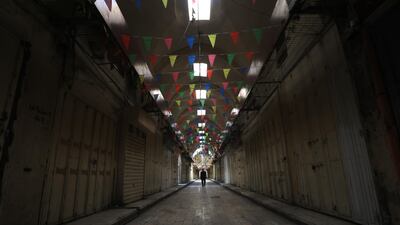
epa08360794 Palestinians walk in empty street inside al-Tujjar caravanserai in the West Bank city of Nablus, 13 April 2020. Nablus was closed due to the current novel coronavirus emergency after the Palestinian National Authority (PA) has imposed a new 14-day period of home confinement for all Palestinians living in the West Bank amid the ongoing pandemic of the COVID-19 disease caused by the SARS-CoV-2 coronavirus. EPA/ALAA BADARNEH -

epa08362541 Palestinians deliver food for patients and health workers at three quarantine centres in the West Bank city of Nablus, 14 April 2020. Nablus was closed due to the current novel coronavirus emergency after the Palestinian National Authority (PA) has imposed a new 14-day period of home confinement for all Palestinians living in the West Bank amid the ongoing pandemic of the COVID-19 disease caused by the SARS-CoV-2 coronavirus. EPA/ALAA BADARNEH -

A member of Palestinian Civil Defence wears a face shield as he takes part in a drill for dealing with coronavirus cases, amid concerns about the spread of the disease (COVID-19), in Ramallah in the Israeli-occupied West Bank April 23, 2020. REUTERS/Mohamad Torokman -

epa08362952 Palestinians fly a kite from their home roof over a neighborhood of the West Bank City of Nablus, 14 April 2020. Nablus was closed due to the current novel coronavirus emergency after the Palestinian National Authority (PA) has imposed a new 14-day period of home confinement for all Palestinians living in the West Bank amid the ongoing pandemic of the COVID-19 disease caused by the SARS-CoV-2 coronavirus. EPA/ALAA BADARNEH -
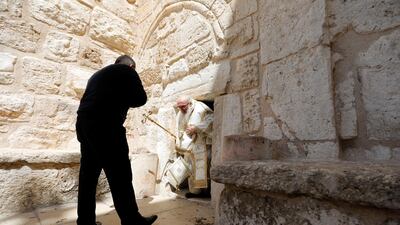
The head of the Greek Orthodox Church in Bethlehem Bishop Theofilactos leaves the Church of the Nativity to receive the Holy Fire as the ceremony is celebrated without a crowd due to the coronavirus disease restrictions in Bethlehem in the Israeli-occupied West Bank April 18, 2020. REUTERS/Mussa Qawasma -
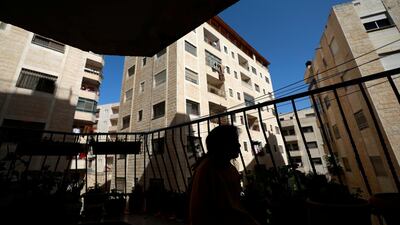
A Palestinian girl looks out of her family apartment during a home-confinement order imposed to prevent the spread of the coronavirus disease (COVID-19), in Ramallah in the Israeli-occupied West Bank April 19, 2020. REUTERS/Mohamad Torokman -

A Palestinian groom, Rafeh Qassim, wears a mask as he sits in a car with his bride on their wedding day amid concerns about the spread of the coronavirus disease (COVID-19), in Ramallah in the Israeli-occupied West Bank April 18, 2020. REUTERS/Mohamad Torokman TPX IMAGES OF THE DAY -
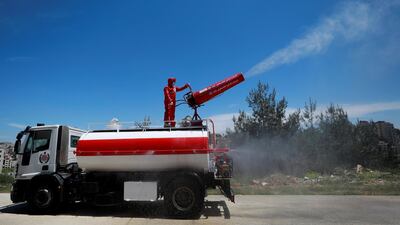
A member of Palestinian Civil Defence on a truck sprays disinfectants during a drill for dealing with coronavirus cases, amid concerns about the spread of the disease (COVID-19), in Ramallah in the Israeli-occupied West Bank April 23, 2020. REUTERS/Mohamad Torokman -

epa08380077 Medical staff of the Palestinian health ministry checks the temperature of workers crossing the checkpoint of Mitar, near the West Bank town of Hebron, 23 April 2020. The instructions of the National Authority Ministry of Health forbid gatherings and movement between cities to prevent the spread of the SARS-CoV-2 coronavirus which causes the COVID-19 disease. EPA/ABED AL HASHLAMOUN -
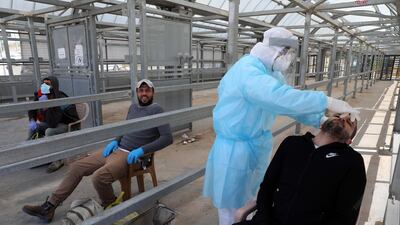
epa08380080 Medical staff of the Palestinian health ministry takes a swab sample from a worker crossing the checkpoint of Mitar, near the West Bank town of Hebron, 23 April 2020. The instructions of the National Authority Ministry of Health forbid gatherings and movement between cities to prevent the spread of the SARS-CoV-2 coronavirus which causes the COVID-19 disease. EPA/ABED AL HASHLAMOUN -

Dr Hani Abdin, dean of the Faculty of Medicine at the Palestinian Al-Quds University, speaks during an interview at the campus in Abu Dis in the West Bank on April 23, 2020, as he showcases a respirator device built on campus and certified by Palestinian health authorities. Al-Quds University announced on April 23 that the Palestinian Ministry of Health had approved the computerised artificial respiration apparatus built by the university in the fight against the COVID-19 coronavirus pandemic. The university will launch its first devices for hospital use in the following week while working to register a patent. / AFP / ABBAS MOMANI -
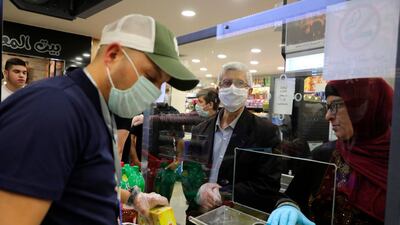
Palestinians, wearing protective masks due to the COVID-19 coronavirus pandemic, pay for their shopping at the checkout counter of a supermarket on the last day before the start of the Muslim holy month of Ramadan, beginning later in the night, at a supermarket in the city of Hebron in the occupied West Bank on April 23, 2020. / AFP / HAZEM BADER -

Palestinian security officers look at an ostrich in a cage at the Qalqilya Zoo in the occupied West Bank, after the animal park was completely closed to visitors due to the novel coronavirus pandemic, on April 21, 2020. The zoo manager said the animals had started mating more due to the calm atmosphere, with the lack of visitors also improving their behaviour. The zoo is funded by the local municipality but faces a potential financial crisis with budget cuts. / AFP / JAAFAR ASHTIYEH -
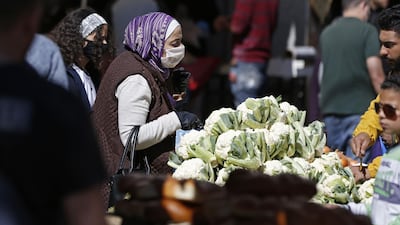
Palestinians, some wearing protective masks, shop at a fruit and vegetables market during the Muslim holy month of Ramadan amid the COVID-19 pandemic, in the occupied West Bank city of Ramallah on April 26, 2020. / AFP / ABBAS MOMANI -

Palestinian Reem Abu Ayyash shows a spoon filled with rice during a video call with her husband Rami, a nurse who treats the coronavirus disease (COVID-19) patients and has avoided his family during Ramadan out of fear of contagion, as she prepares to have her Iftar (breaking fast) meal with her daughter at their home near Hebron in the Israeli-occupied West Bank April 28, 2020. Picture taken April 28, 2020. REUTERS/Mussa Qawasma TPX IMAGES OF THE DAY -

A Palestinian preacher speaks before a camera while recording a sermon and broadcasting the audio onto loudspeakers inside an empty mosque, due to the COVID-19 coronavirus pandemic, in the village of Salem east of Nablus in the occupied West Bank on the first Friday of the Muslim holy month of Ramadan on April 24, 2020. / AFP / JAAFAR ASHTIYEH


The Palestinian Authority has not publicly requested vaccines from Israel and says it has secured its own supply through the World Health Organisation and agreements with drug makers.
Still, this month Israel provided 2,000 doses of the Moderna vaccine to the authority, which oversees the West Bank's population of 3.3 million people, allowing it to begin vaccinating medical workers.
The authority said it had independently acquired another 10,000 doses of the Sputnik V vaccine.
It would need Israel’s permission to transfer them to Gaza.
Hamas is believed to be holding two captives, an Israeli of Ethiopian descent who entered Gaza shortly after the 2014 war and an Arab Bedouin citizen of Israel. In exchange, Hamas is likely to demand the release of a large number of Palestinian prisoners held by Israel, including individuals implicated in deadly attacks.

