

Live updates: Follow the latest news on Israel-Gaza
French President Emmanuel Macron has suggested the international coalition fighting ISIS in Iraq and Syria could be expanded to also target Hamas in the Gaza Strip.
Several experts have told The National the proposal is unrealistic, as it would quickly alienate Arab countries and lead to divisions in the alliance made up of 81 nations.
Speaking alongside Israeli Prime Minister Benjamin Netanyahu in Jerusalem on Tuesday, Mr Macron said France was “ready” for the global coalition against ISIS “to also fight against Hamas”.
Israel is not part of the anti-ISIS coalition, which was established to fight ISIS in September 2014, though its Arab neighbours such as Lebanon, Jordan and Egypt are.
Analysts said while greater international co-operation was needed to address urgent matters such as aid delivery to Gaza, hostage talks and ceasefire negotiations, any attempt to use coalition resources to strike Hamas in Gaza would promptly lead to friction.
“The idea that the international community should form a coalition to fight Hamas is just about the worst possible idea on the table,” said Charles Lister, a senior fellow and director of the Syria and Countering Terrorism and Extremism programmes at the Middle East Institute.
“It would further exacerbate tensions, widen regional divisions and virtually guarantee the regional escalation that everyone wants to avoid.”
Karim Emile Bitar, associate research fellow at the Institute for International and Strategic Affairs in Paris, said any expansion of the anti-ISIS coalition was “very unlikely to happen”.
“What is absolutely needed, however, is an increasing multilateral co-operation and efforts on behalf of all regional and international powers to insist on the respect of humanitarian law and ideally call for an immediate ceasefire,” he said.

The anti-ISIS coalition was created after militants stormed across Iraq and Syria in 2014, carrying out murderous atrocities as they claimed large parts of both countries to be their new “caliphate”. Mr Netanyahu has compared Hamas, whose armed wing killed 1,400 people in southern Israel on October 7, to ISIS.
Hadi Jalo Marie, chairman of the Political Decision think tank in Baghdad, highlighted the many differences between the two groups.
ISIS “is a cross-border terrorist organisation that includes extremists of different nationalities and threatens all countries, including the West”, he said.
“Hamas is a Palestinian group [that] fights only Israel inside Palestine, not in other countries,” he added, noting there could be “negative reactions” to Mr Macron's suggestion from many countries except Israel and some of its allies.
Jordanian counter-terrorism specialist Saud Al Sharafat said it was unclear whether Mr Macron had discussed the issue with Washington before making the announcement in Israel.
“The French always like to come with a distinctive suggestion,” Mr Al Sharafat said.
He pointed out several Arab countries opposed to the current Israeli military operations in Gaza are members of the anti-ISIS coalition.
“The immediate effect of what Macron envisages could be the break-up of the coalition,” said Mr Al Sharafat, who heads the Shorufat Centre for Globalisation and Terrorism Studies in Amman.
James Jeffrey, former US special envoy to Syria and chairman of the Wilson Centre's Middle East Programme, said Mr Macron's idea was a good one “in spirit,” but “in practical terms it won't work.”
The French leader's suggestion “recognises – as US, Europe and Asian allies did in the case of Ukraine – that we are facing a common threat to the international order and should respond”, Mr Jeffrey said.
But the coalition is made up of nations and organisations with differing views of Hamas, Israel and the Palestinian question, he added.
For any expanded coalition to work, “Israel would have to shift position on the Palestinians”, Mr Jeffrey said.
“At least lip service to the two-state solution and an absolute, no-exception halt to settlements and settlement growth.”
The latest from the Israel-Gaza war – in pictures
-
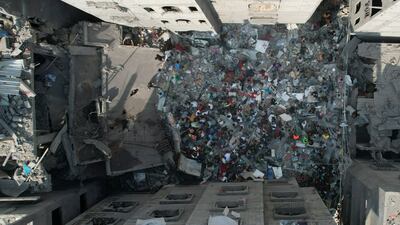
Palestinians look for survivors of Israeli bombardment of the Gaza Strip at Nusseirat refugee camp. AP -
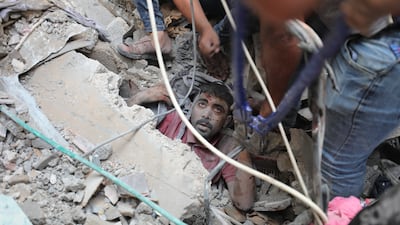
A survivor is found in the rubble in Nusseirat. AP -
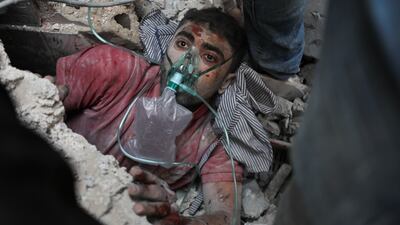
A man is given oxygen and pulled from the rubble in Nusseirat. AP -
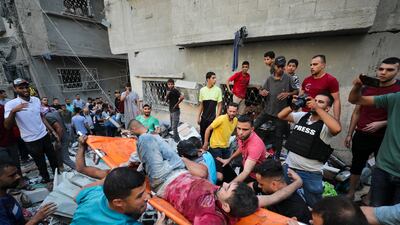
This desperate search for survivors is being replicated across the Gaza Strip. AP -
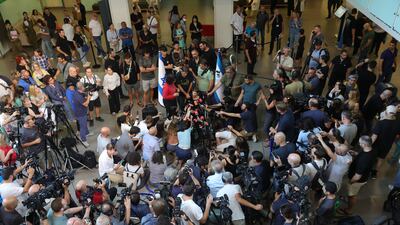
Yocheved Lifshitz speaks to the media outside a Tel Aviv hospital after being released by Hamas. EPA -
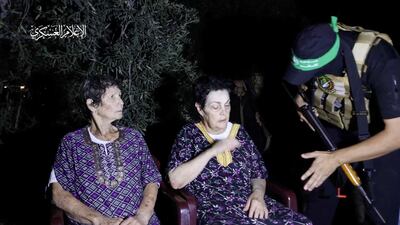
Israeli women who were held hostage by Palestinian Hamas militants, Yocheved Lifshitz and Nurit Cooper (also known as Nurit Yitzhak), are released by the militants. Reuters -
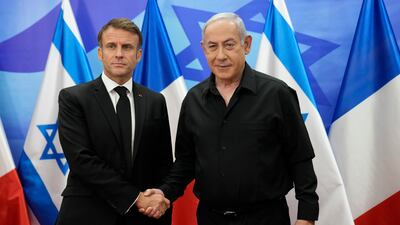
Israeli Prime Minister Benjamin Netanyahu, right, welcomes French President Emmanuel Macron before their talks in Jerusalem. AP -

Palestinians search for casualties at the site of an Israeli air strike on a house in Khan Younis, in the southern Gaza Strip. Reuters -

Palestinians inspect the damage of a destroyed house that was hit by an Israeli air strike in Khan Younis. AP -
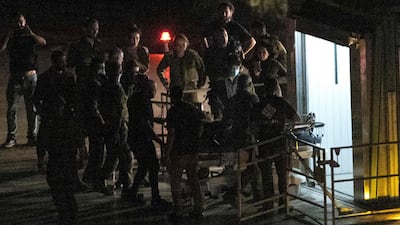
Ms Cooper and Ms Lifshitz arrive at the Tel Aviv Sourasky Medical Centre after being released by Hamas on Monday. AFP -
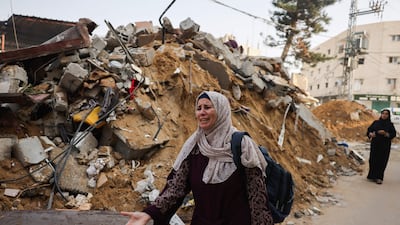
A woman cries next to the rubble of a building after Israeli strikes on Rafah in the south of the Gaza Strip. AFP -
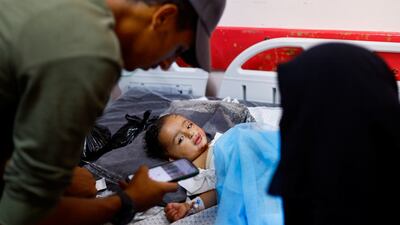
Wateen, a 14-month-old Palestinian baby, who was wounded in an Israeli strike that killed her mother and injured her twin brother Ahmed, recovers at Nasser hospital, in Khan Younis, Gaza Strip. Reuters -
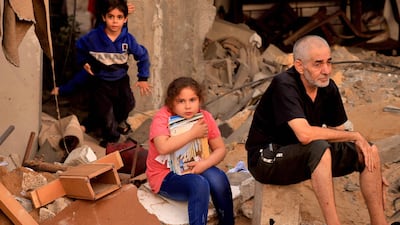
A Palestinian girl clutches salvaged books as people look for survivors in the rubble of a destroyed building hit in an Israeli strike in Khan Younis. AFP -
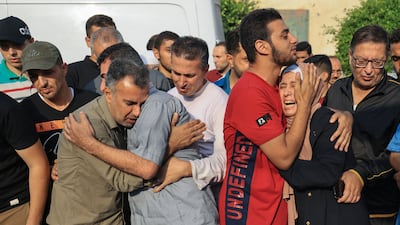
People mourn during the funeral of members of the Abu Morad family who died following Israeli strikes, in Khan Younis. AFP -
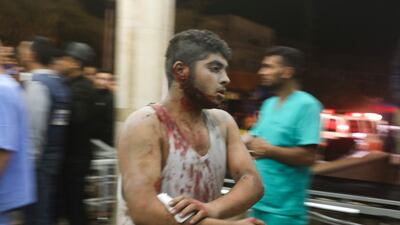
A wounded Palestinian man arrives at Nasser Medical Complex, following Israeli air strikes on the town of Khan Younis in the southern Gaza Strip. AP -
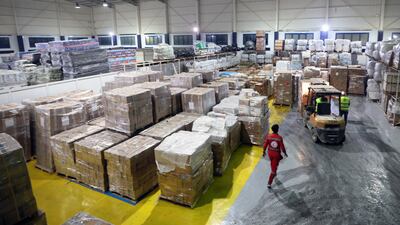
Red Crescent Society employees sort humanitarian aid bound for Palestinians in Gaza, at a warehouse in Arish, Egypt. EPA -
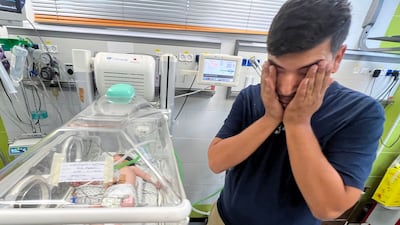
Ayman Abou Chamalah stands next to his daughter Mecca as she receives care inside an incubator at a hospital in Rafah. AFP -
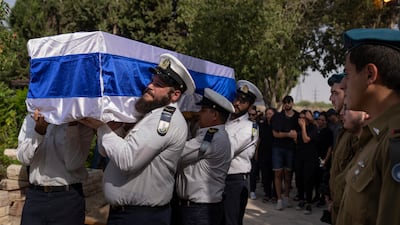
Israeli soldiers carry the coffin of Erik Kraunik, chief of security in the kibbutz of Be'eri, during his funeral at a cemetery in Yehud, Israel. AP -
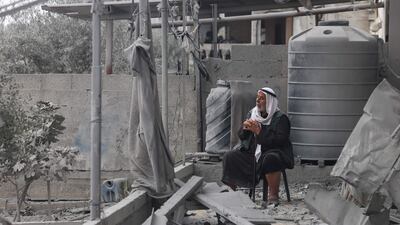
A man sits among the rubble of a building destroyed in Israel's bombardment of Rafah, in the southern Gaza Strip. AFP -
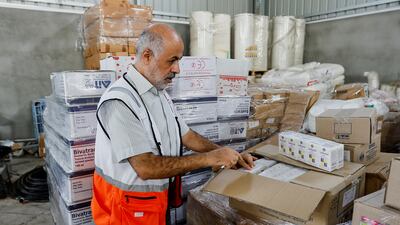
A Red Crescent worker sorts aid for Palestinians in Khan Younis, in the southern part of the blockaded enclave. Reuters -
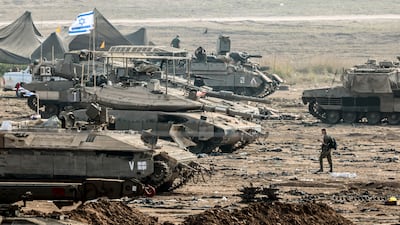
Israeli soldiers take part in a drill near the border with Gaza ahead of an expected ground invasion. EPA -
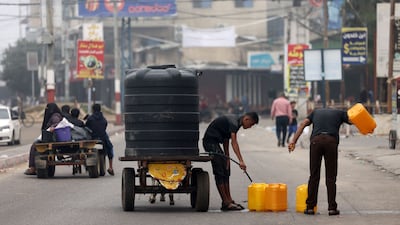
Men fill fuel containers with drinking water in Rafah. AFP -

Smoke billows over Gaza after an air strike, as seen from southern Israel. AP -
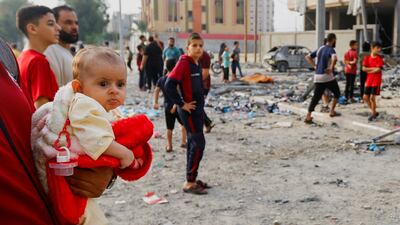
A person holds a child as Palestinians gather in Khan Younis at the site of a house destroyed during an Israeli bombardment. Reuters -
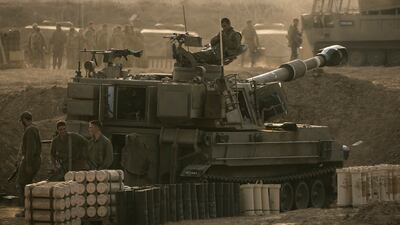
Israeli soldiers sit on top of a tank near the border with Gaza. Getty Images -
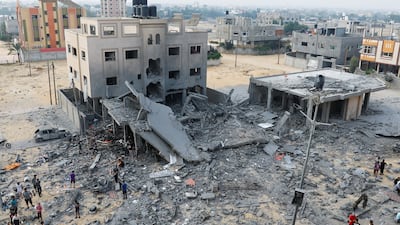
Buildings destroyed by Israeli air strikes in Khan Younis. Reuters -
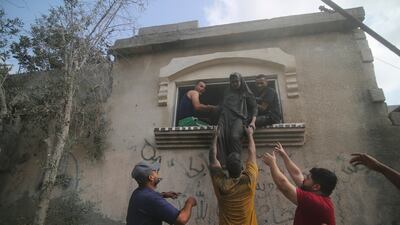
Palestinians are evacuated from a building in Rafah that was hit during Israel's bombardment. AP -
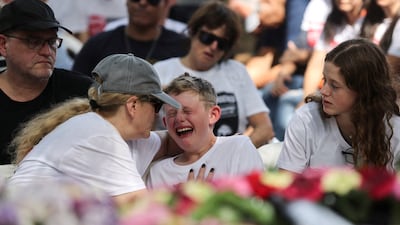
Shahar Idan, 9, mourns during the funeral of his brother Maayan, 18, who was killed by Hamas gunmen in the kibbutz of Nahal Oz. His father Tzahi is being held hostage in Gaza. Reuters -

Palestinian doctors treat a premature baby at Al Aqsa Hospital in Deir Al Balah, Gaza. AP -
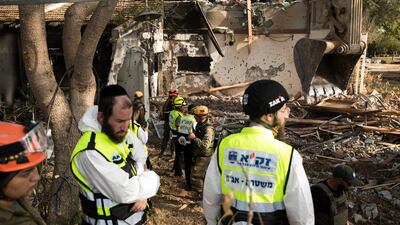
Rescue crews search for bodies after Hamas militants attacked the kibbutz of Be'eri in Israel. Getty Images -
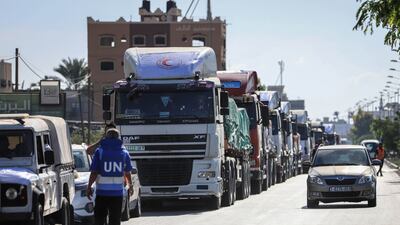
Lorries carrying humanitarian aid head to Deir Al Balah after crossing from Egypt through Rafah. Bloomberg -
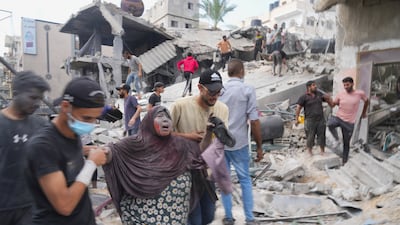
Palestinians evacuate survivors in Deir Al Balah after an Israeli bombardment. AP -
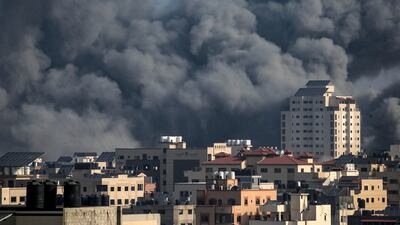
Smoke rises after Israeli air strikes on Gaza. EPA -
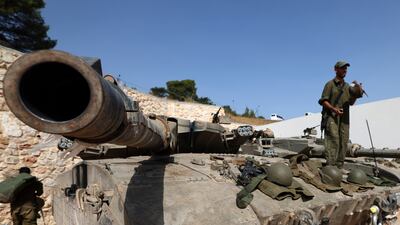
Israeli soldiers at a position along the border with Lebanon. EPA -
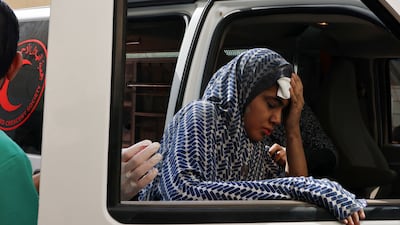
A woman leans against the window of an ambulance outside Kuwait Hospital after an Israeli strike in Rafah. AFP -
A Palestinian cries as the body of his daughter is recovered from beneath the rubble of a building destroyed during an Israeli air strike on Rafah. AFP -
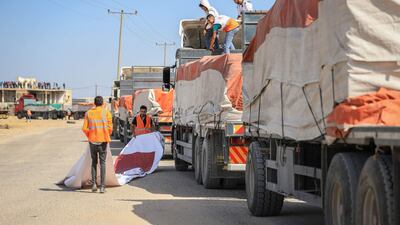
A convoy carrying humanitarian aid arrives in Rafah after crossing into the Gaza Strip from Egypt. Bloomberg -
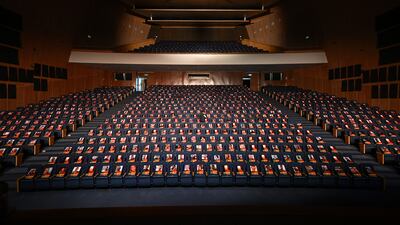
The pictures of more than 1,000 people abducted or killed during the attack by Hamas militants are displayed on empty seats at Tel Aviv University. Getty -
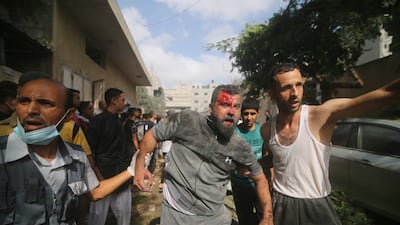
Palestinians are evacuated from buildings in Rafah after the bombardment of the Gaza Strip. AP -
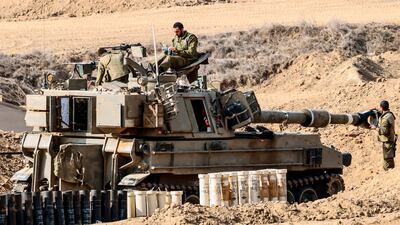
Israeli soldiers gather at an undisclosed location near the border with Gaza. EPA -
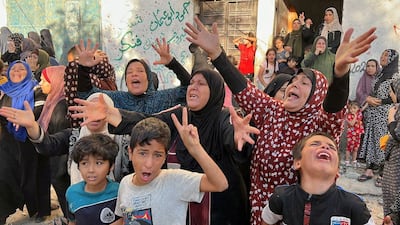
Palestinians mourn outside a house in Gaza struck by Israel. Reuters -
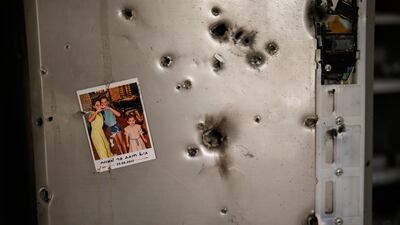
A bullet-riddled fridge in a house in the kibbutz of Kissufim in southern Israel, where 14 people were killed and four were abducted by Hamas militants on October 7. AP -
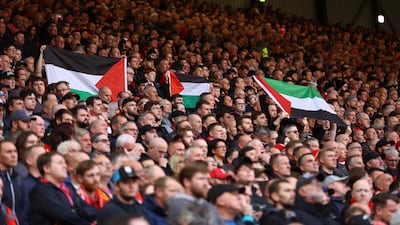
Football fans inside Anfield stadium hold up Palestine flags during the Liverpool-Everton derby on Saturday. Reuters -
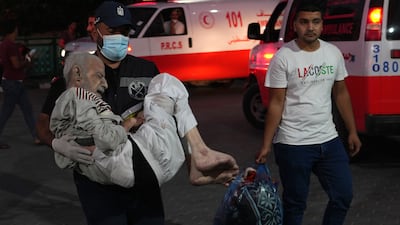
Palestinians wounded in the bombardment of Gaza are taken to Al Asa Hospital in Deir Al Balah. AP -
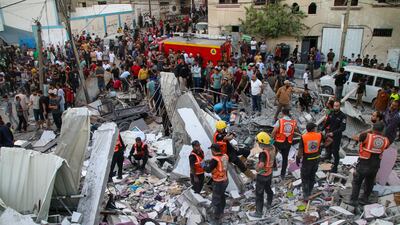
Rescuers search for victims and survivors in buildings destroyed by air strikes in Khan Younis, Gaza. Getty -
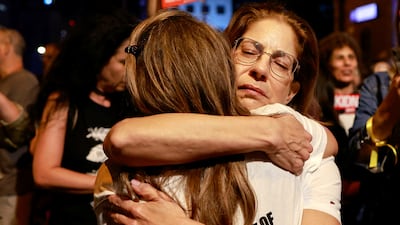
Residents of Tel Aviv show support for the families of hostages being held in Gaza by Hamas. Reuters


Joel Rayburn, founder and director of the American Centre for Levant Studies, said the Israel-Gaza conflict was so closely related to the broader Israeli-Palestinian political question that it would be “supremely difficult” to replicate a narrowly focused counter-terrorism coalition modelled on the counter-ISIS alliance.
“The campaign against the ISIS caliphate did not directly involve any broader political questions, only military plans,” he noted.

