


Live updates: Follow the latest news on Israel-Gaza
US allies have expressed their disappointment that Washington blocked a UN Security Council resolution calling for “humanitarian pauses” to alleviate the unfolding catastrophe in the Gaza Strip.
The US on Wednesday vetoed the resolution that rejected and condemned “the heinous terrorist attacks by Hamas” in southern Israel on October 7 and called for “pauses” in the conflict to allow safe, rapid and unhindered access for UN humanitarian agencies and their implementing partners.
The Brazil-drafted text received 12 votes in favour, two abstentions and the US veto, meaning it would have passed were it not for the American block.
“No UNSC resolution is perfect but given the gravity of the situation on the ground, the UAE believes this was a good-faith effort to focus on the key priorities and that’s why the vote reflected the high number of 12 countries in favour,” Lana Nusseibeh, the UAE's UN ambassador, told The National.
The US envoy to the UN, Linda Thomas-Greenfield, told the Security Council that the Biden administration couldn’t endorse a measure that didn’t mention Israel’s right to self-defence.
Two members of the G7 on the council, France and Japan, broke with the US by supporting the text. The UK abstained.
Speaking to The National, France’s ambassador to the UN, Nicolas De Riviere, expressed his disappointment over the Security Council's failure to address the escalating crisis in the Middle East.
For France, he said, there is no contradiction in supporting the right of Israel to defend itself and calling for the full respect of international humanitarian law and the Geneva Conventions.
It is crucial for the Security Council to express itself very clearly on these two aspects, he added.
He described the Brazilian text as a “good draft” that contained a “crystal-clear” condemnation of the Hamas terrorist attack against Israel.
Mr De Riviere emphasised that the Council missed a crucial opportunity to fulfil its duty in the face of a “deteriorating situation” on the ground.
The global body whose responsibility is to maintain international peace and security “cannot remain silent”, he argued.
“We have a moral responsibility to act. It is a humanitarian issue but also a political one.”
Under international law, only the Security Council can authorise force. Each of its five permanent members, known as the P5 – US, UK, Russia, China, and France – can veto any action.
In less than two weeks, Israeli air strikes have killed more than 3,400 people in Gaza, and a complete blockade on the Palestinian enclave has exacerbated the humanitarian crisis, pushing its healthcare system to the brink of collapse.
The French diplomat said France will continue engaging constructively with other members of the Security Council.
“We need to find a solution to the question of Palestine. It is essential for the stability of the region.”
Ms Nusseibeh said she believes all options have yet to be exhausted.
“The calls for a ceasefire are getting more urgent, and we cannot give up. So we’re working very hard, with our international and regional partners to ensure international humanitarian law is upheld,” she said.
“Humanitarian aid is still not getting in, and this already horrific situation continues to worsen.”
More than one million people have been displaced in just over a week and the number of civilian casualties in Gaza is “shocking”, the UAE ambassador added.
“The Council must live up to its responsibilities to the people of Gaza and the region, and we will continue to be a calm but urgent voice pushing for consensus on principles that we are all responsible for upholding – enshrined in international law.”
Gaza's entire population has been cut off from supplies of electricity, food, fuel and water for over a week under a “complete siege” ordered by Israel in the wake of the Hamas attacks that killed some 1,400 people in Israel and saw about 200 taken hostage.
Ms Nusseibeh noted that the 12-country majority vote underscored the resolution's importance in underscoring the significance of international humanitarian law, humanitarian aid facilitation, hostage release, civilian protection, humanitarian pauses for aid access, as well as “encouraging efforts towards an overall cessation of hostilities”.
Richard Gowan, the UN Director of the International Crisis Group, told The National both Brazil and the US wanted to avoid this veto, but the Al Ahli Hospital attack wrecked efforts to find a compromise.
Mr Gowan doubts the Security Council will find consensus in the near future on Gaza after this setback. But, he warned, should the war spill into Lebanon, the panel will have to work out what to do with the United Nations peacekeeping mission in Lebanon, known as Unifil.
“That could be the next great drama at the UN,” he said.
Louis Charbonneau, UN Director at Human Rights Watch, has criticised the US veto as self-defeating because Washington blocked a powerful Security Council condemnation of the Hamas attack and a demand to release the hostages.
The vote blocked the “very demands they so often insist upon in other contexts: all parties to comply with international humanitarian law and ensure that vital humanitarian aid and essential services reach people in need”, he said.
Thousands protest in Lebanon over Gaza hospital bombing – in pictures
-

Lebanese security forces use water cannons as they clash with protesters outside the US embassy in Awkar. AFP -

Thousands rallied to protest the deaths of hundreds of people in a strike on a Gaza hospital that they blamed on Israel, which has denied responsibility. AFP -
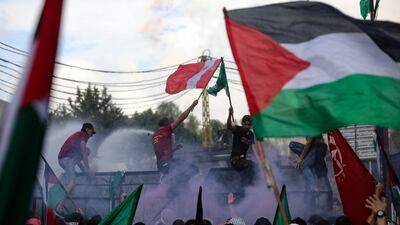
Protesters gathered outside the US embassy in Awkar east of Beirut to express solidarity with the Palestinians in Gaza. AFP -

Security forces have used water cannon and tear gas to disperse hundreds of protesters outside the US embassy. AP -
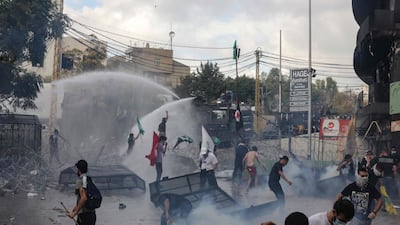
Officers retaliated and sought to break up crowds in the northern suburb of Awkar. AFP -

Many that took place in the protest waved Palestinian flags outside the US embassy. AFP -
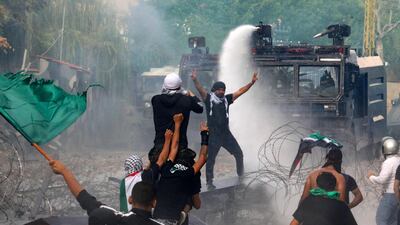
Demonstrators were seen covering their faces as they fled the gas, while others ran. AFP -
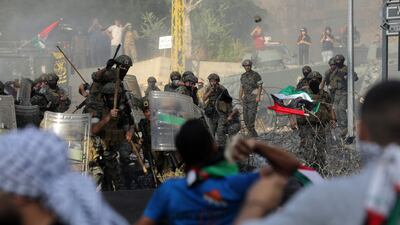
The protest came after hundreds of demonstrators swarmed around the hilltop embassy, as news of hundreds of deaths in a Gaza hospital strike emerged. AFP



