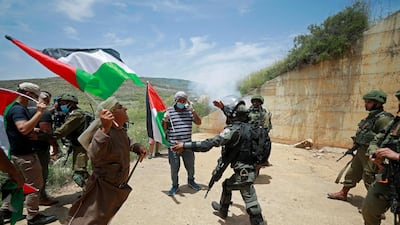
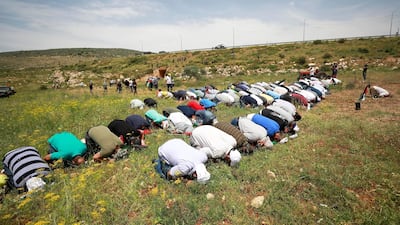
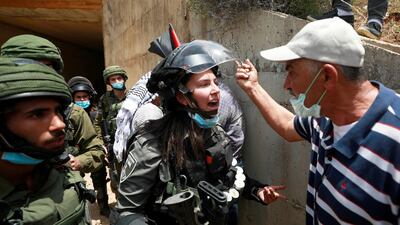
Palestinians and Israeli activists trying to block Route 60, the main Jewish settler road in the West Bank, as a protest against the confiscation of Palestinian land, are dispersed by Israeli security forces on March 12, 2021 near the village of Yatta, south of Hebron, in the occupied West Bank. AFP
Palestinians and Israeli activists trying to block Route 60, the main Jewish settler road in the West Bank, as a protest against the confiscation of Palestinian land, are dispersed by Israeli security

Middle East Quartet talk restarting Palestinian-Israel talks


  • English
  • Arabic

The UN, US, Russia and EU discussed how to restarted long stalled efforts to negotiate an end to the decades-long Palestinian-Israeli conflict and a two state solution on Tuesday during a virtual meeting.

A brief statement from the four Mideast mediators, known as the Quartet, said envoys discussed returning “to meaningful negotiations that will lead to a two-state solution, including tangible steps to advance freedom, security and prosperity for Palestinians and Israelis, which is important in its own right.”

There have been no substantive peace talks between Israel and the Palestinians since 2014, and the two sides are fiercely divided over the core issues of the conflict.

The UN sent out the statement on the Quartet discussion after polls closed in Tuesday’s Israeli election.

Exit polls indicated there was no clear winner, leaving Prime Minister Benjamin Netanyahu's fate uncertain and signalling continued political deadlock in Israel.

In late January, UN Secretary-General Antonio Guterres said there were “reasons to hope” for progress toward ending the Israeli-Palestinian conflict after years of inaction.

He said the UN would explore all initiatives to facilitate “a true peace process” based on the two-state solution.

Clearly referring to the former US administration, without naming ex-president Donald Trump, Mr Guterres said: “we were completely locked down in a situation in which there was no progress visible.”

The Trump administration provided unprecedented support to Israel, recognising Jerusalem as Israel’s capital, moving the US Embassy from Tel Aviv, slashing financial assistance for the Palestinians and reversing course on the illegitimacy of Israeli settlements on land claimed by the Palestinians.

For more than three decades, the Palestinians have sought an independent state in the West Bank, Gaza and East Jerusalem, territories seized by Israel in the 1967 war.

Israel withdrew from Gaza in 2005 but imposed a crippling blockade when the Palestinian group Hamas won legislative election and then seized power from President Mahmoud Abbas’ Fatah in Gaza in 2007.

Israel has annexed east Jerusalem – a step that is not internationally recognised – and has said it has no intention of dismantling any of its West Bank settlements, which the UN says are illegal under international humanitarian law.

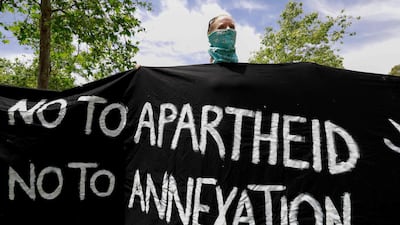
  • An Israeli activist holds a banner during a protest against the US peace plan for the Middle East, in front of the US ambassador's residence in Jerusalem, on May 15, 2020, as Palestinians commemorate the 72nd anniversary of the 1948 Nakba. which left hundreds of thousands of Palestinians displaced by the war accompanying the birth of Israel. AFP
    An Israeli activist holds a banner during a protest against the US peace plan for the Middle East, in front of the US ambassador's residence in Jerusalem, on May 15, 2020, as Palestinians commemorate the 72nd anniversary of the 1948 Nakba. which left hundreds of thousands of Palestinians displaced by the war accompanying the birth of Israel. AFP
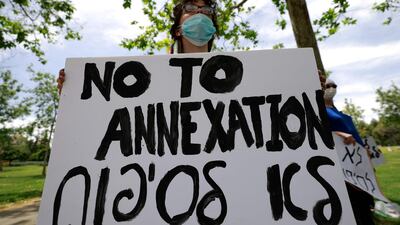
  • Israeli activists hold placards as they protest against the US peace plan for the Middle East in front of the US ambassador's residence in Jerusalem, on May 15, 2020. AFP
    Israeli activists hold placards as they protest against the US peace plan for the Middle East in front of the US ambassador's residence in Jerusalem, on May 15, 2020. AFP
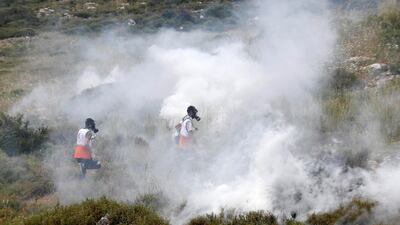
  • Palestinian medics run away from teargas used by Israeli troops during a protest marking the 72nd anniversary of Nakba and against Israeli plan to annex parts of the occupied West Bank, in the village of Sawiya near Nablus May 15, 2020. Reuters
    Palestinian medics run away from teargas used by Israeli troops during a protest marking the 72nd anniversary of Nakba and against Israeli plan to annex parts of the occupied West Bank, in the village of Sawiya near Nablus May 15, 2020. Reuters
  • Israeli troops stand guard as Palestinians marking the 72nd anniversary of Nakba and protest against Israeli plan to annex parts of the occupied West Bank, in the village of Sawiya near Nablus May 15, 2020. Reuters
    Israeli troops stand guard as Palestinians marking the 72nd anniversary of Nakba and protest against Israeli plan to annex parts of the occupied West Bank, in the village of Sawiya near Nablus May 15, 2020. Reuters
  • Palestinians argue with Israeli troops during a protest marking the 72nd anniversary of Nakba and against Israeli plan to annex parts of the occupied West Bank, in the village of Sawiya near Nablus May 15, 2020. Reuters
    Palestinians argue with Israeli troops during a protest marking the 72nd anniversary of Nakba and against Israeli plan to annex parts of the occupied West Bank, in the village of Sawiya near Nablus May 15, 2020. Reuters
  • Palestinians pray during a protest marking the 72nd anniversary of Nakba and against an Israeli plan to annex parts of the occupied West Bank, in the village of Sawiya near Nablus on May 15, 2020. Reuters
    Palestinians pray during a protest marking the 72nd anniversary of Nakba and against an Israeli plan to annex parts of the occupied West Bank, in the village of Sawiya near Nablus on May 15, 2020. Reuters
  • A Palestinian man argues with an Israeli border policewoman during a protest marking the 72nd anniversary of Nakba and against Israeli plan to annex parts of the occupied West Bank, in the village of Sawiya near Nablus on May 15, 2020. Reuters
    A Palestinian man argues with an Israeli border policewoman during a protest marking the 72nd anniversary of Nakba and against Israeli plan to annex parts of the occupied West Bank, in the village of Sawiya near Nablus on May 15, 2020. Reuters

Nearly 500,000 Israelis live in the West Bank, in addition to more than 200,000 in East Jerusalem.

The peace plan unveiled by Trump in February 2020 envisioned a disjointed Palestinian state that turned over key parts of the West Bank to Israel, siding with Israel on key contentious issues including borders and the status of Jerusalem and Jewish settlements. It was vehemently rejected by the Palestinians.

Soon after US President Joe Biden was inaugurated on January 20, his administration announced that it was restoring relations with the Palestinians and renewing aid to Palestinian refugees, a reversal of Trump's cut-off and a key element of its new support for a two-state solution.

Mr Guterres made clear in January that Mr Biden’s more even-handed approach opened the possibility of Quartet meetings previously blocked by the US, as well as broader peace efforts.

The Quartet was established in 2002 and has been criticised for its failure to get either Israel or the Palestinian Authority to change their policies and negotiate an end to their conflict.

Tuesday’s statement by the Quartet envoys did not mention any future steps.

It did say the envoys discussed “the situation on the ground, in particular the Covid-19 pandemic, the unsustainable disparity in economic development between Israelis and Palestinians, and the need for the parties to refrain from unilateral actions that make a two-state solution more difficult to achieve.”


A new relationship with the old country

Treaty of Friendship between the United Kingdom of Great Britain and Northern Ireland and the United Arab Emirates

The United kingdom of Great Britain and Northern Ireland and the United Arab Emirates; Considering that the United Arab Emirates has assumed full responsibility as a sovereign and independent State; Determined that the long-standing and traditional relations of close friendship and cooperation between their peoples shall continue; Desiring to give expression to this intention in the form of a Treaty Friendship; Have agreed as follows:

ARTICLE 1 The relations between the United Kingdom of Great Britain and Northern Ireland and the United Arab Emirates shall be governed by a spirit of close friendship. In recognition of this, the Contracting Parties, conscious of their common interest in the peace and stability of the region, shall: (a) consult together on matters of mutual concern in time of need; (b) settle all their disputes by peaceful means in conformity with the provisions of the Charter of the United Nations.

ARTICLE 2 The Contracting Parties shall encourage education, scientific and cultural cooperation between the two States in accordance with arrangements to be agreed. Such arrangements shall cover among other things: (a) the promotion of mutual understanding of their respective cultures, civilisations and languages, the promotion of contacts among professional bodies, universities and cultural institutions; (c) the encouragement of technical, scientific and cultural exchanges.

ARTICLE 3 The Contracting Parties shall maintain the close relationship already existing between them in the field of trade and commerce. Representatives of the Contracting Parties shall meet from time to time to consider means by which such relations can be further developed and strengthened, including the possibility of concluding treaties or agreements on matters of mutual concern.

ARTICLE 4 This Treaty shall enter into force on today’s date and shall remain in force for a period of ten years. Unless twelve months before the expiry of the said period of ten years either Contracting Party shall have given notice to the other of its intention to terminate the Treaty, this Treaty shall remain in force thereafter until the expiry of twelve months from the date on which notice of such intention is given.

IN WITNESS WHEREOF the undersigned have signed this Treaty.

DONE in duplicate at Dubai the second day of December 1971AD, corresponding to the fifteenth day of Shawwal 1391H, in the English and Arabic languages, both texts being equally authoritative.

Signed

Geoffrey Arthur  Sheikh Zayed