
Close friends and family members of murdered Lebanese intellectual Lokman Slim spoke about their deep sense of loss after his death on Thursday.
He had a deep Lebanese personality. He was Shiite in life but also deeply Lebanese
His sister Rasha Al Ameer, a novelist and editor, said: "It’s a tragedy for Lebanon and the Arab world. He loved life and they took him."
Slim was focused on life, friendships, travel, writing and books, she said.
"I lost a brother, a partner in work, a personal confidante. My life is completely torn," Al Ameer said.
In addition to being a well-known researcher of Lebanese history and culture, Slim was also known as an outspoken critic of Hezbollah, the powerful militia whose political wing is influential in Lebanese government.
No group has claimed responsibility, but his death provoked a political outcry in Lebanon. There is widespread belief that Hezbollah was behind the killing.
-
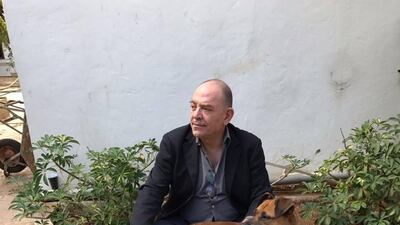
Lokman Slim with his dog. "He was a generous person and loved people. He even loved trees and the garden and animals generally," recalled Ahmad Jaber. Lokman Slim / Facebook -

Lokman Slim was a Shiite Muslim secular intellectual known for his opposition to the Shiite movement Hezbollah. AFP -
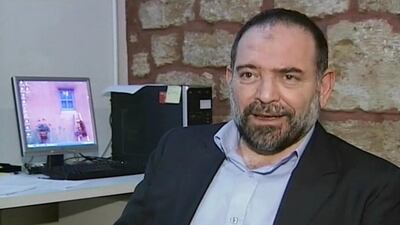
Slim, who is remembered by friends as multi-talented, was also a publisher who ran a research centre focused on Lebanese culture and history. Reuters -
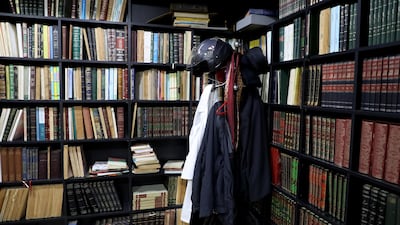
Lokman Slim's office. "Lokman is a researcher. Lokman is a writer. Lokman is an artist. Lokman was a man of political opinions. Lokman was an outstanding personality," said Ali El Amine. Reuters -
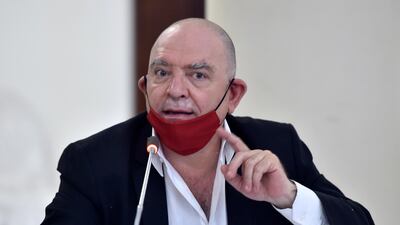
Slim speaks during a conference in Beirut, Lebanon, 04 February 2021. EPA photo


Slim, 58, co-founded publishing house Dar Al Jadeed with Al Ameer in 1990.
In recent years, he was increasingly involved in his work with research centre Umam.
He produced two documentaries about Lebanon and Syria with his German wife Monika Borgmann.
A man of many talents
Ali El Amine, 53, a journalist and longtime friend, said the death was ultimately a loss for Lebanese society at large. His prolific research on the country's history and culture was invaluable, El Amine said.
"What characterised Lokman Slim was his strong character and positions. The depth of his culture. The cleverness of his words. Lokman was a researcher. Lokman was a writer. Lokman was an artist. Lokman was a man of political opinions. Lokman was an outstanding personality," he said.
Intimidation
Asked why any militia might kill a public figure with a profile as high as Slim's, El Amine said he was unsure. But the killing was intended to send a strong political message, most likely directed at Washington, he said.
"There are two contradictory reasons," he said.
"Maybe Hezbollah feels that it has been pushed into a corner by Israel and the international community and wants to send a message," he said.
"Or it feels comfortable now and this decision to assassinate him was taken before, but implemented now. Maybe it was taken during Trump’s mandate, but they went ahead with it under Biden, because his administration is less concerned by them [Hezbollah]. Maybe."
Some said it was too early to say who may have been responsible for the killing. They described the south of Lebanon as suffering from a lack of rule of law.
MP Yassine Jaber, a member of Amal, a party allied with Hezbollah, said it was too early to jump to conclusions.
“We have to wait and see if he was targeted on purpose or whether it was thieves,” he said.
El Amine was more certain.
"I believe that all signs show ... the crime has Hezbollah's signature: the place of the crime, the person who was targeted."
Al Ameer agreed.
"The two totalitarian Shiite parties, and the government – all these people are working together to kill anybody who is different," she said, referring to Amal and Hezbollah.
"I know who his enemies were. They were all those people who didn't want a bright Lebanon."
For El Amine, Slim's assassination will cause fear among all Lebanese activists.
"It will have deep repercussions. Maybe they [Hezbollah] think it’ll help in making people stay quiet, so that they do not protest or object."
As to whether anti-Hezbollah voices and the protest movement in general could be silenced by the killing, El Amine was defiant.
"Of course it’s scary but what’s the choice? We have no other choice but to express ourselves. We are working to defend ourselves and our rights. We are not attacking anyone. That’s our fight."
The murder may change the nature of the struggle against Hezbollah, El Amine said.
"There has never been a targeted Shiite assassination in the past 15 years, only Christian and Sunni figures. He’s the first Shiite."
In this regard, El Amine said Slim's daringly outspoken views had now raised his status as a patriot and a man who died for his beliefs.
"He had a deep Lebanese personality. He was Shiite in life but also deeply Lebanese."
El Amine was physically assaulted by unknown assailants in south Lebanon when he ran as an independent for parliamentary elections in 2018.
He noted that Slim's research touched on controversial and sometimes taboo periods in modern Lebanese history, including the legacy of the civil war and contemporary issues such as the rights of those detained by security forces.
"Recently he was leaning towards working with civil society and organisations and he had dozens of ongoing projects in relation with the war, detainees ... topics nobody else in Lebanon was working on in such detail," he said.
Al Ameer told The National that the family would respect his wish to be incinerated and scatter his ashes in places he loved.

