The Middle East has been held up as the key to the next generation of breakthroughs in palaeontology, as fossil hunters mark 200 years since dinosaurs were first officially catalogued.
From carnivorous dinosaurs in Egypt and three-toed footprints in Jordan to the wealth of fossils and amber preserved in Lebanon's quarries, the Middle East is becoming a happy hunting ground for palaeontologists.
With more than 2,000 species of dinosaurs identified since 1824, the knowledge of experts has vastly developed since English naturalist and theologian William Buckland officially announced classification of a newly discovered ancient reptile on February 20 that year.
University of Edinburgh palaeontologist Professor Steve Brusatte, who was an adviser on the film Jurassic Park, said there is still much more to discover.
"His [Buckland's] announcement opened the floodgates and started a fossil rush, and people went out looking for other giant bones in England and beyond," he told The National.
Dr Benjamin Kear, the curator of vertebrate palaeontology and researcher in palaeontology at the Museum of Evolution at Uppsala University in Sweden, was part of the team that discovered the first evidence of dinosaurs in Saudi Arabia in 2014.
Now working on a project in Lebanon, he has heralded the Middle East as the key to unlocking more hidden secrets about dinosaurs, describing it as a “goldmine” which has the potential to create a “real-life Jurassic Park”.
“Dinosaurs went everywhere. The fossils will be there but the problem has been that people have not been able to look. My colleague and I have worked all across the Middle East just trying to find traces of this long-lost world,” he told The National.
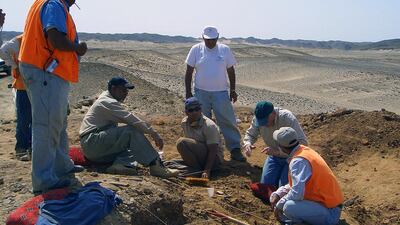
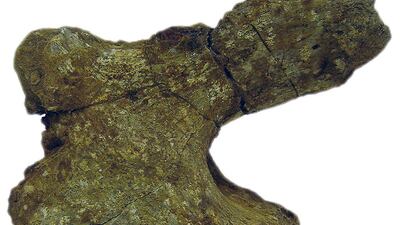
Dr Kear and his team found teeth and bones dating from around 72 million years ago in the north-western part of Saudi Arabia, along the coast of the Red Sea.
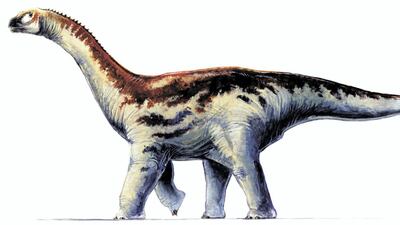
They belonged to two types of dinosaurs, a bipedal meat-eating abelisaurid distantly related to a Tyrannosaurus but smaller, and a plant-eating titanosaur which could have been up to 20 metres in length.
“It is a gold mine of future exploration. Dinosaur fossils are everywhere across the Middle East.
“The ideal place to look is the Middle East, it is one of the undiscovered areas. The possibilities are endless," said Dr Kear.
“My recent work is in Lebanon. People sell fossils, and we have been working directly with fossil hunters as they are sitting on huge collections of spectacular stuff and we are helping them see the value of turning it into geotourism.
“With the limestone layers in Lebanon, we can get a snapshot of what was going on in the Middle East 90 million years ago. It is a real-world Jurassic Park. We are looking for the protein residue that has been preserved in the amber so we can push the boundaries.
"The Middle East is at the cutting edge of what will be the real Jurassic Park.
“It is a long way off but the science is developing at an accelerating rate. The things coming up will be very exciting. Who knows where we will be in another 200 years.”
Dinosaur research has come a long way in two centuries.
Dr Kear's work is building on the discovery made by Buckland, who in 1824 addressed the Geological Society of London, describing an enormous jaw and limb bones which had been unearthed in a slate quarry in the village of Stonesfield, near Oxford.
He recognised that the fossils belonged to a huge bygone reptile, and gave it a formal scientific name Megalosaurus, meaning "great lizard".
With that, the first dinosaur was officially recognised, though the word "dinosaur" would not be coined until the 1840s.
In the intervening 200 years, dinosaur science has flourished, providing insight into what these creatures looked like, how they lived, how they evolved and what doomed them.
Dinosaurs walked the planet from between 231 million and 66 million years ago, during the Mesozoic Era. Their bird descendants are with us today.
When Buckland first discovered Megalosaurus he thought it was a 20-metre long lizard that walked on four legs and could live on land or in the water.
Scientists now know it was not quadrupedal and not a lizard, but belonged to the theropod group comprising meat-eating dinosaurs such as Tyrannosaurus and Spinosaurus, and was about nine metres long.
At the time, Buckland did not know how long ago dinosaurs had lived, as he believed Earth to be only a few thousand years old. Scientists now know Earth is about 4.5 billion years old.
Megalosaurus lived about 165 million years ago.
English naturalist Richard Owen recognised that Megalosaurus' fossils and two other large land-dwelling reptiles, Iguanodon and Hylaeosaurus, formed a common group, calling them Dinosauria in 1841.
The subsequent discovery of Hadrosaurus and Dryptosaurus fossils in New Jersey showed that at least some dinosaurs were bipedal, changing the perception that they resembled reptilian rhinoceroses. Around the 1870s, the first complete large dinosaur skeletons were discovered in the US and Belgium, which showed experts their distinctive anatomy and diversity.
Palaeontology is like a 1,000-piece jigsaw but you only have 10 pieces and no picture on the box
Emma Nicholls,
Oxford University Museum of Natural History
In the 1960s, the identification of the smallish meat-eating dinosaur Deinonychus shook up dinosaur science, helping inaugurate a research period called the Dinosaur Renaissance.
It showed that dinosaurs could be small and agile. Some were remarkably similar anatomically to early birds like Archaeopteryx, confirming that birds evolved from small, feathered dinosaurs. It also prompted a debate over whether dinosaurs were warm-blooded like birds, contradicting the long-standing conception of them as slow, lumbering and cold-blooded.
Paleontologists put cranial fossils into computed tomography scanners to build digital models of them, gaining better knowledge of their senses, such as sight, hearing and smell.
Researchers can also now tell the colour of dinosaurs.
The dinosaur puzzle
Paleontologist Emma Nicholls works at the Oxford University Museum of Natural History, home to the Megalosaurus fossils Buckland studied.
"Our understanding of dinosaurs has changed significantly since the 19th century," she told The National.
"Buckland and other gentlemen naturalists of the early 19th century would be stunned at how much we now know about dinosaurs.
“Although we understand so much more about dinosaurs than ever before there are still lots of unanswered questions. Like how they eat, move, how they are related to each other.
"It was all happening on a world map that was changing and moving. Dinosaurs roamed the earth and then when the land fragmented there were large barriers between them. We know they were all over the world.
“Palaeontology is like a 1,000-piece jigsaw but you only have 10 pieces and no picture on the box. The technology we have now would have blown Buckland’s mind, CT scans mean we can study everything about them. We now even know what colour some are.”
She said it has sometimes been difficult to locate the right rocks for fossils and access them.
“Many of the rocks are the wrong age for us to find dinosaur fossils and others are inaccessible, such as when they are under the Amazon rainforest or have been built upon, and another issue is political instability,” she said.
“There are lots of reasons why parts of the world have gaps. Jurassic rocks run up the centre of the Arabian peninsula from Saudi Arabia, Jordan, Iraq and Syria, the rocks are the right age but there are not many. Egypt has stood out with major finds in recent years.
“The Middle East has huge potential for a lot of exciting dinosaur finds. We just need to get the research groups together to do it.”
In Oman in 2015, a team announced they had found two incomplete Hadrosaur skeletons and fossils.
In 2019, two Polish doctors stumbled across three-toed footprints while hiking between Shobak and the ancient city of Petra in the south of Jordan.
The first dinosaur footprint in the region was discovered in 1962 in Jerusalem, and in 2008 dinosaur tracks from the Upper Jurassic period were found in Yemen. They belonged to ornithopods, which were bipedal herbivores, and sauropods, a group that includes the titanosaurs.
More recently, dinosaur footprints were spotted in Lebanon and Egypt, and last year a new kind of large-bodied meat-eating dinosaur was found at a fossil site in the Sahara by a team from Egypt’s Mansoura University Vertebrate Paleontology Centre, which is the first centre of its kind in the Middle East.
Prof Brusatte said there are many unanswered questions.
“There is still a large amount we do not know about dinosaurs because dinosaurs were here over 150 million years ago and there were probably millions of different species once living on earth, and we have only found a handful,” he said.
“There is still a long way to go to solve this mystery of the dinosaurs and it is always evolving, of how they became so successful, so large and roamed so many parts of the world.
"There is definitely a lot we still need to do and explore, especially in the Middle East. There are more people discussing it and finding things than ever before and it is quite exciting.
“There are not many museums and universities where students can study palaeontology in the Middle East, but other places like China, Argentina, Brazil and South America that were in a similar position are now at the front line and are making leading discoveries," said Prof Brusatte.
"More students in the Middle East being offered the chance to study is the key. A number of places have discovered dinosaur fossils – Iran, Lebanon – and we need more people living there searching for them. I think there is great potential in the Middle East.
“There is a large expanse of land and great diversity of different rocks. The finds in Iran, Oman and Lebanon have opened up the possibility that there could be more dinosaur fossils hidden and I cannot wait to see these next discoveries.”
He believes AI will play a role in taking bigger steps in future.
“It is hard to predict what the next discovery will be but we are using a lot of new technology to study fossils and using a lot of AI technology. It is all the rage everywhere and the potential in palaeontology, good or bad, is vast,” he said.
“When people are celebrating the 300th anniversary it will be a field where large advances have been made in our ability to use computing power to understand the bigger picture of the dinosaur revolution.”
Dr Kear believes that what has been discovered in the last 200 years is just the tip of the iceberg.
“We are standing on the shoulders of giants and we would not be here without Buckland’s discovery 200 years ago,” Dr Kear said.
“The biggest problem is instability in countries and getting access to the regions. But I guarantee there are going to be very exciting times ahead.”

COMPANY PROFILE
Company name: SimpliFi
Started: August 2021
Founder: Ali Sattar
Based: UAE
Industry: Finance, technology
Investors: 4DX, Rally Cap, Raed, Global Founders, Sukna and individuals
Tamkeen's offering
- Option 1: 70% in year 1, 50% in year 2, 30% in year 3
- Option 2: 50% across three years
- Option 3: 30% across five years
Timeline
2012-2015
The company offers payments/bribes to win key contracts in the Middle East
May 2017
The UK SFO officially opens investigation into Petrofac’s use of agents, corruption, and potential bribery to secure contracts
September 2021
Petrofac pleads guilty to seven counts of failing to prevent bribery under the UK Bribery Act
October 2021
Court fines Petrofac £77 million for bribery. Former executive receives a two-year suspended sentence
December 2024
Petrofac enters into comprehensive restructuring to strengthen the financial position of the group
May 2025
The High Court of England and Wales approves the company’s restructuring plan
July 2025
The Court of Appeal issues a judgment challenging parts of the restructuring plan
August 2025
Petrofac issues a business update to execute the restructuring and confirms it will appeal the Court of Appeal decision
October 2025
Petrofac loses a major TenneT offshore wind contract worth €13 billion. Holding company files for administration in the UK. Petrofac delisted from the London Stock Exchange
November 2025
180 Petrofac employees laid off in the UAE
In numbers: China in Dubai
The number of Chinese people living in Dubai: An estimated 200,000
Number of Chinese people in International City: Almost 50,000
Daily visitors to Dragon Mart in 2018/19: 120,000
Daily visitors to Dragon Mart in 2010: 20,000
Percentage increase in visitors in eight years: 500 per cent
Key facilities
- Olympic-size swimming pool with a split bulkhead for multi-use configurations, including water polo and 50m/25m training lanes
- Premier League-standard football pitch
- 400m Olympic running track
- NBA-spec basketball court with auditorium
- 600-seat auditorium
- Spaces for historical and cultural exploration
- An elevated football field that doubles as a helipad
- Specialist robotics and science laboratories
- AR and VR-enabled learning centres
- Disruption Lab and Research Centre for developing entrepreneurial skills
Ten tax points to be aware of in 2026
1. Domestic VAT refund amendments: request your refund within five years
If a business does not apply for the refund on time, they lose their credit.
2. E-invoicing in the UAE
Businesses should continue preparing for the implementation of e-invoicing in the UAE, with 2026 a preparation and transition period ahead of phased mandatory adoption.
3. More tax audits
Tax authorities are increasingly using data already available across multiple filings to identify audit risks.
4. More beneficial VAT and excise tax penalty regime
Tax disputes are expected to become more frequent and more structured, with clearer administrative objection and appeal processes. The UAE has adopted a new penalty regime for VAT and excise disputes, which now mirrors the penalty regime for corporate tax.
5. Greater emphasis on statutory audit
There is a greater need for the accuracy of financial statements. The International Financial Reporting Standards standards need to be strictly adhered to and, as a result, the quality of the audits will need to increase.
6. Further transfer pricing enforcement
Transfer pricing enforcement, which refers to the practice of establishing prices for internal transactions between related entities, is expected to broaden in scope. The UAE will shortly open the possibility to negotiate advance pricing agreements, or essentially rulings for transfer pricing purposes.
7. Limited time periods for audits
Recent amendments also introduce a default five-year limitation period for tax audits and assessments, subject to specific statutory exceptions. While the standard audit and assessment period is five years, this may be extended to up to 15 years in cases involving fraud or tax evasion.
8. Pillar 2 implementation
Many multinational groups will begin to feel the practical effect of the Domestic Minimum Top-Up Tax (DMTT), the UAE's implementation of the OECD’s global minimum tax under Pillar 2. While the rules apply for financial years starting on or after January 1, 2025, it is 2026 that marks the transition to an operational phase.
9. Reduced compliance obligations for imported goods and services
Businesses that apply the reverse-charge mechanism for VAT purposes in the UAE may benefit from reduced compliance obligations.
10. Substance and CbC reporting focus
Tax authorities are expected to continue strengthening the enforcement of economic substance and Country-by-Country (CbC) reporting frameworks. In the UAE, these regimes are increasingly being used as risk-assessment tools, providing tax authorities with a comprehensive view of multinational groups’ global footprints and enabling them to assess whether profits are aligned with real economic activity.
Contributed by Thomas Vanhee and Hend Rashwan, Aurifer
Mohammed bin Zayed Majlis
TOUCH RULES
Touch is derived from rugby league. Teams consist of up to 14 players with a maximum of six on the field at any time.
Teams can make as many substitutions as they want during the 40 minute matches.
Similar to rugby league, the attacking team has six attempts - or touches - before possession changes over.
A touch is any contact between the player with the ball and a defender, and must be with minimum force.
After a touch the player performs a “roll-ball” - similar to the play-the-ball in league - stepping over or rolling the ball between the feet.
At the roll-ball, the defenders have to retreat a minimum of five metres.
A touchdown is scored when an attacking player places the ball on or over the score-line.
Why your domicile status is important
Your UK residence status is assessed using the statutory residence test. While your residence status – ie where you live - is assessed every year, your domicile status is assessed over your lifetime.
Your domicile of origin generally comes from your parents and if your parents were not married, then it is decided by your father. Your domicile is generally the country your father considered his permanent home when you were born.
UK residents who have their permanent home ("domicile") outside the UK may not have to pay UK tax on foreign income. For example, they do not pay tax on foreign income or gains if they are less than £2,000 in the tax year and do not transfer that gain to a UK bank account.
A UK-domiciled person, however, is liable for UK tax on their worldwide income and gains when they are resident in the UK.
Benefits of first-time home buyers' scheme
- Priority access to new homes from participating developers
- Discounts on sales price of off-plan units
- Flexible payment plans from developers
- Mortgages with better interest rates, faster approval times and reduced fees
- DLD registration fee can be paid through banks or credit cards at zero interest rates
Who has lived at The Bishops Avenue?
- George Sainsbury of the supermarket dynasty, sugar magnate William Park Lyle and actress Dame Gracie Fields were residents in the 1930s when the street was only known as ‘Millionaires’ Row’.
- Then came the international super rich, including the last king of Greece, Constantine II, the Sultan of Brunei and Indian steel magnate Lakshmi Mittal who was at one point ranked the third richest person in the world.
- Turkish tycoon Halis Torprak sold his mansion for £50m in 2008 after spending just two days there. The House of Saud sold 10 properties on the road in 2013 for almost £80m.
- Other residents have included Iraqi businessman Nemir Kirdar, singer Ariana Grande, holiday camp impresario Sir Billy Butlin, businessman Asil Nadir, Paul McCartney’s former wife Heather Mills.
Hunting park to luxury living
- Land was originally the Bishop of London's hunting park, hence the name
- The road was laid out in the mid 19th Century, meandering through woodland and farmland
- Its earliest houses at the turn of the 20th Century were substantial detached properties with extensive grounds
Specs
Engine: Duel electric motors
Power: 659hp
Torque: 1075Nm
On sale: Available for pre-order now
Price: On request
The Saudi Cup race card
1 The Jockey Club Local Handicap (TB) 1,800m (Dirt) $500,000
2 The Riyadh Dirt Sprint (TB) 1,200m (D) $1.500,000
3 The 1351 Turf Sprint 1,351m (Turf) $1,000,000
4 The Saudi Derby (TB) 1600m (D) $800,000
5 The Neom Turf Cup (TB) 2,100m (T) $1,000,000
6 The Obaiya Arabian Classic (PB) 2,000m (D) $1,900,000
7 The Red Sea Turf Handicap (TB) 3,000m (T) $2,500,000
8 The Saudi Cup (TB) 1,800m (D) $20,000,000
World record transfers
1. Kylian Mbappe - to Real Madrid in 2017/18 - €180 million (Dh770.4m - if a deal goes through)
2. Paul Pogba - to Manchester United in 2016/17 - €105m
3. Gareth Bale - to Real Madrid in 2013/14 - €101m
4. Cristiano Ronaldo - to Real Madrid in 2009/10 - €94m
5. Gonzalo Higuain - to Juventus in 2016/17 - €90m
6. Neymar - to Barcelona in 2013/14 - €88.2m
7. Romelu Lukaku - to Manchester United in 2017/18 - €84.7m
8. Luis Suarez - to Barcelona in 2014/15 - €81.72m
9. Angel di Maria - to Manchester United in 2014/15 - €75m
10. James Rodriguez - to Real Madrid in 2014/15 - €75m
Defence review at a glance
• Increase defence spending to 2.5% of GDP by 2027 but given “turbulent times it may be necessary to go faster”
• Prioritise a shift towards working with AI and autonomous systems
• Invest in the resilience of military space systems.
• Number of active reserves should be increased by 20%
• More F-35 fighter jets required in the next decade
• New “hybrid Navy” with AUKUS submarines and autonomous vessels
UAE’s revised Cricket World Cup League Two schedule
August, 2021: Host - United States; Teams - UAE, United States and Scotland
Between September and November, 2021 (dates TBC): Host - Namibia; Teams - Namibia, Oman, UAE
December, 2021: Host - UAE; Teams - UAE, Namibia, Oman
February, 2022: Hosts - Nepal; Teams - UAE, Nepal, PNG
June, 2022: Hosts - Scotland; Teams - UAE, United States, Scotland
September, 2022: Hosts - PNG; Teams - UAE, PNG, Nepal
February, 2023: Hosts - UAE; Teams - UAE, PNG, Nepal
Test
Director: S Sashikanth
Cast: Nayanthara, Siddharth, Meera Jasmine, R Madhavan
Star rating: 2/5
UAE%20Warriors%2045%20Results
%3Cp%3E%3Cstrong%3E%0DMain%20Event%0D%3A%20Lightweight%20Title%3C%2Fstrong%3E%0D%3Cbr%3EAmru%20Magomedov%20def%20Jakhongir%20Jumaev%20-%20Round%201%20(submission)%0D%3Cbr%3E%3Cstrong%3ECo-Main%20Event%0D%3A%20Bantamweight%3C%2Fstrong%3E%0D%3Cbr%3ERany%20Saadeh%20def%20Genil%20Franciso%20-%20Round%202%20(submission)%0D%3Cbr%3E%3Cstrong%3ECatchweight%20150%20lbs%3C%2Fstrong%3E%0D%3Cbr%3EWalter%20Cogliandro%20def%20Ali%20Al%20Qaisi%20-%20Round%201%20(TKO)%0D%3Cbr%3E%3Cstrong%3EBantamweight%3C%2Fstrong%3E%0D%3Cbr%3ERenat%20Khavalov%20def%20Hikaru%20Yoshino%20-%20Round%202%20(TKO)%0D%3Cbr%3E%3Cstrong%3EFlyweight%3C%2Fstrong%3E%0D%3Cbr%3EVictor%20Nunes%20def%20Nawras%20Abzakh%20-%20Round%201%20(TKO)%0D%3Cbr%3E%3Cstrong%3EFlyweight%3C%2Fstrong%3E%0D%3Cbr%3EYamato%20Fujita%20def%20Sanzhar%20Adilov%20-%20Round%201%20(submission)%0D%3Cbr%3E%3Cstrong%3ELightweight%3C%2Fstrong%3E%0D%3Cbr%3EAbdullo%20Khodzhaev%20def%20Petru%20Buzdugen%20-%20Round%201%20(TKO)%0D%3Cbr%3E%3Cstrong%3ECatchweight%20139%20lbs%3C%2Fstrong%3E%0D%3Cbr%3ERazhabali%20Shaydullaev%20def%20Magomed%20Al-Abdullah%20-%20Round%202%20(submission)%0D%3Cbr%3E%3Cstrong%3EFlyweight%3C%2Fstrong%3E%0D%3Cbr%3ECong%20Wang%20def%20Amena%20Hadaya%20-%20Points%20(unanimous%20decision)%0D%3Cbr%3E%3Cstrong%3EMiddleweight%3C%2Fstrong%3E%0D%3Cbr%3EKhabib%20Nabiev%20def%20Adis%20Taalaybek%20Uulu%20-%20Round%202%20(submission)%0D%3Cbr%3E%3Cstrong%3ELight%20Heavyweight%3C%2Fstrong%3E%0D%3Cbr%3EBartosz%20Szewczyk%20def%20Artem%20Zemlyakov%20-%20Round%202%20(TKO)%3C%2Fp%3E%0A
The%20specs
%3Cp%3E%3Cstrong%3EEngine%3A%3C%2Fstrong%3E%206.5-litre%20V12%20and%20three%20electric%20motors%0D%3Cbr%3E%3Cstrong%3EPower%3A%20%3C%2Fstrong%3E1%2C015hp%0D%3Cbr%3E%3Cstrong%3ETorque%3A%20%3C%2Fstrong%3E1%2C500Nm%20(estimate)%0D%3Cbr%3E%3Cstrong%3ETransmission%3A%3C%2Fstrong%3E%20Eight-speed%20dual-clutch%20auto%0D%3Cbr%3E%3Cstrong%3EOn%20sale%3A%3C%2Fstrong%3E%20Early%202024%0D%3Cbr%3E%3Cstrong%3EPrice%3A%20%3C%2Fstrong%3EFrom%20Dh2%20million%20(estimate)%3C%2Fp%3E%0A
THE SPECS
Engine: 6.75-litre twin-turbocharged V12 petrol engine
Power: 420kW
Torque: 780Nm
Transmission: 8-speed automatic
Price: From Dh1,350,000
On sale: Available for preorder now
if you go
The flights
Air Astana flies direct from Dubai to Almaty from Dh2,440 per person return, and to Astana (via Almaty) from Dh2,930 return, both including taxes.
The hotels
Rooms at the Ritz-Carlton Almaty cost from Dh1,944 per night including taxes; and in Astana the new Ritz-Carlton Astana (www.marriott) costs from Dh1,325; alternatively, the new St Regis Astana costs from Dh1,458 per night including taxes.
When to visit
March-May and September-November
Visas
Citizens of many countries, including the UAE do not need a visa to enter Kazakhstan for up to 30 days. Contact the nearest Kazakhstan embassy or consulate.
Gifts exchanged
- King Charles - replica of President Eisenhower Sword
- Queen Camilla - Tiffany & Co vintage 18-carat gold, diamond and ruby flower brooch
- Donald Trump - hand-bound leather book with Declaration of Independence
- Melania Trump - personalised Anya Hindmarch handbag
Scoreline
Al Wasl 1 (Caio Canedo 90 1')
Al Ain 2 (Ismail Ahmed 3', Marcus Berg 50')
Red cards: Ismail Ahmed (Al Ain) 77'
Drishyam 2
Directed by: Jeethu Joseph
Starring: Mohanlal, Meena, Ansiba, Murali Gopy
Rating: 4 stars
Zayed Sustainability Prize
Pharaoh's curse
British aristocrat Lord Carnarvon, who funded the expedition to find the Tutankhamun tomb, died in a Cairo hotel four months after the crypt was opened.
He had been in poor health for many years after a car crash, and a mosquito bite made worse by a shaving cut led to blood poisoning and pneumonia.
Reports at the time said Lord Carnarvon suffered from “pain as the inflammation affected the nasal passages and eyes”.
Decades later, scientists contended he had died of aspergillosis after inhaling spores of the fungus aspergillus in the tomb, which can lie dormant for months. The fact several others who entered were also found dead withiin a short time led to the myth of the curse.