
Outside remittances are fuelling more than half of Lebanon’s national income — making it the most remittance-dependent country in the world, a report has found.
The Mercy Corps' 2021 findings are in stark contrast to the previous year when Lebanon ranked as the 12th-most remittance-dependent nation globally.
The report, published on Tuesday, defines the struggling country's dependence on remittances as a coping strategy in the absence of political decisions to enact a recovery plan or bring about economic reforms.
Remittances accounted for 53.8 per cent of the nation's gross domestic product in 2021, the report stated, estimating that between 15 and 30 per cent of families rely on them as a source of income.
-

November 1, 2019: Banks implement capital controls after shutting for two weeks. Reuters -
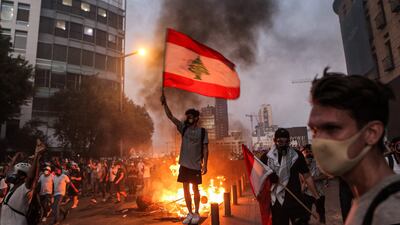
March 2020: Lebanon defaults on its sovereign debt for the first time in its history, amid protests in the country. AFP -
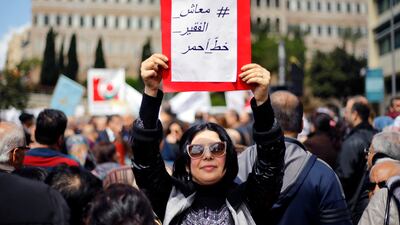
April 2020: The government of Hassan Diab, prime minister at the time, pictured with President Michel Aoun, approves a financial recovery plan. Reuters -
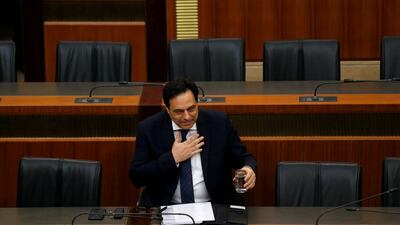
May 1, 2020: Mr Diab's government requests assistance from the International Monetary Fund. The Association of Banks in Lebanon rejects the plan. Reuters -
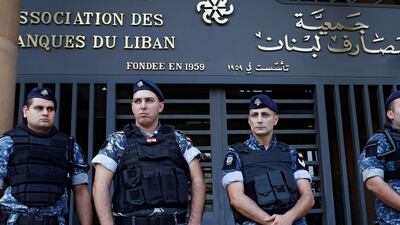
May 20, 2020: the ABL presents an alternative plan. Reuters -
July 1, 2020: a Parliamentary fact-finding committee backs the ABL. The IMF suspends negotiations with Lebanon. AP -
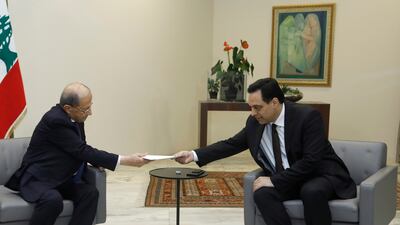
August 10, 2020: Mr Diab resigns following a devastating explosion at Beirut’s port, in which at least 232 people died and 7,000 were injured. AP -
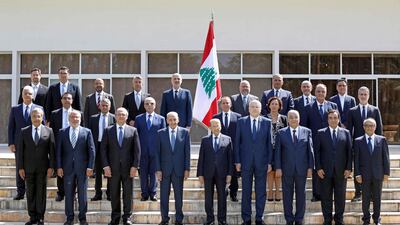
September 10, 2021: Najib Mikati, fourth from right, forms a government. AFP -
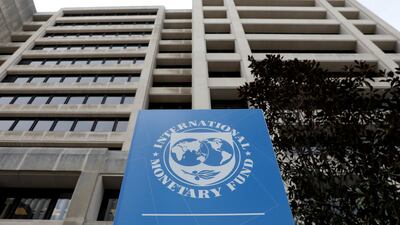
January 2022: Lebanon re-starts negotiations with the IMF. Reuters -
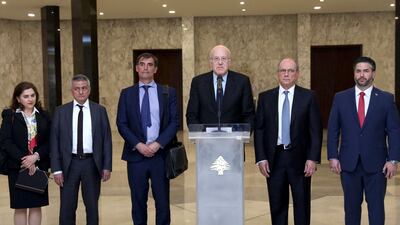
April 7, 2022: The IMF and Lebanon reach a staff-level agreement. AFP -
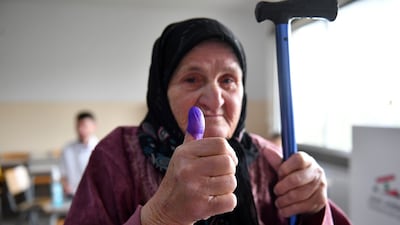
May 15, 2022: Lebanon holds parliamentary elections. EPA -
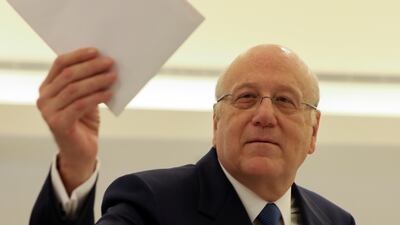
May 20, 2022: Mr Mikati’s government approves a new financial recovery plan. Reuters -
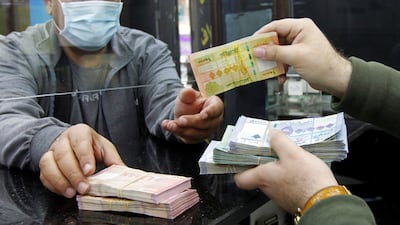
May 24, 2022: The ABL rejects the plan. The local currency hits the record low of 34,000 Lebanese pounds to the dollar – 95 per cent lower than the official rate. Reuters
Of those households, 32 per cent reported that without remittances, they could not cover expenses. Forty-one per cent told the Mercy Corps, a humanitarian NGO, that they could not cover most basic needs without financial help from abroad.
Households receive remittances from relatives abroad through methods including money sent intermittently through transfer services and also by individuals travelling back to Lebanon from abroad.
The report said a large proportion of these remittances — up to 70 per cent according to some experts — are carried in person through Beirut's airport.
Lebanon is battling an economic crisis that the World Bank describes as one of the worst in modern history, now in its fourth year. The crisis nearly eradicated Lebanon’s middle class, with about two-thirds of the population now living in poverty, according to UN estimates.
Meanwhile, people have been locked out of their savings due to informal capital controls imposed by Lebanon's commercial banks. The Lebanese pound has plunged and is worth just a fraction of what it was, losing more than 95 per cent of its value since 2019.
The currency's value against the dollar fluctuates on a near-daily basis, causing most businesses to price up in order to cover potential losses.

Inflation is at a record high. Subsidies on basic goods and services such as fuel, medicine and food have been lifted and are now priced in line with the US dollar or its parallel market equivalent.
As a result of the severe financial crisis and currency crash, the Mercy Corps report found that food prices increased by 700 per cent between 2019 and 2021 and remained on an upward trajectory into 2022.
Remittances are not keeping pace with the rising cost of living, the report said, adding that purchasing power of foreign transfers decreased rapidly amid the removal of Lebanon’s central bank subsidies in 2021.
Salaries have not kept pace with the currency’s devaluation and subsequent exponential inflation, the report found. It said by 2021, families in Lebanon were spending more than five times the minimum wage on food alone.
A previously middle-class Lebanese family told Mercy Corps in July that their food budget was “at least” five times the minimum wage, while their income had devalued so substantially that they had resorted to rationing food and fuel.
Although they keep struggling families afloat, the effect of remittances on Lebanon’s economy "has been minimal", the report concluded, and may in fact "divert spending away from productive sectors toward services and consumption".

Who's who in Yemen conflict
Houthis: Iran-backed rebels who occupy Sanaa and run unrecognised government
Yemeni government: Exiled government in Aden led by eight-member Presidential Leadership Council
Southern Transitional Council: Faction in Yemeni government that seeks autonomy for the south
Habrish 'rebels': Tribal-backed forces feuding with STC over control of oil in government territory
Uefa Nations League: How it Works
The Uefa Nations League, introduced last year, has reached its final stage, to be played over five days in northern Portugal. The format of its closing tournament is compact, spread over two semi-finals, with the first, Portugal versus Switzerland in Porto on Wednesday evening, and the second, England against the Netherlands, in Guimaraes, on Thursday.
The winners of each semi will then meet at Porto’s Dragao stadium on Sunday, with the losing semi-finalists contesting a third-place play-off in Guimaraes earlier that day.
Qualifying for the final stage was via League A of the inaugural Nations League, in which the top 12 European countries according to Uefa's co-efficient seeding system were divided into four groups, the teams playing each other twice between September and November. Portugal, who finished above Italy and Poland, successfully bid to host the finals.
Disclaimer
Director: Alfonso Cuaron
Stars: Cate Blanchett, Kevin Kline, Lesley Manville
Rating: 4/5
Tree of Hell
Starring: Raed Zeno, Hadi Awada, Dr Mohammad Abdalla
Director: Raed Zeno
Rating: 4/5
The President's Cake
Director: Hasan Hadi
Starring: Baneen Ahmad Nayyef, Waheed Thabet Khreibat, Sajad Mohamad Qasem
Rating: 4/5
Islamophobia definition
A widely accepted definition was made by the All Party Parliamentary Group on British Muslims in 2019: “Islamophobia is rooted in racism and is a type of racism that targets expressions of Muslimness or perceived Muslimness.” It further defines it as “inciting hatred or violence against Muslims”.
Our family matters legal consultant
Name: Hassan Mohsen Elhais
Position: legal consultant with Al Rowaad Advocates and Legal Consultants.
Ziina users can donate to relief efforts in Beirut
Ziina users will be able to use the app to help relief efforts in Beirut, which has been left reeling after an August blast caused an estimated $15 billion in damage and left thousands homeless. Ziina has partnered with the United Nations High Commissioner for Refugees to raise money for the Lebanese capital, co-founder Faisal Toukan says. “As of October 1, the UNHCR has the first certified badge on Ziina and is automatically part of user's top friends' list during this campaign. Users can now donate any amount to the Beirut relief with two clicks. The money raised will go towards rebuilding houses for the families that were impacted by the explosion.”
MATCH INFO
Pakistan 106-8 (20 ovs)
Iftikhar 45, Richardson 3-18
Australia 109-0 (11.5 ovs)
Warner 48 no, Finch 52 no
Australia win series 2-0
Our coronavirus coverage
Gillian Duncan: What we know so far and what comes next?
Lin Yaduo: This is the time for facts, not fear
National Editorial: China deserves the whole world's support
National Editorial: We can defeat coronavirus if we all work together
More on animal trafficking
COMPANY%20PROFILE
%20Ramez%20Gab%20Min%20El%20Akher
While you're here
Anna Zacharias: UAE's first national brand has been unveiled
Kate Hazell: Meet the creatives starting a design revolution
Hani Asfour: What is the future of the office chair?
While you're here
Sholto Byrnes on Myanmar politics
CRICKET%20WORLD%20CUP%20QUALIFIER%2C%20ZIMBABWE%20
Off-roading in the UAE: How to checklist
Killing of Qassem Suleimani
National Editorial: Suleimani has been killed, now we must de-escalate
Mina Al Oraibi: Air strike casts a long shadow over the decade ahead
Matthew Levitt: Iran retains its ability to launch terror attacks
Damien McElroy: A CEO tasked with spreading Iran's influence
Hussein Ibish: Trump's order on solid constitutional ground
Simon Waldman: Cautious Israel keeping a low profile
While you're here
Aya Iskandarani: Why Hezbollah’s man in Iraq is now worth $10 million to the US
Khaled Yacoub Oweis: Hezbollah bids to control Lebanon’s financial system
National Editorial: Hezbollah's murky dealings in Iraq have been unveiled
E-cigarettes report
Countdown to Zero exhibition will show how disease can be beaten
Countdown to Zero: Defeating Disease, an international multimedia exhibition created by the American Museum of National History in collaboration with The Carter Center, will open in Abu Dhabi a month before Reaching the Last Mile.
Opening on October 15 and running until November 15, the free exhibition opens at The Galleria mall on Al Maryah Island, and has already been seen at the Jimmy Carter Presidential Library and Museum in Atlanta, the American Museum of Natural History in New York, and the London School of Hygiene and Tropical Medicine.
Our commentary on Brexit
- Alistair Burt: Despite Brexit, Britain can remain a world power
- Sam Williams: Departure is influenced by its sense of place
Saudi National Day
More on animal trafficking
While you're here
Mina Al-Oraibi: Beirut's suffering is a direct result of a failed political system
Michael Young: From one crisis to the next, where is Lebanon headed?
Joyce Karam: US delegation to push for independent government
Where to donate in the UAE
You can donate to several registered charities through a “donation catalogue”. The use of the donation is quite specific, such as buying a fan for a poor family in Niger for Dh130.
The General Authority of Islamic Affairs & Endowments
The site has an e-donation service accepting debit card, credit card or e-Dirham, an electronic payment tool developed by the Ministry of Finance and First Abu Dhabi Bank.
You can donate online or order Smiles n’ Stuff products handcrafted by Al Noor students. The centre publishes a wish list of extras needed, starting at Dh500.
Beit Al Khair Society has the motto “From – and to – the UAE,” with donations going towards the neediest in the country. Its website has a list of physical donation sites, but people can also contribute money by SMS, bank transfer and through the hotline 800-22554.
Dar Al Ber Society, which has charity projects in 39 countries, accept cash payments, money transfers or SMS donations. Its donation hotline is 800-79.
Dubai Cares provides several options for individuals and companies to donate, including online, through banks, at retail outlets, via phone and by purchasing Dubai Cares branded merchandise. It is currently running a campaign called Bookings 2030, which allows people to help change the future of six underprivileged children and young people.
Those who travel on Emirates have undoubtedly seen the little donation envelopes in the seat pockets. But the foundation also accepts donations online and in the form of Skywards Miles. Donated miles are used to sponsor travel for doctors, surgeons, engineers and other professionals volunteering on humanitarian missions around the world.
On the Emirates Red Crescent website you can choose between 35 different purposes for your donation, such as providing food for fasters, supporting debtors and contributing to a refugee women fund. It also has a list of bank accounts for each donation type.
Gulf for Good raises funds for partner charity projects through challenges, like climbing Kilimanjaro and cycling through Thailand. This year’s projects are in partnership with Street Child Nepal, Larchfield Kids, the Foundation for African Empowerment and SOS Children's Villages. Since 2001, the organisation has raised more than $3.5 million (Dh12.8m) in support of over 50 children’s charities.
Sheikh Mohammed bin Rashid Al Maktoum launched the Noor Dubai Foundation a decade ago with the aim of eliminating all forms of preventable blindness globally. You can donate Dh50 to support mobile eye camps by texting the word “Noor” to 4565 (Etisalat) or 4849 (du).
Conflict, drought, famine
Estimates of the number of deaths caused by the famine range from 400,000 to 1 million, according to a document prepared for the UK House of Lords in 2024.
It has been claimed that the policies of the Ethiopian government, which took control after deposing Emperor Haile Selassie in a military-led revolution in 1974, contributed to the scale of the famine.
Dr Miriam Bradley, senior lecturer in humanitarian studies at the University of Manchester, has argued that, by the early 1980s, “several government policies combined to cause, rather than prevent, a famine which lasted from 1983 to 1985. Mengistu’s government imposed Stalinist-model agricultural policies involving forced collectivisation and villagisation [relocation of communities into planned villages].
The West became aware of the catastrophe through a series of BBC News reports by journalist Michael Buerk in October 1984 describing a “biblical famine” and containing graphic images of thousands of people, including children, facing starvation.
Band Aid
Bob Geldof, singer with the Irish rock group The Boomtown Rats, formed Band Aid in response to the horrific images shown in the news broadcasts.
With Midge Ure of the band Ultravox, he wrote the hit charity single Do They Know it’s Christmas in December 1984, featuring a string of high-profile musicians.
Following the single’s success, the idea to stage a rock concert evolved.
Live Aid was a series of simultaneous concerts that took place at Wembley Stadium in London, John F Kennedy Stadium in Philadelphia, the US, and at various other venues across the world.
The combined event was broadcast to an estimated worldwide audience of 1.5 billion.
Milestones on the road to union
1970
October 26: Bahrain withdraws from a proposal to create a federation of nine with the seven Trucial States and Qatar.
December: Ahmed Al Suwaidi visits New York to discuss potential UN membership.
1971
March 1: Alex Douglas Hume, Conservative foreign secretary confirms that Britain will leave the Gulf and “strongly supports” the creation of a Union of Arab Emirates.
July 12: Historic meeting at which Sheikh Zayed and Sheikh Rashid make a binding agreement to create what will become the UAE.
July 18: It is announced that the UAE will be formed from six emirates, with a proposed constitution signed. RAK is not yet part of the agreement.
August 6: The fifth anniversary of Sheikh Zayed becoming Ruler of Abu Dhabi, with official celebrations deferred until later in the year.
August 15: Bahrain becomes independent.
September 3: Qatar becomes independent.
November 23-25: Meeting with Sheikh Zayed and Sheikh Rashid and senior British officials to fix December 2 as date of creation of the UAE.
November 29: At 5.30pm Iranian forces seize the Greater and Lesser Tunbs by force.
November 30: Despite a power sharing agreement, Tehran takes full control of Abu Musa.
November 31: UK officials visit all six participating Emirates to formally end the Trucial States treaties
December 2: 11am, Dubai. New Supreme Council formally elects Sheikh Zayed as President. Treaty of Friendship signed with the UK. 11.30am. Flag raising ceremony at Union House and Al Manhal Palace in Abu Dhabi witnessed by Sheikh Khalifa, then Crown Prince of Abu Dhabi.
December 6: Arab League formally admits the UAE. The first British Ambassador presents his credentials to Sheikh Zayed.
December 9: UAE joins the United Nations.
War and the virus
Simon Rushton: War vet raises £12m for health workers
More coverage from the Future Forum
• Remittance charges will be tackled by blockchain
• UAE's monumental and risky Mars Mission to inspire future generations, says minister
• Could the UAE drive India's economy?
• News has a bright future and the UAE is at the heart of it
• Architecture is over - here's cybertecture
• The National announces Future of News journalism competition
• Round up: Experts share their visions of the world to come
Infiniti QX80 specs
Engine: twin-turbocharged 3.5-liter V6
Power: 450hp
Torque: 700Nm
Price: From Dh450,000, Autograph model from Dh510,000
Available: Now
COMPANY%20PROFILE
Abu Dhabi racecard
5pm: Maiden (Purebred Arabians); Dh80,000; 1,400m.
5.30pm: Maiden (PA); Dh80,00; 1,400m.
6pm: Sheikh Zayed bin Sultan Al Nahyan National Day Cup (PA); Group 3; Dh500,000; 1,600m.
6.30pm: Sheikh Zayed bin Sultan Al Nahyan National Day Cup (Thoroughbred); Listed; Dh380,000; 1,600m
7pm: Wathba Stallions Cup for Private Owners Handicap (PA); Dh70,000; 1,400m.
7.30pm: Handicap (PA); Dh80,000; 1,600m
The specs
AT4 Ultimate, as tested
Engine: 6.2-litre V8
Power: 420hp
Torque: 623Nm
Transmission: 10-speed automatic
Price: From Dh330,800 (Elevation: Dh236,400; AT4: Dh286,800; Denali: Dh345,800)
On sale: Now
You might also like
Lexus LX700h specs
Engine: 3.4-litre twin-turbo V6 plus supplementary electric motor
Power: 464hp at 5,200rpm
Torque: 790Nm from 2,000-3,600rpm
Transmission: 10-speed auto
Fuel consumption: 11.7L/100km
On sale: Now
Price: From Dh590,000
Who was Alfred Nobel?
The Nobel Prize was created by wealthy Swedish chemist and entrepreneur Alfred Nobel.
- In his will he dictated that the bulk of his estate should be used to fund "prizes to those who, during the preceding year, have conferred the greatest benefit to humankind".
- Nobel is best known as the inventor of dynamite, but also wrote poetry and drama and could speak Russian, French, English and German by the age of 17. The five original prize categories reflect the interests closest to his heart.
- Nobel died in 1896 but it took until 1901, following a legal battle over his will, before the first prizes were awarded.
Small%20Things%20Like%20These
Key figures in the life of the fort
Sheikh Dhiyab bin Isa (ruled 1761-1793) Built Qasr Al Hosn as a watchtower to guard over the only freshwater well on Abu Dhabi island.
Sheikh Shakhbut bin Dhiyab (ruled 1793-1816) Expanded the tower into a small fort and transferred his ruling place of residence from Liwa Oasis to the fort on the island.
Sheikh Tahnoon bin Shakhbut (ruled 1818-1833) Expanded Qasr Al Hosn further as Abu Dhabi grew from a small village of palm huts to a town of more than 5,000 inhabitants.
Sheikh Khalifa bin Shakhbut (ruled 1833-1845) Repaired and fortified the fort.
Sheikh Saeed bin Tahnoon (ruled 1845-1855) Turned Qasr Al Hosn into a strong two-storied structure.
Sheikh Zayed bin Khalifa (ruled 1855-1909) Expanded Qasr Al Hosn further to reflect the emirate's increasing prominence.
Sheikh Shakhbut bin Sultan (ruled 1928-1966) Renovated and enlarged Qasr Al Hosn, adding a decorative arch and two new villas.
Sheikh Zayed bin Sultan (ruled 1966-2004) Moved the royal residence to Al Manhal palace and kept his diwan at Qasr Al Hosn.
Sources: Jayanti Maitra, www.adach.ae
David Haye record
Total fights: 32
Wins: 28
Wins by KO: 26
Losses: 4


