Lebanon's Gebran Bassil calls for consensus president as governance vacuum looms


Jamie Prentis
  • English
  • Arabic

Gebran Bassil, the influential leader of Lebanon's Free Patriotic Movement, has said he will not stand in the way of a consensus future president but urged rival factions to agree on a candidate to prevent a prolonged government vacuum in a country grappling with a severe economic crisis.

The term of incumbent Michel Aoun will end next Monday and many sessions in the 128-seat Lebanese Parliament have failed to elect a successor.

The government is supposed to take on presidential powers in the event of a vacuum but the administration of Prime Minister Najib Mikati has remained in caretaker status for months amid squabbling over the Cabinet’s make up.

Critics of Mr Bassil argue that he and his allies are behind the failure to elect a successor to Mr Aoun because they have cast blank ballots in parliamentary votes. But Mr Bassil said his opponents are failing to propose realistic candidates who can bridge the divide in Lebanon's deeply divided political class.

Mr Bassil, the son-in-law of Mr Aoun, said a government vacuum would have “disastrous consequences on our economy, prosperity and, unfortunately, on security”.

Two thirds of the vote is needed for a presidential candidate to secure a win in the first round of voting. An absolute majority is required in subsequent rounds.

Four sessions have failed to make headway, with Michel Moawad the only person to receive any significant support. But his support — 39 votes in the last session — have consistently been outnumbered by blank ballots, including from the FPM.

Mr Moawad has received support from the Lebanese Forces, the Kataeb, the Druze Progressive Socialist Party and a handful of independents. But many believe he is too divisive to beat the vote and quorum threshold, in part because he is a staunch critic of Iran-backed Hezbollah, the powerful armed group and political party with which the FPM is allied.

“Yes, it is not productive to cast a white paper but it's also unproductive to put forward a name where you know that he has zero chance to succeed,” said Mr Bassil.

“It’s the same. It's filling the blank with some ink without being serious about it. What would be serious — and we are working on making it happen — is to reach an agreement, each party. It is counterproductive from one side to say we want to impose a president by challenging others.”

He said he had called for dialogue between Lebanon’s factions in a bid to find a president.

'A vacancy can last'

Electing a president in Lebanon is often a drawn-out affair. In 2016, it took 46 sessions and 29 months to elect Mr Aoun, whose ascendancy came after a series of backdoor deals between key players. In the country's confessional system, the presidency is always held by a Maronite Christian, the speaker a Shiite Muslim and the prime minister a Sunni Muslim.

“A vacancy can last, and this is very dangerous for the country,” Mr Bassil said. “Why wait for the vacancy, then to have a dialogue and then [for] everybody to have [to] present more concessions?”

Mr Bassil has long been seen as harbouring presidential ambitions but said he is not presenting his candidacy. He appeared to suggest that, at the moment, he knew he would not succeed and presented instead the favoured candidate of his party or his allies — whether himself or someone else — would not work.

“If I stand my ground and make the fight, maybe the time will be in my benefit. But I'm not playing this game. Because I believe that the bad situation in the country, mainly economically and socially, doesn't give us the luxury of time to wait. That's the main reason.”

Gebran Bassil, leader of the Free Patriotic Movement, at his home in Mtaileb, Lebanon. Matt Kynaston / The National

Lebanon is embroiled in a severe economic crisis, described by the World Bank as one of the worst in modern history, which has been blamed on rampant corruption and mismanagement by Lebanon’s ruling classes.

Mr Bassil, a former foreign and energy minister, was himself a frequent target during the 2019 protests against Lebanon’s rulers that brought down the government.

He was asked by The National how the average person in Lebanon might see politicians as out of touch as they bicker over the president or government portfolios while the country is gripped by a financial crisis.

“This is a country that is based in its creation on diversity and living together,” he said. “So any community that feels threatened for its existence would react. We're all minorities in this country. So every time that there's somebody that feels threatened in its political rights, its political existence and even in their material existence. So that's why this is not a minor issue.

“If the Christians feel that they are threatened, and they are leaving the country, this wouldn't keep the same Lebanon that we know. The same applies to the Muslims. If they feel threatened from inside or from outside, like they do sometimes, this is not good, this is not healthy for the country.”

A rare bright spot for Lebanon has been a historic maritime deal with Israel, which is due to be signed on Thursday. The agreement demarcates the sea borders between the two countries, which remain technically at war, and allows both to conduct gas exploration in the Mediterranean while easing a potential source of tension.

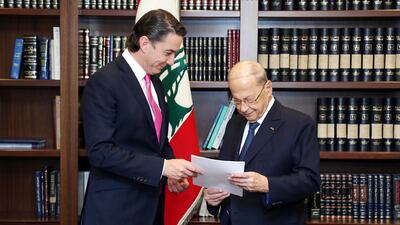
  • Lebanese President Michel Aoun, right, and US senior adviser for energy security Amos Hochstein with a letter of agreement over the maritime deal. EPA
    Lebanese President Michel Aoun, right, and US senior adviser for energy security Amos Hochstein with a letter of agreement over the maritime deal. EPA
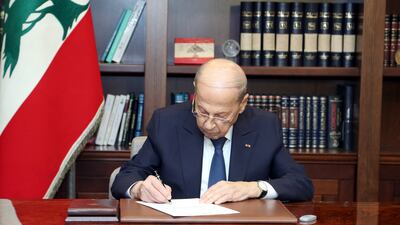
  • Mr Aoun signs the US-brokered border deal at the Presidential Palace in Beirut. EPA
    Mr Aoun signs the US-brokered border deal at the Presidential Palace in Beirut. EPA
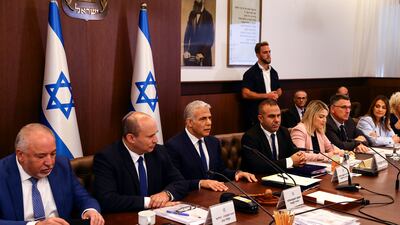
  • Israeli Prime Minister Yair Lapid, centre, at a special Cabinet meeting in Jerusalem to approve the deal. EPA
    Israeli Prime Minister Yair Lapid, centre, at a special Cabinet meeting in Jerusalem to approve the deal. EPA
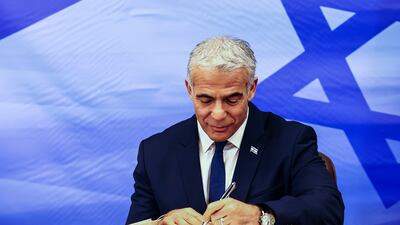
  • Mr Lapid signs the agreement, which sets a maritime border between Israel and Lebanon. EPA
    Mr Lapid signs the agreement, which sets a maritime border between Israel and Lebanon. EPA
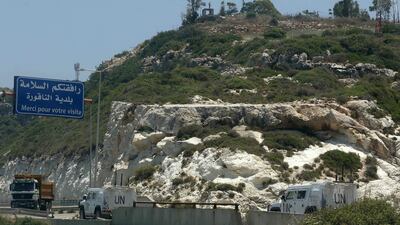
  • UN peacekeepers stand guard as Lebanese troops sit on an armored vehicle in Naqoura, near the Israeli border. Reuters
    UN peacekeepers stand guard as Lebanese troops sit on an armored vehicle in Naqoura, near the Israeli border. Reuters
  • London-based Energean's ship begins drilling at the Karish natural gas field off Israel. Reuters
    London-based Energean's ship begins drilling at the Karish natural gas field off Israel. Reuters
  • Israel gave London-listed Energean permission to begin producing gas from Karish, the offshore field at the heart of a maritime border agreement. Reuters
    Israel gave London-listed Energean permission to begin producing gas from Karish, the offshore field at the heart of a maritime border agreement. Reuters
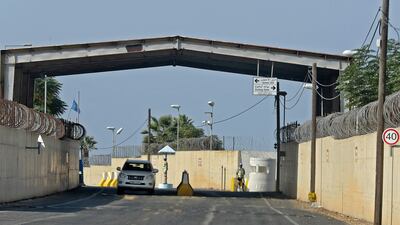
  • Members of the UN peacekeeping force stand guard at a Lebanese-Israeli border crossing in Naqura. AFP
    Members of the UN peacekeeping force stand guard at a Lebanese-Israeli border crossing in Naqura. AFP
  • UN peacekeeping vehicles patrol Naqura. AFP
    UN peacekeeping vehicles patrol Naqura. AFP
  • Lebanese bathers swim at the southernmost border area of Naqura. AFP
    Lebanese bathers swim at the southernmost border area of Naqura. AFP
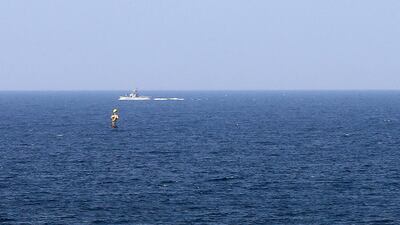
  • An Israeli military boat patrols Mediterranean waters around a border-marking buoy, off Naqura. AFP
    An Israeli military boat patrols Mediterranean waters around a border-marking buoy, off Naqura. AFP
  • Mr Lapid attends a Cabinet meeting in Jerusalem. Reuters
    Mr Lapid attends a Cabinet meeting in Jerusalem. Reuters
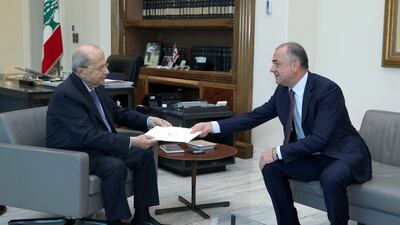
  • Mr Aoun, left, receives the final draft of the maritime border agreement with Israel. AP
    Mr Aoun, left, receives the final draft of the maritime border agreement with Israel. AP

The dispute had rumbled on for years, but Mr Bassil — who says he was involved in the indirect negotiations — highlighted three important factors as to why the deal has now been agreed upon.

He pointed out the role of US energy envoy Amos Hochstein, who mediated the indirect talks and was described as someone who understood the needs of each party and the situation at the UN-patrolled border.

Mr Bassil highlighted the global energy crisis and the need for gas, particularly in Europe following Russia’s invasion of Ukraine.

But he also mentioned the role of Hezbollah, which has been sanctioned by the US and threatened Israel over any exploration of disputed areas before a deal was reached.

“[A] factor that helped, I believe, to speed up the process is when Hezbollah came into the equation and said that, yes, we will protect our rights,” Mr Bassil said, referring to an “equilibrium of force”.

Few in Lebanon garner as much controversy as Mr Bassil, who was sanctioned by the US in 2020 for alleged corruption and material support to Hezbollah — accusations he denies and is seeking to appeal.

But he is nonetheless, as a senior politician, former minister and son-in-law of the president, inextricably linked to a ruling class blamed for the economic collapse, the deadly 2020 Beirut port blast and others crises.

Gebran Bassil speaks to his supporters during an electoral festival in Beirut. He was sanctioned by the US in 2020 for alleged corruption and material support to Hezbollah. EPA

Mr Bassil frequently refers to a “political assassination clearly designed and tailored to get rid of me”.

He said corruption accusations were “baseless” and instead related to his understanding with Hezbollah, which has been proscribed as a terrorist organisation — whether in its entirety or just its military wing — by the US, EU and some Arab states.

“I'm independent, and nobody can influence me or dictate on me what to do politically in my country. That's why wherever I see that the interests of my country coincide with the outside, I can do them like we did in the last agreement on the maritime borders,” Mr Bassil said.

In 2006, the FPM and Hezbollah signed an agreement. Mr Bassil said the reasons behind the agreement remain valid even if it has been the main driver of the sanctions imposed on him.

“I work for the interest of Lebanon,” he said. “I found that the condition put on me not to be sanctioned, which is I have to break with Hezbollah at that time, would have created chaos and lack of unity, and a war in this country. I did not do it.

“And I knew that the cost would be the sanctions, and I accepted it. But I refuse to accept that this is because of corruption. That's why I’m challenging it.”


Match info

Deccan Gladiators 87-8

Asif Khan 25, Dwayne Bravo 2-16

Maratha Arabians 89-2

Chadwick Walton 51 not out

Arabians won the final by eight wickets

Turkish Ladies

Various artists, Sony Music Turkey 

The President's Cake

Director: Hasan Hadi

Starring: Baneen Ahmad Nayyef, Waheed Thabet Khreibat, Sajad Mohamad Qasem 

Rating: 4/5

While you're here

Michael Young: Where is Lebanon headed?

Kareem Shaheen: I owe everything to Beirut

Raghida Dergham: We have to bounce back

Sly%20Cooper%20and%20the%20Thievius%20Raccoonus
%3Cp%3E%3Cstrong%3EDeveloper%3A%3C%2Fstrong%3E%20Sucker%20Punch%20Productions%3Cbr%3E%3Cstrong%3EPublisher%3A%3C%2Fstrong%3E%20Sony%20Computer%20Entertainment%3Cbr%3E%3Cstrong%3EConsole%3A%3C%2Fstrong%3E%20PlayStation%202%20to%205%3Cbr%3E%3Cstrong%3ERating%3A%3C%2Fstrong%3E%205%2F5%3C%2Fp%3E%0A
WHAT%20MACRO%20FACTORS%20ARE%20IMPACTING%20META%20TECH%20MARKETS%3F
%3Cp%3E%E2%80%A2%20Looming%20global%20slowdown%20and%20recession%20in%20key%20economies%3C%2Fp%3E%0A%3Cp%3E%E2%80%A2%20Russia-Ukraine%20war%3C%2Fp%3E%0A%3Cp%3E%E2%80%A2%20Interest%20rate%20hikes%20and%20the%20rising%20cost%20of%20debt%20servicing%3C%2Fp%3E%0A%3Cp%3E%E2%80%A2%20Oil%20price%20volatility%3C%2Fp%3E%0A%3Cp%3E%E2%80%A2%20Persisting%20inflationary%20pressures%3C%2Fp%3E%0A%3Cp%3E%E2%80%A2%20Exchange%20rate%20fluctuations%3C%2Fp%3E%0A%3Cp%3E%E2%80%A2%20Shortage%20of%20labour%2Fskills%3C%2Fp%3E%0A%3Cp%3E%E2%80%A2%20A%20resurgence%20of%20Covid%3F%3C%2Fp%3E%0A
The biog:

Favourite book: The Leader Who Had No Title by Robin Sharma

Pet Peeve: Racism 

Proudest moment: Graduating from Sorbonne 

What puts her off: Dishonesty in all its forms

Happiest period in her life: The beginning of her 30s

Favourite movie: "I have two. The Pursuit of Happiness and Homeless to Harvard"

Role model: Everyone. A child can be my role model 

Slogan: The queen of peace, love and positive energy

Key facilities
  • Olympic-size swimming pool with a split bulkhead for multi-use configurations, including water polo and 50m/25m training lanes
  • Premier League-standard football pitch
  • 400m Olympic running track
  • NBA-spec basketball court with auditorium
  • 600-seat auditorium
  • Spaces for historical and cultural exploration
  • An elevated football field that doubles as a helipad
  • Specialist robotics and science laboratories
  • AR and VR-enabled learning centres
  • Disruption Lab and Research Centre for developing entrepreneurial skills
UNSC Elections 2022-23

Seats open:

  • Two for Africa Group
  • One for Asia-Pacific Group (traditionally Arab state or Tunisia)
  • One for Latin America and Caribbean Group
  • One for Eastern Europe Group

Countries so far running: 

  • UAE
  • Albania 
  • Brazil 

Mercer, the investment consulting arm of US services company Marsh & McLennan, expects its wealth division to at least double its assets under management (AUM) in the Middle East as wealth in the region continues to grow despite economic headwinds, a company official said.

Mercer Wealth, which globally has $160 billion in AUM, plans to boost its AUM in the region to $2-$3bn in the next 2-3 years from the present $1bn, said Yasir AbuShaban, a Dubai-based principal with Mercer Wealth.

Within the next two to three years, we are looking at reaching $2 to $3 billion as a conservative estimate and we do see an opportunity to do so,” said Mr AbuShaban.

Mercer does not directly make investments, but allocates clients’ money they have discretion to, to professional asset managers. They also provide advice to clients.

“We have buying power. We can negotiate on their (client’s) behalf with asset managers to provide them lower fees than they otherwise would have to get on their own,” he added.

Mercer Wealth’s clients include sovereign wealth funds, family offices, and insurance companies among others.

From its office in Dubai, Mercer also looks after Africa, India and Turkey, where they also see opportunity for growth.

Wealth creation in Middle East and Africa (MEA) grew 8.5 per cent to $8.1 trillion last year from $7.5tn in 2015, higher than last year’s global average of 6 per cent and the second-highest growth in a region after Asia-Pacific which grew 9.9 per cent, according to consultancy Boston Consulting Group (BCG). In the region, where wealth grew just 1.9 per cent in 2015 compared with 2014, a pickup in oil prices has helped in wealth generation.

BCG is forecasting MEA wealth will rise to $12tn by 2021, growing at an annual average of 8 per cent.

Drivers of wealth generation in the region will be split evenly between new wealth creation and growth of performance of existing assets, according to BCG.

Another general trend in the region is clients’ looking for a comprehensive approach to investing, according to Mr AbuShaban.

“Institutional investors or some of the families are seeing a slowdown in the available capital they have to invest and in that sense they are looking at optimizing the way they manage their portfolios and making sure they are not investing haphazardly and different parts of their investment are working together,” said Mr AbuShaban.

Some clients also have a higher appetite for risk, given the low interest-rate environment that does not provide enough yield for some institutional investors. These clients are keen to invest in illiquid assets, such as private equity and infrastructure.

“What we have seen is a desire for higher returns in what has been a low-return environment specifically in various fixed income or bonds,” he said.

“In this environment, we have seen a de facto increase in the risk that clients are taking in things like illiquid investments, private equity investments, infrastructure and private debt, those kind of investments were higher illiquidity results in incrementally higher returns.”

The Abu Dhabi Investment Authority, one of the largest sovereign wealth funds, said in its 2016 report that has gradually increased its exposure in direct private equity and private credit transactions, mainly in Asian markets and especially in China and India. The authority’s private equity department focused on structured equities owing to “their defensive characteristics.”

Match info

What: Fifa Club World Cup play-off
Who: Al Ain v Team Wellington
Where: Hazza bin Zayed Stadium, Al Ain
When: Wednesday, kick off 7.30pm

Iraq negotiating over Iran sanctions impact
  • US sanctions on Iran’s energy industry and exports took effect on Monday, November 5.
  • Washington issued formal waivers to eight buyers of Iranian oil, allowing them to continue limited imports. Iraq did not receive a waiver.
  • Iraq’s government is cooperating with the US to contain Iranian influence in the country, and increased Iraqi oil production is helping to make up for Iranian crude that sanctions are blocking from markets, US officials say.
  • Iraq, the second-biggest producer in the Organization of Petroleum Exporting Countries, pumped last month at a record 4.78 million barrels a day, former Oil Minister Jabbar Al-Luaibi said on Oct. 20. Iraq exported 3.83 million barrels a day last month, according to tanker tracking and data from port agents.
  • Iraq has been working to restore production at its northern Kirkuk oil field. Kirkuk could add 200,000 barrels a day of oil to Iraq’s total output, Hook said.
  • The country stopped trucking Kirkuk oil to Iran about three weeks ago, in line with U.S. sanctions, according to four people with knowledge of the matter who asked not to be identified because they aren’t allowed to speak to media.
  • Oil exports from Iran, OPEC’s third-largest supplier, have slumped since President Donald Trump announced in May that he’d reimpose sanctions. Iran shipped about 1.76 million barrels a day in October out of 3.42 million in total production, data compiled by Bloomberg show.
  • Benchmark Brent crude fell 47 cents to $72.70 a barrel in London trading at 7:26 a.m. local time. U.S. West Texas Intermediate was 25 cents lower at $62.85 a barrel in New York. WTI held near the lowest level in seven months as concerns of a tightening market eased after the U.S. granted its waivers to buyers of Iranian crude.

FFP EXPLAINED

What is Financial Fair Play?
Introduced in 2011 by Uefa, European football’s governing body, it demands that clubs live within their means. Chiefly, spend within their income and not make substantial losses.

What the rules dictate? 
The second phase of its implementation limits losses to €30 million (Dh136m) over three seasons. Extra expenditure is permitted for investment in sustainable areas (youth academies, stadium development, etc). Money provided by owners is not viewed as income. Revenue from “related parties” to those owners is assessed by Uefa's “financial control body” to be sure it is a fair value, or in line with market prices.

What are the penalties? 
There are a number of punishments, including fines, a loss of prize money or having to reduce squad size for European competition – as happened to PSG in 2014. There is even the threat of a competition ban, which could in theory lead to PSG’s suspension from the Uefa Champions League.

GIANT REVIEW

Starring: Amir El-Masry, Pierce Brosnan

Director: Athale

Rating: 4/5

The five pillars of Islam

1. Fasting 

2. Prayer 

3. Hajj 

4. Shahada 

5. Zakat 

Updated: November 10, 2022, 12:04 PM