

When Mazen Kanaan was offered the chance to escape regular power cuts and soaring bills in Lebanon by installing a cheap solar panel on his Beirut home, he jumped at it.
Within two weeks, the solar panel had failed — and the door-to-door salesman who sold it to him had stopped answering his calls.
Mr Kanaan was told he was probably sold a worn-out panel torn from a property in Italy and falsely advertised as new.
“The panel was supposed to last for 10 years — it barely lasted 10 days,” said Mr Kanaan, 39.
“I had been saving for it for more than three months. I poured my heart into this and it was all just a scam.”
Mr Kanaan is among a growing number of people who have fallen victim to shoddy solar installations and fraudsters in Beirut, as a lack of power causes a rush for green energy, experts say.
He said he reported the incident to the police but was not taken seriously. "The police officer said that there are bigger issues at the moment,” he said.
Decades of financial mismanagement and corruption among Lebanon's elite has plunged the country into a deep economic crisis that has eaten away at the currency's value and left the national infrastructure — including power generation — in chaos.
Most households receive only a few hours of electricity a day, while wealthier families and businesses rely on expensive and polluting diesel generators.
Lebanon has 300 days of sunshine a year but less than 1 per cent of state-provided power comes from solar energy, with 95 per cent generated using oil.
The country missed a target of generating 12 per cent of its electricity from renewable sources by 2020.
-
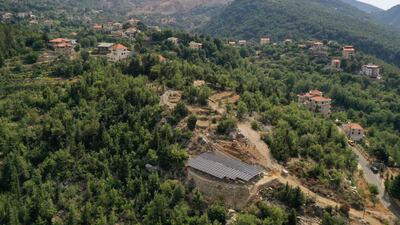
An aerial view of the solar panels installed in the village of Toula in northern Lebanon. All photos by AFP -
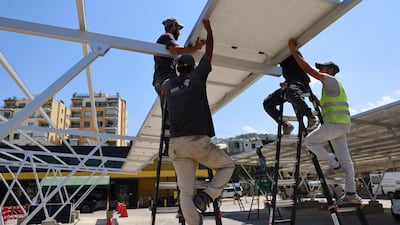
Workers instal solar panels as shades for vehicles in the car park of a shopping mall in the city of Byblos in northern Lebanon. -
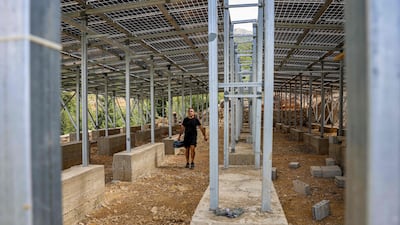
A technician works on the solar panel system installed for the village of Toula in northern Lebanon. -
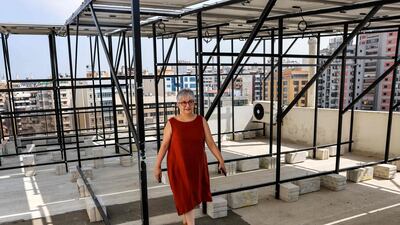
Lebanese homemaker Zeina Sayegh walks beneath the solar panels she installed atop her apartment building in Lebanon's capital Beirut. -
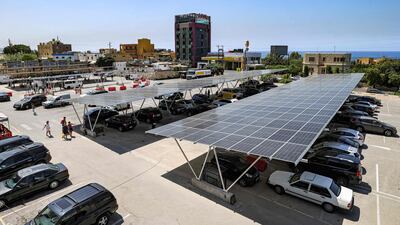
Solar panels cover a shopping mall's car park in the city of Byblos in northern Lebanon. -
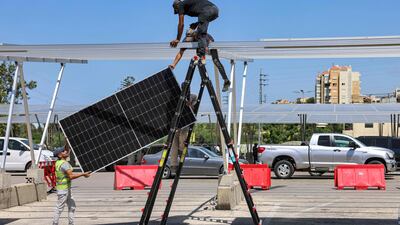
Workers instal solar panels over parking spaces at a shopping mall in Byblos, Lebanon. -
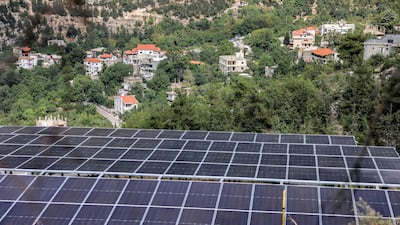
The solar panel system installed on a hillside above the village of Toula in northern Lebanon. -

Solar panels cover the roof of a shopping mall in Byblos, Lebanon.


A growing number of citizens are looking to solar power as an affordable and reliable solution to their energy woes, but the lack of developed infrastructure to provide it means they face high installation costs, a lack of regulation, and scams.
“People in Lebanon are desperate for electricity, so they might, at times, not consider looking into the misleading sales of these products,” said Imad Hage Chehade, director of technology at the Industrial Research Institute, which is affiliated with the Ministry of Industry.
“Many people are falling for this trap … this is making it hard for people to actually trust in the new green potential.”
Mr Chehade and other solar experts said they have seen a growing number of cases of fraud, in which faulty or old panels that have been sent for recycling in wealthy nations are instead imported to Lebanon and passed off as new.
“Unfortunately, green energy scams in Lebanon are evergreen,” Mr Chehade told the Thomson Reuters Foundation.
Solar panels smuggled
Italian police said in 2020 that they were investigating a waste treatment plant in Sicily over suspicions that old solar panels were being smuggled to Africa and the Middle East for resale, according to pv magazine, which covers the solar energy sector.
Mr Chehade said most such panels still had stamps from the original installation that showed which country they came from.
The IRI last year identified another batch of panels apparently redirected from recycling facilities in Dubai. Mr Chehade said the Ministry of Energy and Water had been informed.
Pierre El Khoury, head of the Lebanese Centre for Energy Conservation, part of the energy ministry given the task of supporting the development of renewable energy, said it was investigating the case.
Scams are not the only concern, with poor-quality solar energy parts and installation also common, said Mr Chehade.
-

Schoolteacher Claude Koteich, her teenager daughter and 10-year-old son, should all have been back in class weeks ago – but a crisis in Lebanon's education sector has left them lounging at home on a Monday afternoon. All photos: Reuters -
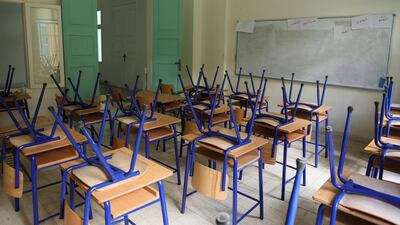
Lebanon's three-year financial meltdown has kept public schools closed so far this academic year, with teachers waging an open-ended strike over severely devalued salaries and administrators worried they will not be able to secure fuel to keep the lights and heating on during the winter. -
![Ms Koteich, 44, has taught French literature at Lebanese public schools for exactly half her lifetime. 'We used to get a salary high enough that I could afford to put them [her children] in private school,' she said.](https://www.thenationalnews.com/resizer/v2/2RL75LZYYFEQDNYSW3SVO2NWSA.JPG?smart=true&auth=c0e79547ec06d247688185041aae4b7b59a165697e6295d330a1b709d4918c9d&width=400&height=225)
Ms Koteich, 44, has taught French literature at Lebanese public schools for exactly half her lifetime. 'We used to get a salary high enough that I could afford to put them [her children] in private school,' she said. -
From a monthly salary that was once about $3,000, Ms Koteich now earns the equivalent of $100 – forcing her to make a tough choice last summer over whether to put her children back in costly private schools or transfer them to a public education system paralysed by the pay dispute. 'I was stuck between yes and no – waiting for our salaries to change, or if the education minister wanted to fulfil our demands,' she said. -
While there is little progress on securing higher salaries given Lebanon's depleted state coffers, at the same time, her children's private school was asking for tuition to be paid mostly in cash dollars to guarantee they could afford to pay for expensive fuel and other imported needs. That would amount to an annual fee of $500 per pupil, plus 15 million Lebanese pounds, or about $400. 'The number was very high and out of this world for me,' Ms Koteich said. -

So as their former classmates don their private school uniforms, Ms Koteich's two children still have no idea when they will return to class. -

The education system in Lebanon has long been heavily reliant on private schools, which taught almost 60 per cent of the country's 1.25 million pupils, according to the Ministry of Higher Education. But the strain on households from the financial collapse has forced a shift and about 55,000 pupils moved from private to public schools in the 2020-2021 school year alone, the World Bank said. -

Public education is historically underfunded, with the government earmarking less than 2 per cent of GDP to education in 2020, according to the World Bank – one of the lowest rates in the Middle East and North Africa. -
!['I noticed that their [my pupils] worries are beyond educational – they started to think about how they can make a living [when] at this age they should be thinking of their homework,' Ms Koteich said.](https://www.thenationalnews.com/resizer/v2/I7KHFQBRPZAOLPLB4MALAEVUSU.JPG?smart=true&auth=160c464189f0b0e9368517576e92e34b32dd63b9020449353439073c26e4ef72&width=400&height=225)
'I noticed that their [my pupils] worries are beyond educational – they started to think about how they can make a living [when] at this age they should be thinking of their homework,' Ms Koteich said. -
![Edouard Beigbeder, the head of Unicef in Lebanon, told Reuters that about one third of children in Lebanon – including Syrian children – are not attending school. 'We have worrying numbers ... more employed in the labour [sector in Lebanon], and some girls getting into early child marriage,' he said.](https://www.thenationalnews.com/resizer/v2/STEUWXNVWDW4UB6IGRZQNWYCLM.jpg?smart=true&auth=175a3a8b78ede85e4a6fc9cb8710c8bf31bdefb0226142e3ff759a1fde83322d&width=400&height=225)
Edouard Beigbeder, the head of Unicef in Lebanon, told Reuters that about one third of children in Lebanon – including Syrian children – are not attending school. 'We have worrying numbers ... more employed in the labour [sector in Lebanon], and some girls getting into early child marriage,' he said. -

A Unicef study this year found that 38 per cent of households had reduced their education expenses compared with just 26 per cent in April 2021. Some hope schools will re-open in October, although there has been no such indication from the government.


![Ms Koteich, 44, has taught French literature at Lebanese public schools for exactly half her lifetime. 'We used to get a salary high enough that I could afford to put them [her children] in private school,' she said.](https://www.thenationalnews.com/resizer/v2/2RL75LZYYFEQDNYSW3SVO2NWSA.JPG?smart=true&auth=c0e79547ec06d247688185041aae4b7b59a165697e6295d330a1b709d4918c9d&width=800&height=450)


!['I noticed that their [my pupils] worries are beyond educational – they started to think about how they can make a living [when] at this age they should be thinking of their homework,' Ms Koteich said.](https://www.thenationalnews.com/resizer/v2/I7KHFQBRPZAOLPLB4MALAEVUSU.JPG?smart=true&auth=160c464189f0b0e9368517576e92e34b32dd63b9020449353439073c26e4ef72&width=800&height=450)
![Edouard Beigbeder, the head of Unicef in Lebanon, told Reuters that about one third of children in Lebanon – including Syrian children – are not attending school. 'We have worrying numbers ... more employed in the labour [sector in Lebanon], and some girls getting into early child marriage,' he said.](https://www.thenationalnews.com/resizer/v2/STEUWXNVWDW4UB6IGRZQNWYCLM.jpg?smart=true&auth=175a3a8b78ede85e4a6fc9cb8710c8bf31bdefb0226142e3ff759a1fde83322d&width=800&height=450)

Companies contacted by the Thomson Reuters Foundation gave prices ranging from $4,000 to $5,000 to install a residential solar panel that could power a house for six to 15 hours a day — as much as 30 times the average monthly pay.
The energy ministry is trying to fix the problem by introducing guidelines for solar buyers that stress the need for surveys and inspections by qualified engineers.
In October, it announced a free certification scheme for domestic solar systems.
However, many people are not aware of the certificates — which confirm the systems have been correctly installed and tested — said Mr El Khoury.
“Solar companies or sellers are not informing the buyers of this procedure, probably because they want to get away with selling dysfunctional panels,” he said.
The IRI has also begun organising training for solar power industry workers, which includes information on how to correctly install the systems, legal requirements and safety on the job.
Green dreams abandoned
Marc Ayoub, an energy researcher at the American University of Beirut, said more action is needed to develop an integrated nationwide renewable energy market.
The state-backed solar power certification system should be toughened to offer guarantees about how much energy panels will produce and how long they will last, Mr Ayoub said, and should also be extended to cover large-scale and commercial arrays.
“These are essential for getting private and foreign funders interested in projects that can be financed,” he said.
“In the end, this would lead to more green jobs in the renewable energy sector, which would help the economy grow.”
More action is also needed to inform communities of the potential and pitfalls of solar systems, he said.
In Beirut, Mr Kanaan said he had abandoned his dream of going green.
“The solar panel I purchased was unfixable; now I've squandered money, time, and solar potential,” he said, adding that he could not even afford to buy power from a generator now.
“I'm working to spread the word to warn others about the scam so that they are informed if they decide to make a purchase."

