Health Minister Firass Abiad announced the ministry's plan to lift subsidies on medicines including those used to treat heart disease, high cholesterol and high blood pressure. AFP
Prices for life-saving medication skyrocketed in Lebanon on Tuesday after the Ministry of Public Health began lifting most drug subsidies, which the cash-strapped state can no longer afford.
Health Minister Firass Abiad had announced last Tuesday a plan to gradually lift subsidies on certain types of medication including those used to treat heart disease, high cholesterol and high blood pressure, causing drug prices to increase by as much as five or six times their original cost.
The ministry issued a new price list on Monday afternoon that was put in place on Tuesday for the first time, pharmacists say.
Pharmacist Georges Zammar said that customers were not expecting the sudden increase and that he had to deal with angry and dumbfounded clients all day.
“I would say 90 per cent of parents asking for baby formula today left my pharmacy empty-handed. They simply didn’t have the money to pay for it,” he said from Pharmacy Radio in Beirut.
The new pricing has become unaffordable for many in a country where about 80 per cent of the population lives in poverty, according to UN data.
A packet of baby formula that lasts three days used to cost 12,000 Lebanese pounds ($0.50 at the market rate) before the latest decision.
The same packet is now priced at 98,000 pounds ($4.20).
Since late 2019, the Lebanese pound has lost more than 90 per cent of its worth, slashing the value of salaries as costs for basic goods rise.
The minimum wage of 675,000 Lebanese was worth $450 in 2019. It is now equal to less than $30.
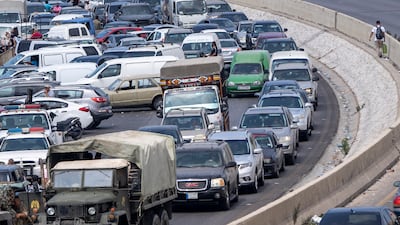
A crowded petrol station on the main road that links Beirut to south Lebanon. AP
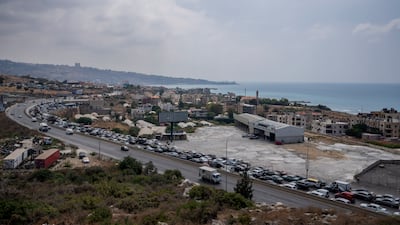
Drivers come from every direction to fill their tanks with fuel. AP
Chronic fuel shortages have plagued the country in recent months, with long queues at petrol stations a common sight. AP
Last month, central bank governor Riad Salameh announced that fuel imports would no longer be subsidised. AP
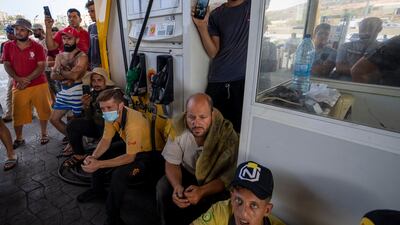
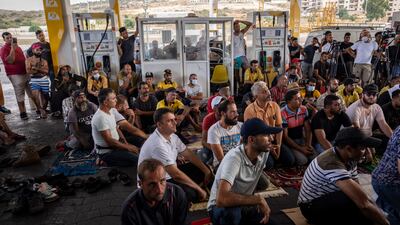
Worshippers listen as cleric Ali Al Hussein delivers a sermon during Friday prayers at a fuel station to protest against the severe shortages. AP
People listen to Al Hussein's sermon in the coastal town of Jiyeh, south of Beirut. AP
But medicines for cancer, incurable diseases, mental and psychological diseases, and drugs used in hospitals have retained their subsidies, a representative for the health ministry told The National.
The Lebanese state spends $35 million on medical subsidies each month, down from $130 million prior to subsidy cuts, Mr Abiad said last week.
The ministry will maintain a 65 per cent subsidy rate on expensive medicines for chronic diseases, while cheaper, generic products will receive less state support, the minister said.
Only wealthy customers, however, will be able to afford the new prices, said Noura, a pharmacist employed at Wardieh Pharmacy in Beirut.
“People who can afford to buy medicine are still getting them, but those who do not have the means will suffer,” she said from behind the counter of an empty drugstore, plunged in darkness due to daily power cuts.
Lebanon has been in economic free fall for the past two years. A lack of foreign currencies, compounded by decades of endemic corruption and political inaction have left the state unable to provide for its citizens.
Petrol, electricity and now medicine are out of reach for many as subsidies for these products have been gradually lifted, with no other social safety net in place for the needy.
The country imports 80 per cent of its drugs in foreign currencies, which the central bank lacks, causing payment delays and shortages.
Subsidised medicines are also routinely smuggled to neighbouring Syria, worsening shortages.
Pharmacists told The National that shortages persist despite the lifting of subsidies, but that the decision may help alleviate the lack of medicine in the long run.
Talal, a taxi driver, says that the decision to lift subsidies means he can no longer afford the medicine he needs for his high blood pressure.
“I went to the pharmacy this morning and couldn’t believe my eyes,” he said. “How am I supposed to afford my drugs now?”

Why it pays to compare
A comparison of sending Dh20,000 from the UAE using two different routes at the same time - the first direct from a UAE bank to a bank in Germany, and the second from the same UAE bank via an online platform to Germany - found key differences in cost and speed. The transfers were both initiated on January 30.
Route 1: bank transfer
The UAE bank charged Dh152.25 for the Dh20,000 transfer. On top of that, their exchange rate margin added a difference of around Dh415, compared with the mid-market rate.
Total cost: Dh567.25 - around 2.9 per cent of the total amount
Total received: €4,670.30
Route 2: online platform
The UAE bank’s charge for sending Dh20,000 to a UK dirham-denominated account was Dh2.10. The exchange rate margin cost was Dh60, plus a Dh12 fee.
Total cost: Dh74.10, around 0.4 per cent of the transaction
Total received: €4,756
The UAE bank transfer was far quicker – around two to three working days, while the online platform took around four to five days, but was considerably cheaper. In the online platform transfer, the funds were also exposed to currency risk during the period it took for them to arrive.
Mercer, the investment consulting arm of US services company Marsh & McLennan, expects its wealth division to at least double its assets under management (AUM) in the Middle East as wealth in the region continues to grow despite economic headwinds, a company official said.
Mercer Wealth, which globally has $160 billion in AUM, plans to boost its AUM in the region to $2-$3bn in the next 2-3 years from the present $1bn, said Yasir AbuShaban, a Dubai-based principal with Mercer Wealth.
“Within the next two to three years, we are looking at reaching $2 to $3 billion as a conservative estimate and we do see an opportunity to do so,” said Mr AbuShaban.
Mercer does not directly make investments, but allocates clients’ money they have discretion to, to professional asset managers. They also provide advice to clients.
“We have buying power. We can negotiate on their (client’s) behalf with asset managers to provide them lower fees than they otherwise would have to get on their own,” he added.
Mercer Wealth’s clients include sovereign wealth funds, family offices, and insurance companies among others.
From its office in Dubai, Mercer also looks after Africa, India and Turkey, where they also see opportunity for growth.
Wealth creation in Middle East and Africa (MEA) grew 8.5 per cent to $8.1 trillion last year from $7.5tn in 2015, higher than last year’s global average of 6 per cent and the second-highest growth in a region after Asia-Pacific which grew 9.9 per cent, according to consultancy Boston Consulting Group (BCG). In the region, where wealth grew just 1.9 per cent in 2015 compared with 2014, a pickup in oil prices has helped in wealth generation.
BCG is forecasting MEA wealth will rise to $12tn by 2021, growing at an annual average of 8 per cent.
Drivers of wealth generation in the region will be split evenly between new wealth creation and growth of performance of existing assets, according to BCG.
Another general trend in the region is clients’ looking for a comprehensive approach to investing, according to Mr AbuShaban.
“Institutional investors or some of the families are seeing a slowdown in the available capital they have to invest and in that sense they are looking at optimizing the way they manage their portfolios and making sure they are not investing haphazardly and different parts of their investment are working together,” said Mr AbuShaban.
Some clients also have a higher appetite for risk, given the low interest-rate environment that does not provide enough yield for some institutional investors. These clients are keen to invest in illiquid assets, such as private equity and infrastructure.
“What we have seen is a desire for higher returns in what has been a low-return environment specifically in various fixed income or bonds,” he said.
“In this environment, we have seen a de facto increase in the risk that clients are taking in things like illiquid investments, private equity investments, infrastructure and private debt, those kind of investments were higher illiquidity results in incrementally higher returns.”
The Abu Dhabi Investment Authority, one of the largest sovereign wealth funds, said in its 2016 report that has gradually increased its exposure in direct private equity and private credit transactions, mainly in Asian markets and especially in China and India. The authority’s private equity department focused on structured equities owing to “their defensive characteristics.”
Sector: Additive manufacturing, 3D printing technologies
Size: 15 full-time employees
Stage: Seed stage and seeking Series A round of financing
Investors: Oman Technology Fund from 2017 to 2019, exited through an agreement with a new investor to secure new funding that it under negotiation right now.
EPL's youngest
Ethan Nwaneri (Arsenal) 15 years, 181 days old
Max Dowman (Arsenal) 15 years, 235 days old
Jeremy Monga (Leicester) 15 years, 271 days old
Harvey Elliott (Fulham) 16 years, 30 days old
Matthew Briggs (Fulham) 16 years, 68 days old
Last-16 Europa League fixtures
Wednesday (Kick-offs UAE)
FC Copenhagen (0) v Istanbul Basaksehir (1) 8.55pm