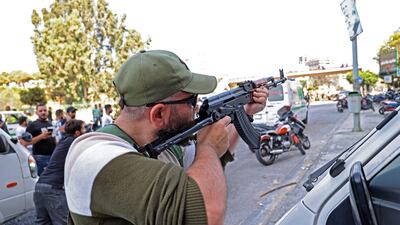
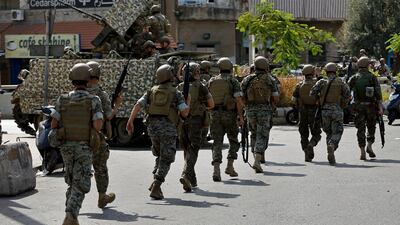
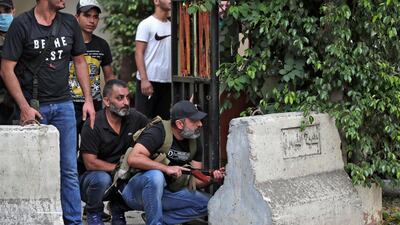
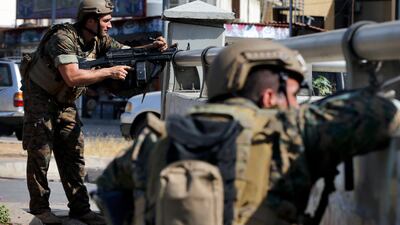
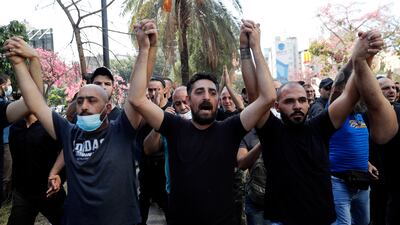
The international community has expressed concern about attempts to derail the investigation into the deadly Beirut blast last year after a Hezbollah-led protest against the judge leading the inquiry turned into deadly fighting.
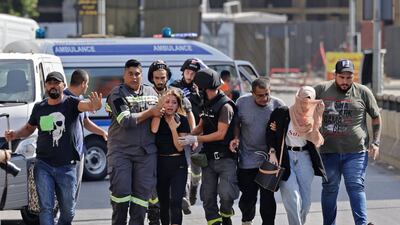
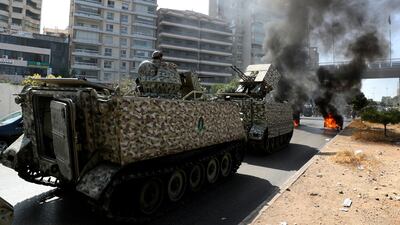
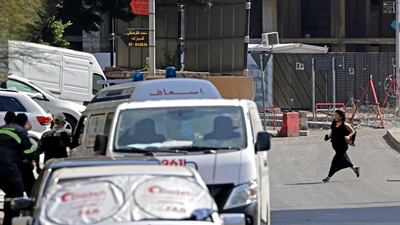
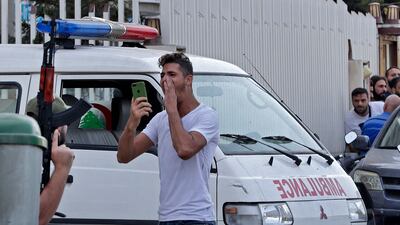
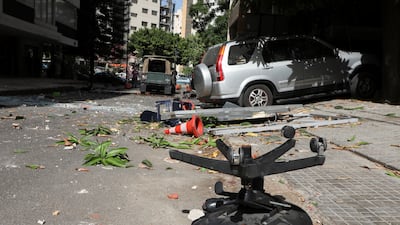
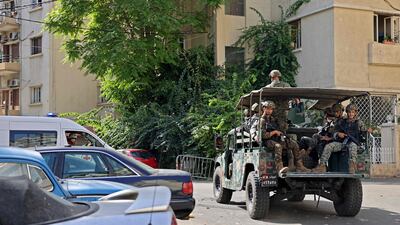
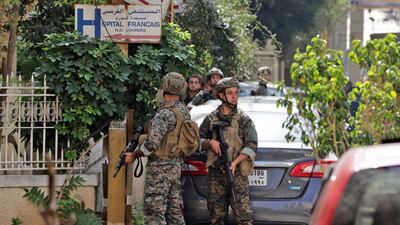
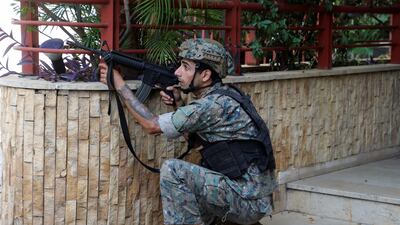
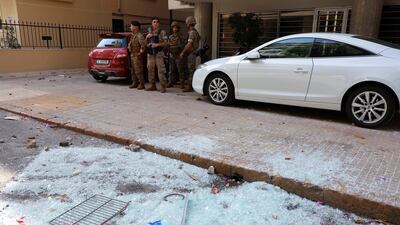
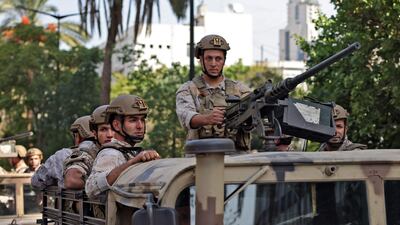
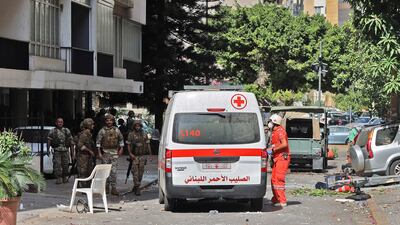
Unknown gunmen killed six people in Beirut on Thursday, all of them members or supporters of Hezbollah and its ally Amal, on a former frontline in Lebanon’s civil war. The violence in the capital threatened to throw the country into further chaos after two years of economic meltdown.
French Foreign Minister Jean-Yves Le Drian expressed “deep concern” for the fate of the investigation in a statement released on Thursday.
“France notes its deep concern over recent obstacles to the smooth unfolding of the investigation into the explosion in the port of Beirut on August 4, 2020, and the violence that has taken place in that regard,” he said.
Mr Le Drian said the Lebanese judiciary system must be able to work independently and impartially on this investigation “without obstacles and with the full support of the Lebanese authorities”.
For the past week, Hezbollah and its allies have been lobbying Lebanon’s newly formed government to dismiss Tarek Bitar, the judge leading the investigation, because he summoned for interrogation politicians who are close to the group.
Politicians summoned for questioning in the inquiry succeeded in removing Mr Bitar's predecessor, Fadi Sawan, in February. They are now asking the courts to dismiss Mr Bitar.
UN Secretary General Antonio Guterres called for an immediate end to the violence and stressed the need for an impartial investigation into the blast.
The UN special co-ordinator for Lebanon Joanna Wronecka said that “now is the time for all sides to support judicial independence in the interest of the people”.
More than 200 people were killed, more than 6,000 injured and large areas of the capital destroyed when hundreds of tonnes of ammonium nitrate, a highly explosive chemical used as fertiliser, detonated at the port after being stored there for more than six years.
Thursday’s clashes coincided with a visit to Beirut by US Undersecretary of State Victoria Nuland, who called for calm and expressed support for a transparent investigation into the explosion.
Today’s unacceptable violence makes clear what the stakes are
Victoria Nuland,
US Undersecretary of State
“Today’s unacceptable violence makes clear what the stakes are,” Ms Nuland said.
“A clean, impartial, independent judiciary is the guarantor of all the rights and the values that we, as democracies, hold dear and share.”
The violence also prompted concern among Gulf states. Kuwait's embassy in Lebanon asked its citizens to leave the country, while Saudi Arabia called for calm and stability.
"The kingdom hopes that peace and security will prevail in Lebanon by ending the possession and use of arms outside of state control," Saudi Arabia's Ministry of Foreign Affairs said, in an apparent reference to Hezbollah.
The Iran-backed group has access to an arsenal of weapons and has fought alongside the Syrian army in that country's civil war.
Lebanese President Michel Aoun called for an investigation into the clashes.
The Lebanese Army said it arrested nine people “from both sides”, including a Syrian.

WHAT FANS WILL LOVE ABOUT RUSSIA
FANS WILL LOVE
Uber is ridiculously cheap and, as Diego Saez discovered, mush safer. A 45-minute taxi from Pulova airport to Saint Petersburg’s Nevsky Prospect can cost as little as 500 roubles (Dh30).
FANS WILL LOATHE
Uber policy in Russia is that they can start the fare as soon as they arrive at the pick-up point — and oftentimes they start it even before arriving, or worse never arrive yet charge you anyway.
FANS WILL LOVE
It’s amazing how active Russians are on social media and your accounts will surge should you post while in the country. Throw in a few Cyrillic hashtags and watch your account numbers rocket.
FANS WILL LOATHE
With cold soups, bland dumplings and dried fish, Russian cuisine is not to everybody’s tastebuds. Fortunately, there are plenty Georgian restaurants to choose from, which are both excellent and economical.
FANS WILL LOVE
The World Cup will take place during St Petersburg's White Nights Festival, which means perpetual daylight in a city that genuinely never sleeps. (Think toddlers walking the streets with their grandmothers at 4am.)
FANS WILL LOATHE
The walk from Krestovsky Ostrov metro station to Saint Petersburg Arena on a rainy day makes you wonder why some of the $1.7 billion was not spent on a weather-protected walkway.
Dirham Stretcher tips for having a baby in the UAE
Selma Abdelhamid, the group's moderator, offers her guide to guide the cost of having a young family:
• Buy second hand stuff
They grow so fast. Don't get a second hand car seat though, unless you 100 per cent know it's not expired and hasn't been in an accident.
• Get a health card and vaccinate your child for free at government health centres
Ms Ma says she discovered this after spending thousands on vaccinations at private clinics.
• Join mum and baby coffee mornings provided by clinics, babysitting companies or nurseries.
Before joining baby classes ask for a free trial session. This way you will know if it's for you or not. You'll be surprised how great some classes are and how bad others are.
• Once baby is ready for solids, cook at home
Take the food with you in reusable pouches or jars. You'll save a fortune and you'll know exactly what you're feeding your child.
The biog
Family: He is the youngest of five brothers, of whom two are dentists.
Celebrities he worked on: Fabio Canavaro, Lojain Omran, RedOne, Saber Al Rabai.
Where he works: Liberty Dental Clinic
Founders: Abdulmajeed Alsukhan, Turki Bin Zarah and Abdulmohsen Albabtain.
Based: Riyadh
Offices: UAE, Vietnam and Germany
Founded: September, 2020
Number of employees: 70
Sector: FinTech, online payment solutions
Funding to date: $116m in two funding rounds
Investors: Checkout.com, Impact46, Vision Ventures, Wealth Well, Seedra, Khwarizmi, Hala Ventures, Nama Ventures and family offices
Mercer, the investment consulting arm of US services company Marsh & McLennan, expects its wealth division to at least double its assets under management (AUM) in the Middle East as wealth in the region continues to grow despite economic headwinds, a company official said.
Mercer Wealth, which globally has $160 billion in AUM, plans to boost its AUM in the region to $2-$3bn in the next 2-3 years from the present $1bn, said Yasir AbuShaban, a Dubai-based principal with Mercer Wealth.
“Within the next two to three years, we are looking at reaching $2 to $3 billion as a conservative estimate and we do see an opportunity to do so,” said Mr AbuShaban.
Mercer does not directly make investments, but allocates clients’ money they have discretion to, to professional asset managers. They also provide advice to clients.
“We have buying power. We can negotiate on their (client’s) behalf with asset managers to provide them lower fees than they otherwise would have to get on their own,” he added.
Mercer Wealth’s clients include sovereign wealth funds, family offices, and insurance companies among others.
From its office in Dubai, Mercer also looks after Africa, India and Turkey, where they also see opportunity for growth.
Wealth creation in Middle East and Africa (MEA) grew 8.5 per cent to $8.1 trillion last year from $7.5tn in 2015, higher than last year’s global average of 6 per cent and the second-highest growth in a region after Asia-Pacific which grew 9.9 per cent, according to consultancy Boston Consulting Group (BCG). In the region, where wealth grew just 1.9 per cent in 2015 compared with 2014, a pickup in oil prices has helped in wealth generation.
BCG is forecasting MEA wealth will rise to $12tn by 2021, growing at an annual average of 8 per cent.
Drivers of wealth generation in the region will be split evenly between new wealth creation and growth of performance of existing assets, according to BCG.
Another general trend in the region is clients’ looking for a comprehensive approach to investing, according to Mr AbuShaban.
“Institutional investors or some of the families are seeing a slowdown in the available capital they have to invest and in that sense they are looking at optimizing the way they manage their portfolios and making sure they are not investing haphazardly and different parts of their investment are working together,” said Mr AbuShaban.
Some clients also have a higher appetite for risk, given the low interest-rate environment that does not provide enough yield for some institutional investors. These clients are keen to invest in illiquid assets, such as private equity and infrastructure.
“What we have seen is a desire for higher returns in what has been a low-return environment specifically in various fixed income or bonds,” he said.
“In this environment, we have seen a de facto increase in the risk that clients are taking in things like illiquid investments, private equity investments, infrastructure and private debt, those kind of investments were higher illiquidity results in incrementally higher returns.”
The Abu Dhabi Investment Authority, one of the largest sovereign wealth funds, said in its 2016 report that has gradually increased its exposure in direct private equity and private credit transactions, mainly in Asian markets and especially in China and India. The authority’s private equity department focused on structured equities owing to “their defensive characteristics.”
Day 2, stumps
Pakistan 482
Australia 30/0 (13 ov)
Australia trail by 452 runs with 10 wickets remaining in the innings