



Jordan’s King Abdullah discussed issues affecting the Eastern Mediterranean on Wednesday with the leaders of Greece and Cyprus, who are wary of increased Turkish influence in the region.
The meeting in Athens came a week after the king met US President Joe Biden in Washington.
King Abdullah's US visit helped to raise Jordan’s diplomatic profile, after a rift within the royal family became public in March and undermined the country's image as a bastion of stability in the Middle East.
Greek Prime Minister Kyriakos Mitsotakis said the three leaders aimed to “advance our co-operation in the political economic and security fields”.
“We will have the opportunity to discuss in detail regional issues of common interest, such as the situation in the Eastern Mediterranean, but also in Libya, Syria,” Mr Mitsotakis said.
“On the Cyprus issue we will have a chance to discuss the recent deplorable developments,” he said at a news conference attended by the king and Cypriot President Nicos Anastasiades .
The Greek prime minister was referring to Turkish plans to reopen the disputed Cypriot resort town of Varosha, a decision the EU described as unilateral and “unacceptable”.
The local Greek Cypriot population of Varosha fled when Turkey invaded the island in 1974.
The leaders of Jordan, Greece and Cyprus have met several times since 2018 as Turkish sway rose in Syria and Libya.
Ankara has also been contesting maritime areas claimed by its Greek-speaking neighbours.
-
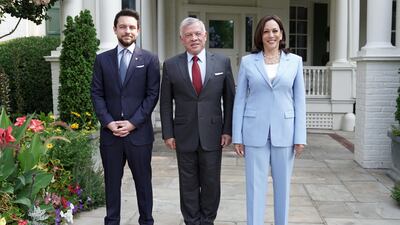
Jordanian King Abdullah II (C) accompanied by Crown Prince Hussein bin Abdullah (L) and US Vice President Kamala Harris at the Vice President's residence at the Naval Observatory in Washington. -
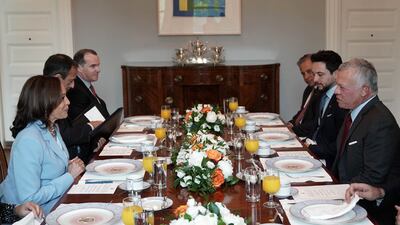
Jordanian King Abdullah II (R) accompanied by Crown Prince Hussein bin Abdullah (2-L) and US Vice President Kamala Harris (L), at the residence of the Vice President in the Naval Observatory in Washington. -

US Vice President Kamala Harris welcomes Jordan's King Abdullah II at her residence at the Naval Observatory in Washington. -
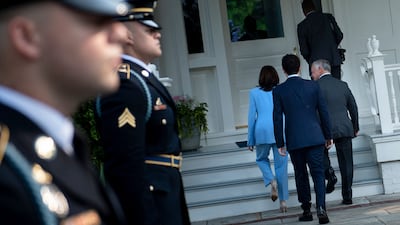
US Vice President Kamala Harris walks with Jordan's Crown Prince Hussein and Jordan's King Abdullah II to a meeting in Washington. -
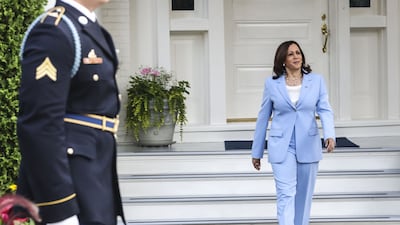
US Vice President Kamala Harris arrives to greet King Abdullah II of Jordan at the vice president's residence in Washington. -
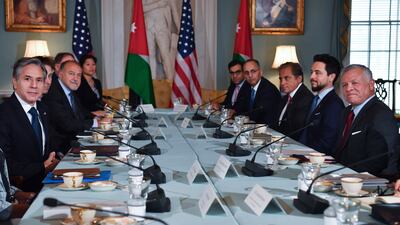
At the State Department in Washington, US Secretary of State Antony Blinken, left, meets Jordan's King Abdullah II, right, as Jordan's Crown Prince Hussein, second right, looks on. -
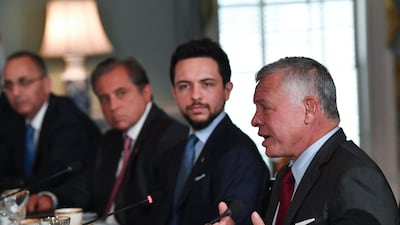
Jordan's King Abdullah speaks as Crown Prince Hussein looks on during a meeting with US Secretary of State Antony Blinken at the State Department in Washington. -
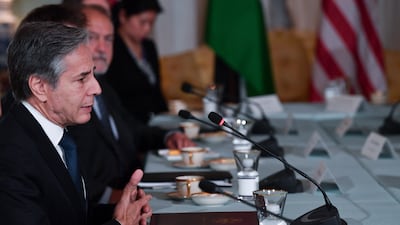
Secretary of State Antony Blinken, left, speaks during a meeting with Jordanian King Abdullah II at the State Department in Washington. -
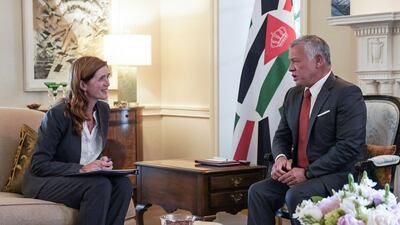
Jordanian King Abdullah II meeting with Administrator of the United States Agency for International Development, Samantha Power. -
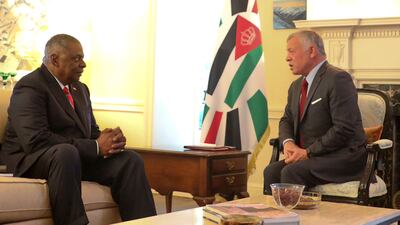
Jordanian King Abdullah II meeting with US Secretary of Defense Lloyd Austin. -
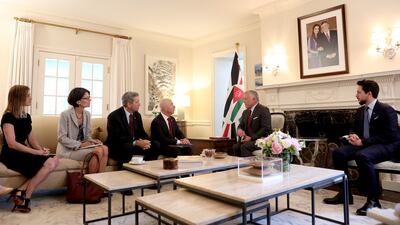
King Abdullah II and Crown Prince Al Hussein meet with US Homeland Security Secretary Alejandro -
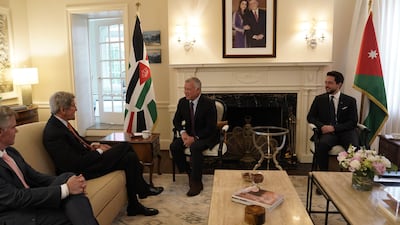
King Abdullah II and Crown Prince Al Hussein meet with US Special Presidential Envoy for Climate John Kerry. -
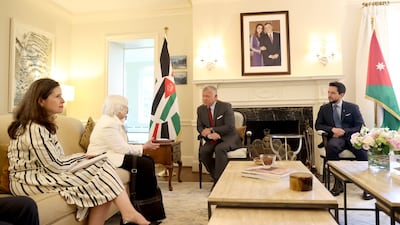
King Abdullah II and Crown Prince Al Hussein meet with US Treasury Secretary Janet Yellen. -
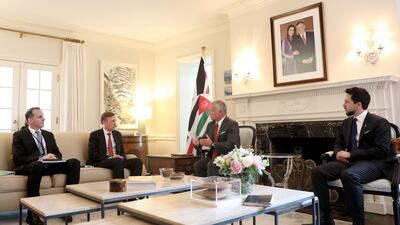
King Abdullah II and Crown Prince Al Hussein meet with US National Security Adviser Jake Sullivan. -
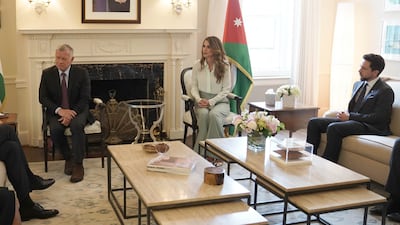
King Abdullah II, Queen Rania and Crown Prince Al Hussein meet with Pfizer Chairman and CEO Albert Bourla. -
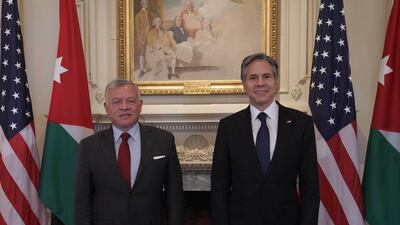
King Abdullah II and Antony Blinken.


Although Jordan is not a Mediterranean nation, King Abdullah said the three countries “share the Eastern Mediterranean” and have common interests in the region.
Jordan has a population of 10 million and its economy is in recession. It is a major recipient of EU and US aid. The kingdom’s gross domestic product is one-fifth of Greece’s and 1.8 times more than Cyprus.
“We will continue to play a vital role in looking at wider co-operation not only in the Levant and the Eastern Mediterranean but also global co-operation,” the king said.
In Washington last week the king called on US allies to consider talking with the Al Assad regime and suggested any international reconstruction funding should be tied to political reform in Syria.
In March, Jordanian security forces arrested about 20 people the authorities described as linked to the king’s half-brother, Prince Hamzah Bin Hussein.
The arrests, which were preceded by an intensified crackdown on dissent, were prompted by what the king described as a sedition attempt.
Most of those arrested were released, except for a distant cousin of the king and Bassem Awadallah, a former confidant of the monarch and high-profile figure on the Middle East business and economic scene.
A secret court in Amman sentenced last month the two men to 15 years in jail on sedition charges they both denied.
In Washington, Mr Biden told the king that “you’ve always been there and we will always be there for Jordan.”

