• Israelis display their ‘Green Pass’, proof of vaccination or immunity against the coronavirus, at the entrance to a performance by singer Nurit Galron at Yarkon Park in Tel Aviv.
    Israelis display their ‘Green Pass’, proof of vaccination or immunity against the coronavirus, at the entrance to a performance by singer Nurit Galron at Yarkon Park in Tel Aviv.
  • A man displays his ‘Green Pass’ at the entrance to the concert.
    A man displays his ‘Green Pass’ at the entrance to the concert.
  • A elderly woman receives a booster shot of her vaccination against Covid-19 at an assisted living residence.
    A elderly woman receives a booster shot of her vaccination against Covid-19 at an assisted living residence.
  • A woman displays her ‘Green Pass’ at the entrance to the Nurit Galron concert at Yarkon Park.
    A woman displays her ‘Green Pass’ at the entrance to the Nurit Galron concert at Yarkon Park.
  • People dance at a concert.
    People dance at a concert.
  • The Nurit Galron concert for which the audience had to show green passes to gain entry.
    The Nurit Galron concert for which the audience had to show green passes to gain entry.
  • The Nurit Galron concert for which the audience had to show green passes to gain entry.
    The Nurit Galron concert for which the audience had to show green passes to gain entry.
  • A customer at Nashville Barber Shop gets a shave after coronavirus restrictions were eased, opening shopping centres, gyms, barber shops, among other sites in Jerusalem.
    A customer at Nashville Barber Shop gets a shave after coronavirus restrictions were eased, opening shopping centres, gyms, barber shops, among other sites in Jerusalem.
  • A visitor presents a coronavirus vaccination certificate at the entrance to the Khan Theatre in Jerusalem.
    A visitor presents a coronavirus vaccination certificate at the entrance to the Khan Theatre in Jerusalem.
  • People present their coronavirus vaccination certificate at the entrance to the Khan Theatre in Jerusalem.
    People present their coronavirus vaccination certificate at the entrance to the Khan Theatre in Jerusalem.
  • People wear face masks as they attend the Khan Theatre to watch a show in Jerusalem.
    People wear face masks as they attend the Khan Theatre to watch a show in Jerusalem.
  • An Orthodox Christian clergy member puts on his face mask while walking out of the Church of Holy Sepulchre in Jerusalem’s Old City.
    An Orthodox Christian clergy member puts on his face mask while walking out of the Church of Holy Sepulchre in Jerusalem’s Old City.
  • A drive-through Covid-19 screening centre run by the Magen David Adom national emergency service in the car park of Yarkon Park, Tel Aviv.
    A drive-through Covid-19 screening centre run by the Magen David Adom national emergency service in the car park of Yarkon Park, Tel Aviv.
  • Residents of an assisted living residence in Israel dance after receiving their booster shots of the vaccination against the Covid-19.
    Residents of an assisted living residence in Israel dance after receiving their booster shots of the vaccination against the Covid-19.
  • Medics, seen through a window of an observation room, wear personal protective equipment as they work inside an underground ward treating Covid-19 patients at the Critical Care Coronavirus Unit at Sheba Medical Centre in Ramat Gan.
    Medics, seen through a window of an observation room, wear personal protective equipment as they work inside an underground ward treating Covid-19 patients at the Critical Care Coronavirus Unit at Sheba Medical Centre in Ramat Gan.
  • A woman is immunised against Covid-19 as part of a Tel Aviv municipality initiative offering a free drink to people having the vaccine shot.
    A woman is immunised against Covid-19 as part of a Tel Aviv municipality initiative offering a free drink to people having the vaccine shot.

Covid passport: vaccinated Israelis get ‘green pass’ to normal life


Rosie Scammell
  • English
  • Arabic

Israelis are flocking to the shops after the government took steps to reopen the economy after a third lockdown, with “green passports” granting privileges to immunised residents.

"Why does Israel have the courage or the stupidity to do the reopening with such a high number of cases?" said Ronni Gamzu, the country's former coronavirus troubleshooter.

“Mainly because we see a shift and we see that our strategy is continuing and showing its effects,” he said on Thursday, days before restrictions were eased nationwide.

Israel is still registering thousands of coronavirus cases a day, although the proportion of positive tests fell from 9.9 per cent at the start of this month to 6.1 per cent on Tuesday.

At the same time, a rapid vaccination drive is under way and about 50 per cent of the population has received their first dose.

While shops, markets and museums were opened to all on Sunday, other places – including gyms, hotels and cultural or sporting venues – are accessible only to those with the pass, widely called a “green passport”.

Tens of thousands of Israelis rushed to get their pass, the health ministry said, which proves they have either received both doses of the vaccine or have recovered from Covid-19.

The high demand immediately caused technical failures, prompting the ministry to allow people to use an inoculation or recovery certificate distributed by healthcare providers for the next fortnight.

“The website is completely non fit for purpose – you had to be very lucky for it not to crash,” said Ruthie Pearlman, 72, an author. After downloading her pass on Saturday night, it took hours the next morning to get one for her husband.

While Pearlman has no plans to use the services restricted to those with the pass, she wanted to get one in case it opens up opportunities in the future.

"It seems to be something that everyone wants," she told The National, and praised the government's approach as smart and measured.

"I had a feeling it might let me into restaurants," said Pearlman, who is also hoping she will soon be able to visit her children and grandchildren in London.

Restaurants, cafes and bars have been shut to sit-in customers since September and no final decision has been made on whether diners will need a green passport if they reopen next month.

The two-tier system is intended to be a temporary measure, which Dr Gamzu said would allow Israel to cautiously head towards resuming normal life.

“This is what we are trying to balance ... get people into their daily life and to earn again their living and continue their routines,” said Dr Gamzu, the director general of Ichilov Medical Centre in Tel Aviv.

Leah Sapir, who is in her sixties, received her green passport on Sunday and said the system could encourage more people to be immunised.

"It gets the point across that getting the vaccination is a good thing to do for your own benefit," she told The National.

Because vaccines are available to all Israeli residents over 16, she did not see the programme as exclusionary. “The virus is what has been taking away our rights, the virus has been making it difficult or dangerous to go out.”

Ido Hadari, head of communications at healthcare provider Maccabi, said green passports could in particular encourage young Israelis to be inoculated but said the scheme should be tightened.

___________________________________

Coronavirus round the world in pictures

  • A shipment of the Sinovac vaccine is unloaded from a Thai airways flight at Suvarnabhumi airport in Bangkok, Thailand. AP
    A shipment of the Sinovac vaccine is unloaded from a Thai airways flight at Suvarnabhumi airport in Bangkok, Thailand. AP
  • People eat at a restaurant, in a neighbourhood among those that have seen some of the highest number of city Covid-19 deaths, in the Queens borough of New York City. AFP
    People eat at a restaurant, in a neighbourhood among those that have seen some of the highest number of city Covid-19 deaths, in the Queens borough of New York City. AFP
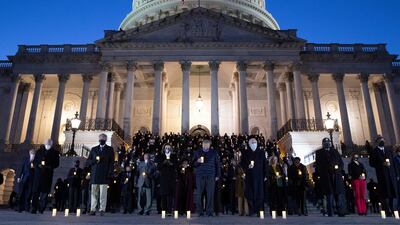
  • From left: House Majority Leader Steny Hoyer, House Minority Leader Kevin McCarthy, US Speaker of the House Nancy Pelosi, Senate Majority Leader Chuck Schumer, Senate Minority Leader Mitch McConnell, with members of Congress observe a moment of silence during an event held at Capitol Hill to honour the 500,000 people in the US who have died from Covid-19.
    From left: House Majority Leader Steny Hoyer, House Minority Leader Kevin McCarthy, US Speaker of the House Nancy Pelosi, Senate Majority Leader Chuck Schumer, Senate Minority Leader Mitch McConnell, with members of Congress observe a moment of silence during an event held at Capitol Hill to honour the 500,000 people in the US who have died from Covid-19.
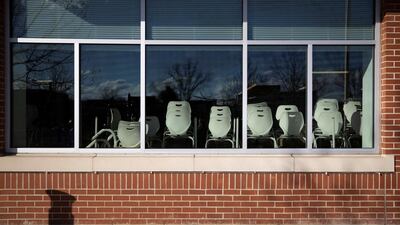
  • Chairs are stacked near the windows of a classroom ahead of in-person learning at the Jefferson-Houston School in Alexandria, Virginia. Reuters
    Chairs are stacked near the windows of a classroom ahead of in-person learning at the Jefferson-Houston School in Alexandria, Virginia. Reuters
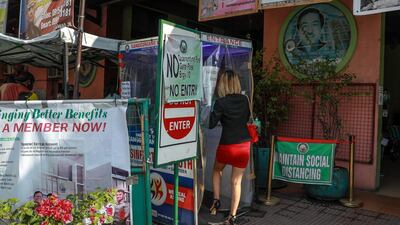
  • A woman walks through a disinfection booth while entering a town village in Pasay City, south of Manila, Philippines. EPA
    A woman walks through a disinfection booth while entering a town village in Pasay City, south of Manila, Philippines. EPA
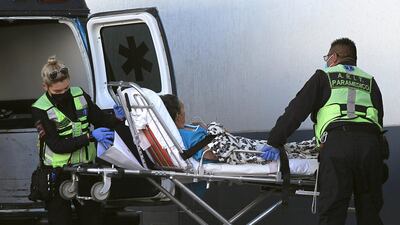
  • Health personnel transport a patient infected with the coronavirus to the General Hospital of the Ciudad Juarez, in the state of Chihuahua, Mexico. EPA
    Health personnel transport a patient infected with the coronavirus to the General Hospital of the Ciudad Juarez, in the state of Chihuahua, Mexico. EPA
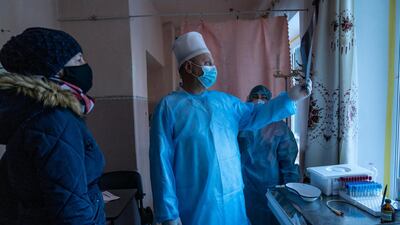
  • A doctor looks at the X-rays of a patient's lungs at the central hospital in Kolomyia, western Ukraine. AP
    A doctor looks at the X-rays of a patient's lungs at the central hospital in Kolomyia, western Ukraine. AP
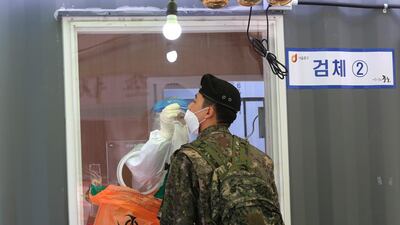
  • A medical worker takes a nasal sample from a soldier at a coronavirus testing site in Seoul, South Korea. AP
    A medical worker takes a nasal sample from a soldier at a coronavirus testing site in Seoul, South Korea. AP
  • People walk past a temporarily closed branch of a sandwich shop in London's financial district during England's third coronavirus lockdown. AP
    People walk past a temporarily closed branch of a sandwich shop in London's financial district during England's third coronavirus lockdown. AP
  • A worker sprays disinfectant inside a school bus in Yongchuan, in central China's Hunan province. AFP
    A worker sprays disinfectant inside a school bus in Yongchuan, in central China's Hunan province. AFP
  • A woman and her child feed pigeons in Bogota, Colombia. AFP
    A woman and her child feed pigeons in Bogota, Colombia. AFP
  • Riot police are seen during a demonstration by workers of bars and restaurants against the restrictions set by the Bogota Mayor Claudia Lopez in Bogota, Colombia. AFP
    Riot police are seen during a demonstration by workers of bars and restaurants against the restrictions set by the Bogota Mayor Claudia Lopez in Bogota, Colombia. AFP

_____________________________________

“We think it should be more robust,” he said. “I want it to cover shops.”

Despite the measures being more lax than he would hope, Mr Hadari said the vaccine programme is going “extremely well” and Maccabi had already immunised 77 per cent of its eligible clients.

Looking ahead, Ms Sapir predicted those wary of the vaccine will be inoculated and Israeli coronavirus cases will steadily decline.

“Then the green pass will be less essential, because even if we don’t have herd immunity we’ll be approaching that,” she said.

Israeli health experts said coronavirus will not be eliminated from the country in part because children under 16 have yet to receive the shot, while there is no large-scale vaccination drive in the Palestinian territories.

The Israeli government was criticised by rights groups for failing to include about five million Palestinians in Gaza and the occupied West Bank in its vaccine programme.

It has given a few thousand vaccines to the Palestinian Authority and Israel reportedly plans to vaccinate 100,000 Palestinians working in the country. Health officials on both sides did not respond to requests to comment on the deal.


Company profile

Name: Back to Games and Boardgame Space

Started: Back to Games (2015); Boardgame Space (Mark Azzam became co-founder in 2017)

Founder: Back to Games (Mr Azzam); Boardgame Space (Mr Azzam and Feras Al Bastaki)

Based: Dubai and Abu Dhabi 

Industry: Back to Games (retail); Boardgame Space (wholesale and distribution) 

Funding: Back to Games: self-funded by Mr Azzam with Dh1.3 million; Mr Azzam invested Dh250,000 in Boardgame Space  

Growth: Back to Games: from 300 products in 2015 to 7,000 in 2019; Boardgame Space: from 34 games in 2017 to 3,500 in 2019

Company profile

Company name: Dharma

Date started: 2018

Founders: Charaf El Mansouri, Nisma Benani, Leah Howe

Based: Abu Dhabi

Sector: TravelTech

Funding stage: Pre-series A 

Investors: Convivialite Ventures, BY Partners, Shorooq Partners, L& Ventures, Flat6Labs

Lampedusa: Gateway to Europe
Pietro Bartolo and Lidia Tilotta
Quercus

Terror attacks in Paris, November 13, 2015

- At 9.16pm, three suicide attackers killed one person outside the Atade de France during a foootball match between France and Germany- At 9.25pm, three attackers opened fire on restaurants and cafes over 20 minutes, killing 39 people- Shortly after 9.40pm, three other attackers launched a three-hour raid on the Bataclan, in which 1,500 people had gathered to watch a rock concert. In total, 90 people were killed- Salah Abdeslam, the only survivor of the terrorists, did not directly participate in the attacks, thought to be due to a technical glitch in his suicide vest- He fled to Belgium and was involved in attacks on Brussels in March 2016. He is serving a life sentence in France

The%20Witcher%20-%20season%20three
%3Cp%3E%3Cstrong%3EDirector%3A%20%3C%2Fstrong%3EVarious%0D%3Cbr%3E%3Cstrong%3E%0D%3Cbr%3EStars%3A%20%3C%2Fstrong%3EHenry%20Cavill%2C%20Freya%20Allan%2C%20Anya%20Chalotra%3Cstrong%3E%0D%3Cbr%3E%0D%3Cbr%3ERating%3A%3C%2Fstrong%3E%203%2F5%3C%2Fp%3E%0A
The President's Cake

Director: Hasan Hadi

Starring: Baneen Ahmad Nayyef, Waheed Thabet Khreibat, Sajad Mohamad Qasem 

Rating: 4/5

THURSDAY'S ORDER OF PLAY

Centre Court

Starting at 10am:

Lucrezia Stefanini v Elena Rybakina (6)

Aryna Sabalenka (4) v Polona Hercog

Sofia Kenin (1) v Zhaoxuan Yan

Kristina Mladenovic v Garbine Muguruza (5)

Sorana Cirstea v Karolina Pliskova (3)

Jessica Pegula v Elina Svitolina (2)

Court 1

Starting at 10am:

Sara Sorribes Tormo v Nadia Podoroska

Marketa Vondrousova v Su-Wei Hsieh

Elise Mertens (7) v Alize Cornet

Tamara Zidansek v Jennifer Brady (11)

Heather Watson v Jodie Burrage

Vera Zvonareva v Amandine Hesse

Court 2

Starting at 10am:

Arantxa Rus v Xiyu Wang

Maria Kostyuk v Lucie Hradecka

Karolina Muchova v Danka Kovinic

Cori Gauff v Ulrikke Eikeri

Mona Barthel v Anastasia Gasanova

Court 3

Starting at 10am:

Kateryna Bondarenko v Yafan Wang

Aliaksandra Sasnovich v Anna Bondar

Bianca Turati v Yaroslava Shvedova

Naga
%3Cp%3E%3Cstrong%3EDirector%3A%C2%A0%3C%2Fstrong%3EMeshal%20Al%20Jaser%3C%2Fp%3E%0A%3Cp%3E%3Cstrong%3EStarring%3A%C2%A0%3C%2Fstrong%3EAdwa%20Bader%2C%20Yazeed%20Almajyul%2C%20Khalid%20Bin%20Shaddad%3C%2Fp%3E%0A%3Cp%3E%3Cstrong%3ERating%3A%20%3C%2Fstrong%3E4%2F5%3C%2Fp%3E%0A
Match info

Australia 580
Pakistan 240 and 335

Result: Australia win by an innings and five runs

About Krews

Founder: Ahmed Al Qubaisi

Based: Abu Dhabi

Founded: January 2019

Number of employees: 10

Sector: Technology/Social media 

Funding to date: Estimated $300,000 from Hub71 in-kind support


Short-term let permits explained

Homeowners and tenants are allowed to list their properties for rental by registering through the Dubai Tourism website to obtain a permit.

Tenants also require a letter of no objection from their landlord before being allowed to list the property.

There is a cost of Dh1,590 before starting the process, with an additional licence fee of Dh300 per bedroom being rented in your home for the duration of the rental, which ranges from three months to a year.

Anyone hoping to list a property for rental must also provide a copy of their title deeds and Ejari, as well as their Emirates ID.

COMPANY%20PROFILE%20
%3Cp%3E%3Cstrong%3ECompany%20name%3A%20%3C%2Fstrong%3ENomad%20Homes%3Cbr%3E%3Cstrong%3EStarted%3A%20%3C%2Fstrong%3E2020%3Cbr%3E%3Cstrong%3EFounders%3A%20%3C%2Fstrong%3EHelen%20Chen%2C%20Damien%20Drap%2C%20and%20Dan%20Piehler%3Cbr%3E%3Cstrong%3EBased%3A%3C%2Fstrong%3E%20UAE%20and%20Europe%3Cbr%3E%3Cstrong%3EIndustry%3C%2Fstrong%3E%3A%20PropTech%3Cbr%3E%3Cstrong%3EFunds%20raised%20so%20far%3A%3C%2Fstrong%3E%20%2444m%3Cbr%3E%3Cstrong%3EInvestors%3A%3C%2Fstrong%3E%20Acrew%20Capital%2C%2001%20Advisors%2C%20HighSage%20Ventures%2C%20Abstract%20Ventures%2C%20Partech%2C%20Precursor%20Ventures%2C%20Potluck%20Ventures%2C%20Knollwood%20and%20several%20undisclosed%20hedge%20funds%3C%2Fp%3E%0A

Mercer, the investment consulting arm of US services company Marsh & McLennan, expects its wealth division to at least double its assets under management (AUM) in the Middle East as wealth in the region continues to grow despite economic headwinds, a company official said.

Mercer Wealth, which globally has $160 billion in AUM, plans to boost its AUM in the region to $2-$3bn in the next 2-3 years from the present $1bn, said Yasir AbuShaban, a Dubai-based principal with Mercer Wealth.

Within the next two to three years, we are looking at reaching $2 to $3 billion as a conservative estimate and we do see an opportunity to do so,” said Mr AbuShaban.

Mercer does not directly make investments, but allocates clients’ money they have discretion to, to professional asset managers. They also provide advice to clients.

“We have buying power. We can negotiate on their (client’s) behalf with asset managers to provide them lower fees than they otherwise would have to get on their own,” he added.

Mercer Wealth’s clients include sovereign wealth funds, family offices, and insurance companies among others.

From its office in Dubai, Mercer also looks after Africa, India and Turkey, where they also see opportunity for growth.

Wealth creation in Middle East and Africa (MEA) grew 8.5 per cent to $8.1 trillion last year from $7.5tn in 2015, higher than last year’s global average of 6 per cent and the second-highest growth in a region after Asia-Pacific which grew 9.9 per cent, according to consultancy Boston Consulting Group (BCG). In the region, where wealth grew just 1.9 per cent in 2015 compared with 2014, a pickup in oil prices has helped in wealth generation.

BCG is forecasting MEA wealth will rise to $12tn by 2021, growing at an annual average of 8 per cent.

Drivers of wealth generation in the region will be split evenly between new wealth creation and growth of performance of existing assets, according to BCG.

Another general trend in the region is clients’ looking for a comprehensive approach to investing, according to Mr AbuShaban.

“Institutional investors or some of the families are seeing a slowdown in the available capital they have to invest and in that sense they are looking at optimizing the way they manage their portfolios and making sure they are not investing haphazardly and different parts of their investment are working together,” said Mr AbuShaban.

Some clients also have a higher appetite for risk, given the low interest-rate environment that does not provide enough yield for some institutional investors. These clients are keen to invest in illiquid assets, such as private equity and infrastructure.

“What we have seen is a desire for higher returns in what has been a low-return environment specifically in various fixed income or bonds,” he said.

“In this environment, we have seen a de facto increase in the risk that clients are taking in things like illiquid investments, private equity investments, infrastructure and private debt, those kind of investments were higher illiquidity results in incrementally higher returns.”

The Abu Dhabi Investment Authority, one of the largest sovereign wealth funds, said in its 2016 report that has gradually increased its exposure in direct private equity and private credit transactions, mainly in Asian markets and especially in China and India. The authority’s private equity department focused on structured equities owing to “their defensive characteristics.”