


Israelis are flocking to the shops after the government took steps to reopen the economy after a third lockdown, with “green passports” granting privileges to immunised residents.
"Why does Israel have the courage or the stupidity to do the reopening with such a high number of cases?" said Ronni Gamzu, the country's former coronavirus troubleshooter.
“Mainly because we see a shift and we see that our strategy is continuing and showing its effects,” he said on Thursday, days before restrictions were eased nationwide.
Israel is still registering thousands of coronavirus cases a day, although the proportion of positive tests fell from 9.9 per cent at the start of this month to 6.1 per cent on Tuesday.
At the same time, a rapid vaccination drive is under way and about 50 per cent of the population has received their first dose.
While shops, markets and museums were opened to all on Sunday, other places – including gyms, hotels and cultural or sporting venues – are accessible only to those with the pass, widely called a “green passport”.
Tens of thousands of Israelis rushed to get their pass, the health ministry said, which proves they have either received both doses of the vaccine or have recovered from Covid-19.
The high demand immediately caused technical failures, prompting the ministry to allow people to use an inoculation or recovery certificate distributed by healthcare providers for the next fortnight.
“The website is completely non fit for purpose – you had to be very lucky for it not to crash,” said Ruthie Pearlman, 72, an author. After downloading her pass on Saturday night, it took hours the next morning to get one for her husband.
While Pearlman has no plans to use the services restricted to those with the pass, she wanted to get one in case it opens up opportunities in the future.
"It seems to be something that everyone wants," she told The National, and praised the government's approach as smart and measured.
"I had a feeling it might let me into restaurants," said Pearlman, who is also hoping she will soon be able to visit her children and grandchildren in London.
Restaurants, cafes and bars have been shut to sit-in customers since September and no final decision has been made on whether diners will need a green passport if they reopen next month.
The two-tier system is intended to be a temporary measure, which Dr Gamzu said would allow Israel to cautiously head towards resuming normal life.
“This is what we are trying to balance ... get people into their daily life and to earn again their living and continue their routines,” said Dr Gamzu, the director general of Ichilov Medical Centre in Tel Aviv.
Leah Sapir, who is in her sixties, received her green passport on Sunday and said the system could encourage more people to be immunised.
"It gets the point across that getting the vaccination is a good thing to do for your own benefit," she told The National.
Because vaccines are available to all Israeli residents over 16, she did not see the programme as exclusionary. “The virus is what has been taking away our rights, the virus has been making it difficult or dangerous to go out.”
Ido Hadari, head of communications at healthcare provider Maccabi, said green passports could in particular encourage young Israelis to be inoculated but said the scheme should be tightened.
___________________________________
Coronavirus round the world – in pictures
-

A shipment of the Sinovac vaccine is unloaded from a Thai airways flight at Suvarnabhumi airport in Bangkok, Thailand. AP -
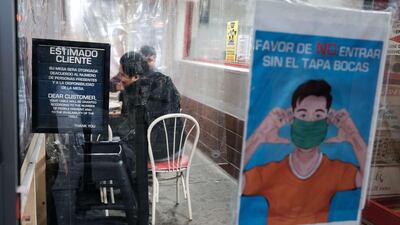
People eat at a restaurant, in a neighbourhood among those that have seen some of the highest number of city Covid-19 deaths, in the Queens borough of New York City. AFP -

From left: House Majority Leader Steny Hoyer, House Minority Leader Kevin McCarthy, US Speaker of the House Nancy Pelosi, Senate Majority Leader Chuck Schumer, Senate Minority Leader Mitch McConnell, with members of Congress observe a moment of silence during an event held at Capitol Hill to honour the 500,000 people in the US who have died from Covid-19. -

Chairs are stacked near the windows of a classroom ahead of in-person learning at the Jefferson-Houston School in Alexandria, Virginia. Reuters -
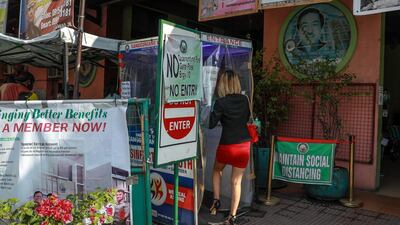
A woman walks through a disinfection booth while entering a town village in Pasay City, south of Manila, Philippines. EPA -
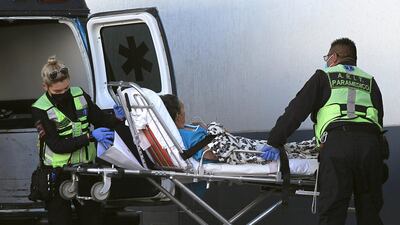
Health personnel transport a patient infected with the coronavirus to the General Hospital of the Ciudad Juarez, in the state of Chihuahua, Mexico. EPA -
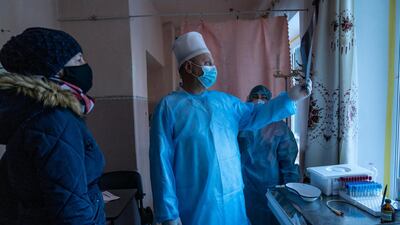
A doctor looks at the X-rays of a patient's lungs at the central hospital in Kolomyia, western Ukraine. AP -
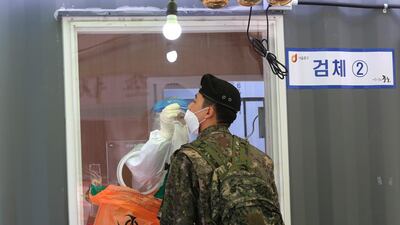
A medical worker takes a nasal sample from a soldier at a coronavirus testing site in Seoul, South Korea. AP -

People walk past a temporarily closed branch of a sandwich shop in London's financial district during England's third coronavirus lockdown. AP -

A worker sprays disinfectant inside a school bus in Yongchuan, in central China's Hunan province. AFP -
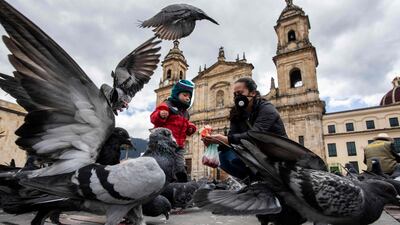
A woman and her child feed pigeons in Bogota, Colombia. AFP -

Riot police are seen during a demonstration by workers of bars and restaurants against the restrictions set by the Bogota Mayor Claudia Lopez in Bogota, Colombia. AFP


_____________________________________
“We think it should be more robust,” he said. “I want it to cover shops.”
Despite the measures being more lax than he would hope, Mr Hadari said the vaccine programme is going “extremely well” and Maccabi had already immunised 77 per cent of its eligible clients.
Looking ahead, Ms Sapir predicted those wary of the vaccine will be inoculated and Israeli coronavirus cases will steadily decline.
“Then the green pass will be less essential, because even if we don’t have herd immunity we’ll be approaching that,” she said.
Israeli health experts said coronavirus will not be eliminated from the country in part because children under 16 have yet to receive the shot, while there is no large-scale vaccination drive in the Palestinian territories.
The Israeli government was criticised by rights groups for failing to include about five million Palestinians in Gaza and the occupied West Bank in its vaccine programme.
It has given a few thousand vaccines to the Palestinian Authority and Israel reportedly plans to vaccinate 100,000 Palestinians working in the country. Health officials on both sides did not respond to requests to comment on the deal.

