

Artist Ziyad Jassam went to great efforts to find the perfect location in one of Baghdad’s suburbs to create his latest landscape painting.
Everything has changed in the south-east district of Arab Jibour, once home to lush green orchards of palm trees and fruit, that lies to the west of the Tigris.
“I kept driving around looking for a green space but unfortunately I found only the ruins of an old orchard,” Jassam, who was looking for a scene to paint for a forthcoming exhibition, told The National.
“This new reality is so painful."
At the annual Iraqi Landscape Exhibition, local artists are lamenting the loss of so much nature, expressing concern about the climate crisis which imperils Iraq today, making it the fifth-most vulnerable country to the rapid warming of the world.
The show, organised by the Iraqi Plastic Artists Society, brings together 74 artists who seek to inspire and drive climate action.
The exhibition features paintings from across Iraq and elicits a range of emotions: joy associated with some artworks and melancholy with others.
-

Artist Masoud Al Jameel stands next to his painting that depicts the scene of a heavy sandstorm that turns the sky of an arid agricultural area to reddish-brown. All photos: Sinan Mahmoud / The National -

Artist Alaa Al Baldawi stands next to his painting that shows a scene from last century of an arable area in southern Iraq, where a tributary of the Tigris River is now almost gone. -
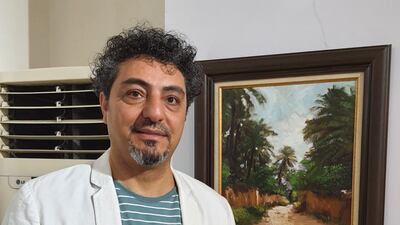
Artist Ziyad Jassam stands next to his oil on canvas painting which shows what is left in the once-lush Arab Jibour suburb in south-east Baghdad. -

At the annual Iraqi Landscape Exhibition, local artists express concern about the climate crisis which imperils Iraq today. -
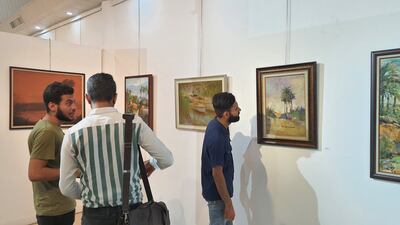
Paintings on display at the annual Iraqi Landscape Exhibition. -

The art show, which is organised by the Iraqi Plastic Artists Society, brings together 74 artists. -

The exhibition features paintings from across Iraq. -
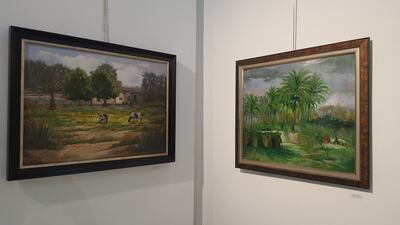
The country faces a wide range of challenges compounded by water insecurity, mismanagement and man-made problems such as the illegal clearing of agricultural areas to build houses. -

More frequent and intense droughts, sandstorms, heatwaves and rising sea levels are damaging people's livelihoods and communities. -
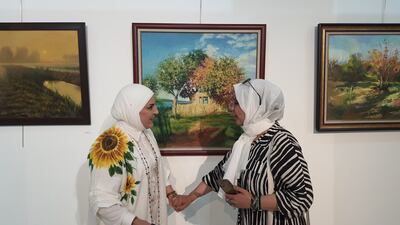
Desertification affects about 39 per cent of Iraq's land and 54 per cent of its agricultural lands have been degraded, mainly by soil salinity caused by reduced water flows in the Tigris and Euphrates rivers, a declining precipitation rate and sea level increases. -
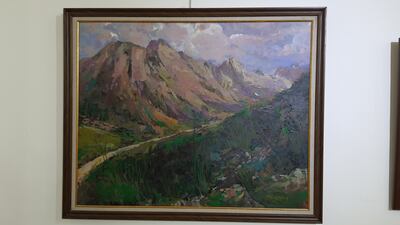
The exhibition is on through July at the main hall of the Iraqi Plastic Artists Society in Baghdad’s Mansour neighbourhood. -
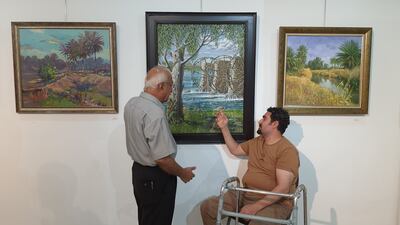
Iraq is thought to be the fifth most vulnerable country in the world to climate change. -
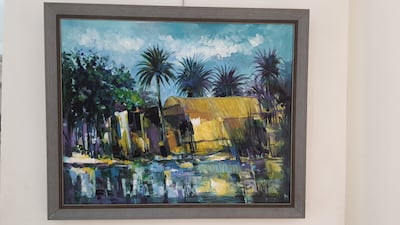
The artists are seeking to inspire and drive climate action.


Shortly after the 2003 US-led invasion that toppled Saddam Hussein and unleashed a bloody insurgency, the Sunni-dominated Arab Jibour, part of what is known as the Baghdad Belt, became one of Al Qaeda in Iraq's strongholds.
For years, the suburb of Iraq's capital city sustained several military assaults by US and local troops in which heavy artillery fire and air strikes were used, uprooting many of its residents.
As security started to improve in early 2018, many of its residents found it hard to resume farming, not least because of acute shortages of water and regular power cuts. Instead, some illegally razed their orchards to sell them to property developers to build lucrative housing projects.
Jassam still fondly remembers the trips to Arab Jibour organised by his teachers when he was a student at the College of Fine Arts during the 1990s. Then, the area's natural beauty held within it a power, which brought about positive moods and feelings of serenity.
“Wherever you turned there was greenery, water, a soothing and warming feeling,” said the painter, 48.
Last month, he returned but found a completely different place.
Many of the orchards had been razed, leaving only slender trunks of decapitated palm trees, while steel-reinforced concrete blast barriers left some land cut off and obscured views of the river.
But after hours of driving, he found the scene for which he'd been seeking. A narrow, unpaved road lined with mud walls led to palm and fruit trees — but it was still far from the Arab Jibour he remembered.
“If you look at this painting you see a window to a beautiful green scene, but if you turn your head right and left you will see only palm trees without fronds,” he said, standing next to his oil-on-canvas measuring 50cm x 40cm.

Climate change has been worsening in Iraq in recent years. The country faces a number of challenges compounded by water insecurity, mismanagement and man-made problems such as the illegal clearing of agricultural areas to build houses.
More frequent and intense droughts, sandstorms, heatwaves and rising sea levels are wreaking havoc on communities and people's livelihoods.
Desertification affects about 39 per cent of Iraq and 54 per cent of its agricultural land has been degraded, mainly by soil salinity caused by reduced water flows in the Tigris and Euphrates, a declining precipitation rate and rising sea levels.
In one corner of the exhibition, Masoud Al Jameel’s painting stands as a warning for the new reality, trying to spur immediate action to tackle the climate change.
It depicts a bleak scene of a heavy sandstorm that turns the sky of an arid agricultural area to reddish-brown. Three palm trees are weathering the strong storm and from afar shadows of trees loom, like ghosts of the lost plants. To achieve these haunting effects, the artist mixed dust with the paint.
“That's what nature in Iraq looks like today; no vegetation cover, and sandstorms becoming more frequent and intense,” the 23-year-old said.
“That is a really sad sight."
Other participants fondly recalled Iraq’s greener heyday.
In his oil and acrylic painting, Alaa Al Baldawi depicts a scene from 20th century of an arable area in the south, where a tributary of the Tigris River runs through lush orchards, while women row on the blue-green water.
But he said the area depicted is almost non-existent now.
“Unfortunately, due to lack of interest in preserving the area and scarcity of water, the stream is dried up and most of the palm trees are gone,” Al Baldawi, 54, lamented.
His 100cm x 80cm painting represents “a longing for our beautiful past and a message to spur immediate action to salvage nature in Iraq”.
The Iraqi Landscape Exhibition will continue throughout July at the main hall of the Iraqi Plastic Artists Society in Baghdad’s upmarket Mansour neighbourhood.

