• Water levels have fallen at Dukan dam on the Little Zab river in north-eastern Iraq. All photos: Reuters
    Water levels have fallen at Dukan dam on the Little Zab river in north-eastern Iraq. All photos: Reuters
  • A general view of Dukan dam in Dukan in the western city of Sulaimaniyah, Iraq June 14, 2021. Picture taken June 14, 2021. Picture taken with a drone. REUTERS / Thaier Al-Sudani
    A general view of Dukan dam in Dukan in the western city of Sulaimaniyah, Iraq June 14, 2021. Picture taken June 14, 2021. Picture taken with a drone. REUTERS / Thaier Al-Sudani
  • Iraqi authorities have blamed Iran for the drop in water flows from the river.
    Iraqi authorities have blamed Iran for the drop in water flows from the river.
  • Darbandikhan Dam on the Sirwan river in northern Iraq. Water levels have also fallen in the river, which flows from north-west Iran.
    Darbandikhan Dam on the Sirwan river in northern Iraq. Water levels have also fallen in the river, which flows from north-west Iran.
  • Iran and Turkey are building dams to solve water scarcity problems, but regional co-operation on the issue is patchy.
    Iran and Turkey are building dams to solve water scarcity problems, but regional co-operation on the issue is patchy.
  • Iraqi officials say the Daryan Dam in Iran is diverting some of the Sirwan back into Iranian territory through a 48-kilometre tunnel.
    Iraqi officials say the Daryan Dam in Iran is diverting some of the Sirwan back into Iranian territory through a 48-kilometre tunnel.
  • Nabil Musa, an Iraqi Kurdish environmental activist, takes pictures of the Sirwan on the outskirts of the north-eastern city of Halabja. Iran is controlling all of the river's water, he says.
    Nabil Musa, an Iraqi Kurdish environmental activist, takes pictures of the Sirwan on the outskirts of the north-eastern city of Halabja. Iran is controlling all of the river's water, he says.
  • An orchard in Diyala province, which borders Iran, has dried out. Iraq says the situation in the province will worsen without an agreement with Iran to share the damage caused by lower water flows.
    An orchard in Diyala province, which borders Iran, has dried out. Iraq says the situation in the province will worsen without an agreement with Iran to share the damage caused by lower water flows.
  • Ahmed Mahmud gave up working as a fisherman two years ago because the river near his home in the village of Imami Zamen was running dry.
    Ahmed Mahmud gave up working as a fisherman two years ago because the river near his home in the village of Imami Zamen was running dry.

Iraq: As rivers run dry, Baghdad seeks regional action on water


  • English
  • Arabic

"Where we are standing right now, there should be a river," says Nabil Musa, gesturing at a dried-up riverbed in northern Iraq.

For the environmental activist, the reason the once swirling Sirwan River has dwindled to a trickle lies across the border in Iran, which he says is "controlling all" of the river's water.

This year's lack of rainfall has left Iraq badly short of water. Officials trying to revive rivers such as the Sirwan say reduced flows from upstream neighbours Iran and Turkey are worsening home-grown problems such as leaks, ageing pipes and the illegal siphoning off of supplies.

Iran and Turkey are building big dams to solve their own lack of water, but regional co-operation on the issue is patchy.

Iraqi officials said the Daryan Dam across the border in Iran is diverting parts of the Sirwan back into Iranian lands through a 48-kilometre tunnel.

Iranian officials declined to comment on the allegation when contacted by Reuters. Iran has said the dam is still being built.

Iraqi villagers say they have felt the impact of reduced volumes from Iran for two years. They complain that the fall has had a punishing effect on communities downstream, especially during increasingly frequent years of drought.

"It's been two years since I had to stop fishing", fisherman Ahmed Mahmud told Reuters from the nearby village of Imami Zamen. With the river drying up, most of the village's 70 families have already left. The primary school is closed.

"If it continues like this, we will have to leave as well", said Mr Zamen.

The Sirwan begins in Iran and runs along its border with Iraq before flowing into Iraq's semi-autonomous Kurdistan region and then on south to join the Tigris. Once abundant, it's now dotted with measuring poles showing where water once reached.

As a heatwave baked the drought-hit region in July, Iraq said the situation in the downstream province of Diyala would worsen without agreement with Iran, where about 18 per cent of Iraq's Tigris river originates, on ways to share "damage" from lower flows.

To try to cope, Baghdad limited this summer's cultivated surfaces in Diyala in both irrigated and rain-fed areas to 30 per cent of last year's and dug water wells to support struggling farmers.

Asked about Iraqi allegations that Iran is reluctant to discuss the water crisis, a senior Iranian foreign ministry official noted that drought in Iran had "caused blackouts and protest". He told Reuters that following the recent formation of Iran's new government, scheduling meetings would take time.

"However, I should underline that because of the water crisis, our first priority would be meeting our domestic needs and then our neighbours'," the official added.

Iraq's water crisis has been in the making for nearly two decades. Outdated infrastructure and short-term policies made Baghdad vulnerable to climate change and lower flows from Iran and Turkey, the source of about 70 per cent of the Tigris and Euphrates rivers.

Iraqi water ministry spokesman Aoun Dhiab told Reuters that from June, flows from Iran and Turkey had halved.

The Turkish Foreign Ministry did not immediately respond to a request for comment.

Negotiations with Turkey on how much water it will allow downstream to Iraq are difficult. But at least they are taking place, Iraqi officials say. In contrast, there are no talks on the subject with Iran, which in the last three decades has signed contracts for the construction of at least 600 dams nationwide.

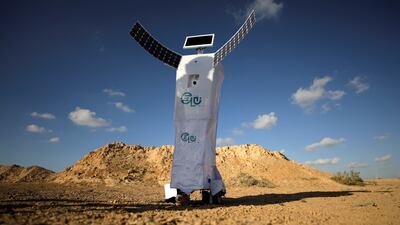
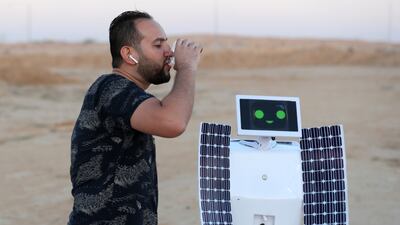
  • A remote-controlled robot called ELU dispenses drinking water during a demonstration in Borg Al Arab desert, Egypt. All photos: Reuters
    A remote-controlled robot called ELU dispenses drinking water during a demonstration in Borg Al Arab desert, Egypt. All photos: Reuters
  • ELU can extract moisture from the air to produce water
    ELU can extract moisture from the air to produce water
  • The robot is used in Alexandria governorate, northern Egypt
    The robot is used in Alexandria governorate, northern Egypt
  • ELU can be used to produce drinking water in harsh environments
    ELU can be used to produce drinking water in harsh environments
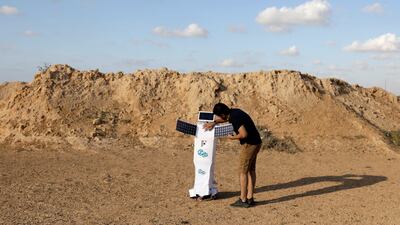
  • Egyptian mechatronics engineer Mahmoud El Komy, 27, checks ELU during a demonstration in Borg Al Arab desert
    Egyptian mechatronics engineer Mahmoud El Komy, 27, checks ELU during a demonstration in Borg Al Arab desert
  • The robot condenses moisture from humidity to produce water, Mr El Komy says
    The robot condenses moisture from humidity to produce water, Mr El Komy says
  • The robot has the ability to work during space flights or even on Mars, he says
    The robot has the ability to work during space flights or even on Mars, he says

Mr Musa said Iran occasionally released water to Iraq. "But we don't know (in advance) when and how much", he said.

Iraqi water officials last June attempted without success to have a meeting with Tehran to discuss water shortages and seek information about Iran's water management strategy.

"We do get information using satellite imagery, on the status of dams and the size of reserves, whether in Turkey or Iran. But we would prefer to get it through diplomatic channels", Mr Dhiab told Reuters.

At a summit in Baghdad on August 28, Middle East countries including Iran discussed regional co-operation. But the issue of regional water policies did not make it on to the agenda.

"We avoided controversial topics that pit them against each other, such as water", said an Iraqi diplomat, on condition of anonymity as he was not allowed to speak to media.


Another way to earn air miles

In addition to the Emirates and Etihad programmes, there is the Air Miles Middle East card, which offers members the ability to choose any airline, has no black-out dates and no restrictions on seat availability. Air Miles is linked up to HSBC credit cards and can also be earned through retail partners such as Spinneys, Sharaf DG and The Toy Store.

An Emirates Dubai-London round-trip ticket costs 180,000 miles on the Air Miles website. But customers earn these ‘miles’ at a much faster rate than airline miles. Adidas offers two air miles per Dh1 spent. Air Miles has partnerships with websites as well, so booking.com and agoda.com offer three miles per Dh1 spent.

“If you use your HSBC credit card when shopping at our partners, you are able to earn Air Miles twice which will mean you can get that flight reward faster and for less spend,” says Paul Lacey, the managing director for Europe, Middle East and India for Aimia, which owns and operates Air Miles Middle East.

Milestones on the road to union

1970

October 26: Bahrain withdraws from a proposal to create a federation of nine with the seven Trucial States and Qatar. 

December: Ahmed Al Suwaidi visits New York to discuss potential UN membership.

1971

March 1:  Alex Douglas Hume, Conservative foreign secretary confirms that Britain will leave the Gulf and “strongly supports” the creation of a Union of Arab Emirates.

July 12: Historic meeting at which Sheikh Zayed and Sheikh Rashid make a binding agreement to create what will become the UAE.

July 18: It is announced that the UAE will be formed from six emirates, with a proposed constitution signed. RAK is not yet part of the agreement.

August 6:  The fifth anniversary of Sheikh Zayed becoming Ruler of Abu Dhabi, with official celebrations deferred until later in the year.

August 15: Bahrain becomes independent.

September 3: Qatar becomes independent.

November 23-25: Meeting with Sheikh Zayed and Sheikh Rashid and senior British officials to fix December 2 as date of creation of the UAE.

November 29:  At 5.30pm Iranian forces seize the Greater and Lesser Tunbs by force.

November 30: Despite  a power sharing agreement, Tehran takes full control of Abu Musa. 

November 31: UK officials visit all six participating Emirates to formally end the Trucial States treaties

December 2: 11am, Dubai. New Supreme Council formally elects Sheikh Zayed as President. Treaty of Friendship signed with the UK. 11.30am. Flag raising ceremony at Union House and Al Manhal Palace in Abu Dhabi witnessed by Sheikh Khalifa, then Crown Prince of Abu Dhabi.

December 6: Arab League formally admits the UAE. The first British Ambassador presents his credentials to Sheikh Zayed.

December 9: UAE joins the United Nations.

Islamophobia definition

A widely accepted definition was made by the All Party Parliamentary Group on British Muslims in 2019: “Islamophobia is rooted in racism and is a type of racism that targets expressions of Muslimness or perceived Muslimness.” It further defines it as “inciting hatred or violence against Muslims”.

LIVERPOOL SQUAD

Alisson Becker, Virgil van Dijk, Georginio Wijnaldum, James Milner, Naby Keita, Roberto Firmino, Sadio Mane, Mohamed Salah, Joe Gomez, Adrian, Jordan Henderson, Alex Oxlade-Chamberlain, Adam Lallana, Andy Lonergan, Xherdan Shaqiri, Andy Robertson, Divock Origi, Curtis Jones, Trent Alexander-Arnold, Neco Williams

Company%C2%A0profile
%3Cp%3E%3Cstrong%3ECompany%20name%3A%20%3C%2Fstrong%3EHayvn%3Cbr%3E%3Cstrong%3EStarted%3A%20%3C%2Fstrong%3E2018%3Cbr%3E%3Cstrong%3EFounders%3A%20%3C%2Fstrong%3EChristopher%20Flinos%2C%20Ahmed%20Ismail%3Cbr%3E%3Cstrong%3EBased%3A%20%3C%2Fstrong%3EAbu%20Dhabi%2C%20UAE%3Cbr%3E%3Cstrong%3ESector%3A%20%3C%2Fstrong%3Efinancial%3Cbr%3E%3Cstrong%3EInitial%20investment%3A%20%3C%2Fstrong%3Eundisclosed%3Cbr%3E%3Cstrong%3ESize%3A%3C%2Fstrong%3E%2044%20employees%3Cbr%3E%3Cstrong%3EInvestment%20stage%3A%20%3C%2Fstrong%3Eseries%20B%20in%20the%20second%20half%20of%202023%3Cbr%3E%3Cstrong%3EInvestors%3A%20%3C%2Fstrong%3EHilbert%20Capital%2C%20Red%20Acre%20Ventures%3C%2Fp%3E%0A
The specs

Engine: Turbocharged four-cylinder 2.7-litre

Power: 325hp

Torque: 500Nm

Transmission: 10-speed automatic

Price: From Dh189,700

On sale: now

Uefa Champions League last 16 draw

Juventus v Tottenham Hotspur

Basel v Manchester City

Sevilla v  Manchester United

Porto v Liverpool

Real Madrid v Paris Saint-Germain

Shakhtar Donetsk v Roma

Chelsea v Barcelona

Bayern Munich v Besiktas

Updated: September 07, 2021, 11:45 AM