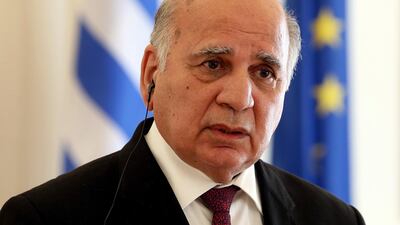

Iraq’s Foreign Minister Fuad Hussein arrived in Saudi Arabia on Monday to discuss enhancing security and stability in the region.
Mr Hussein will hold talks with his Saudi counterpart Prince Faisal bin Farhan in the kingdom’s capital.
"The two ministers will discuss the importance of adopting mutual efforts to enhance security and peace in the region, as well as discussing the implication of regional and international events based on common interests," Foreign Ministry spokesman, Ahmed Al Sahaf, said.
The two sides are expected to “follow up on the outcomes of Iraqi-Saudi co-ordination committee and ways to push the activation of the memorandum of understanding between Baghdad and Riyadh,” Mr Al Sahaf said.
In October 2017, the two sides established the Iraqi-Saudi Joint Co-ordination Council, to help rebuild devastated areas retaken from militants in Iraq.
Mr Hussein also met the head of the Gulf Cooperation Council, Dr Nayef Al Hajraf.
"The officials stressed the need to activate a joint working mechanism which will reflect the depth of relations and common interests," Mr Al Sahaf said.
Mr Hussein’s trip comes hot on the heels of a similar visit by Iraq’s Interior Minister Othman Al Ghanimi on Sunday.
The Iraqi-Saudi rapprochement extends back to 2003, after the US-led invasion that aimed to topple former Iraqi dictator Saddam Hussein.
The kingdom cut relations with Baghdad after it invaded Kuwait in 1990.
The highlight of their reconciliation was in 2015 when Saudi Arabia reopened its embassy in Baghdad following a 25-year break.
Riyadh sent an ambassador, Thamer Al Sabhan, to Baghdad shortly after.
Mr Al Sabhan was forced to leave his post by Iraq less than a year later after he said Iran-backed Shiite militias in the country were exacerbating tension with Sunni Arabs.
But the reopening of the Saudi embassy in Baghdad was seen as heralding closer co-operation against ISIS, which controlled territory in Iraq and Syria at the time.
Consular services were not resumed until then and Iraqis applying for visas had to go through the Saudi embassy in Jordan.

