

Iran’s judiciary chief has threatened to prosecute "without mercy" women who appear in public unveiled as an increasing number of women defy the country's compulsory dress code.
Chief Justice Gholamhossein Mohseni Ejei’s warning, reported by Iranian media on Saturday, follows an Interior Ministry statement on Thursday that reaffirmed the government's intention to enforce the law requiring women to wear a headscarf, or hijab, in public.
“Unveiling is tantamount to enmity with [our] values,” Mr Ejei was quoted as saying by several news sites. Those “who commit such anomalous acts will be punished” and will be “prosecuted without mercy,” he said, without saying what the punishment entails.
Mr Ejei said law enforcement officers were “obliged to refer obvious crimes and any kind of abnormality that is against the religious law and occurs in public to judicial authorities”.
A growing number of Iranian women stopped wearing headscarves after nationwide protests broke out in September over the death in custody of a young woman detained for allegedly violating the hijab rule. Mahsa Amini, a 22-year-old from Iran's Kurdish region, died days after being detained by morality police in Tehran.
The protests continued for months despite a violent by crackdown by government forces in which nearly 500 protesters were killed, according to estimates by Iranian rights groups. Thousands more were arrested, with at least four executed on charges related to the protests.
-
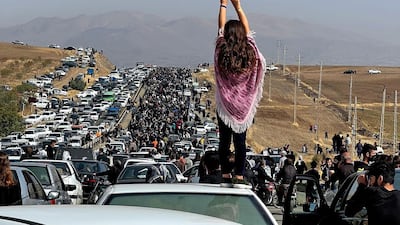
An unveiled woman stands on top of a vehicle as thousands make their way towards Aichi cemetery in Saqez, Mahsa Amini's home town, to mark 40 days since her death. AFP -

Protesters attempt to dodge projectiles fired at them during clashes at Iran's Islamic Azad University in Tehran. AFP -

Protesters gather at Amirkabir University of Technology in Tehran. AFP -

A man, bottom left, fires a weapon during the clashes at Islamic Azad University. AFP -

Protesters chant at a vigil for Amini at the entrance of the Khajeh Nasir Toosi University of Technology in Tehran. Reuters -

Iranian police arrive to disperse a protest marking 40 days since Amini's death. AP -

People block an intersection during a protest to mark 40 days since Amini's death. AP -
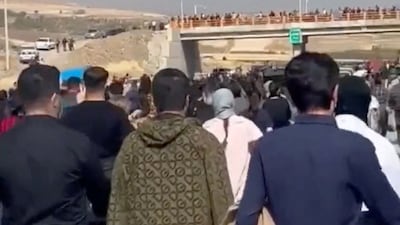
People march down the motorway towards Aichi cemetery near Saqez, where Amini is buried. Reuters -
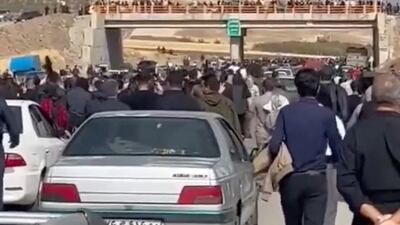
People march towards Aichi cemetary. Reuters -
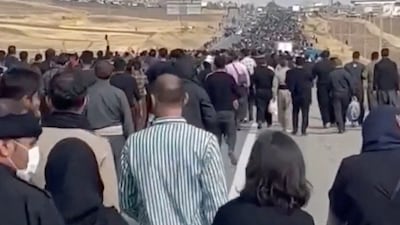
Protesters walk towards the cemetery. Reuters -

A view of demonstrators walking to the cemetery. Reuters -
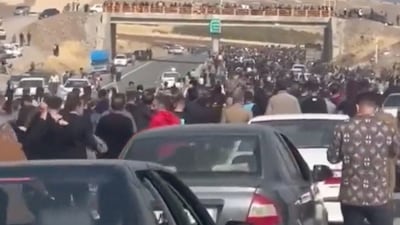
Cars line the street as people march towards the cemetery. Reuters -

Protesters march towards the cemetery 40 days after Amini's death. Reuters


Despite the risk of arrest for defying the obligatory dress code, women are widely seen unveiled in malls, restaurants, shops and streets around the country. Videos of unveiled women resisting the morality police have flooded social media.
Under laws imposed after Iran's 1979 Islamic revolution, women are obliged to cover their hair and wear long, loose-fitting clothes. Violators have faced public rebuke, fines or arrest.
The Interior Ministry statement on Thursday said there would be no “retreat or tolerance” on the issue, describing the veil as “one of the civilisational foundations of the Iranian nation” and “one of the practical principles of the Islamic Republic”.
It urged ordinary citizens to confront unveiled women. Such directives have in the past emboldened hardliners to attack women with impunity if they considered them to be violating the dress code.

