

Iran’s crackdown on a protest movement across the country is intensifying, rights groups say, as senior government officials claimed the protests were entering their final days.
The Centre for Human Rights in Iran said that in Tehran province alone, 3,000 people have been arrested in the past six weeks. Other rights groups say arrests across the country have exceeded 12,000.
Nationwide protests sparked by the death of Mahsa Amini, a 22-year-old Iranian Kurd who died after being detained by morality police for allegedly “inappropriate attire”, have posed one of the boldest challenges to the Iranian regime since protests rocked the country in 2009.
-
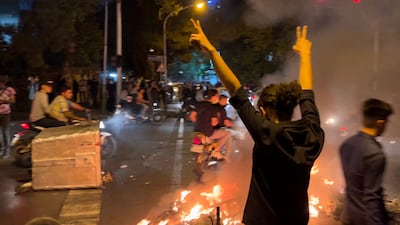
A protest for Mahsa Amini, a woman who died after being arrested by the Islamic republic's 'morality police', in Tehran. AFP -
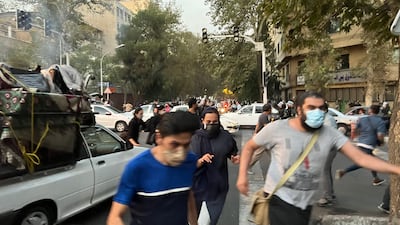
Demonstrators disperse during the protest for Amini, who died in a hospital in the capital Tehran on Friday. AFP -
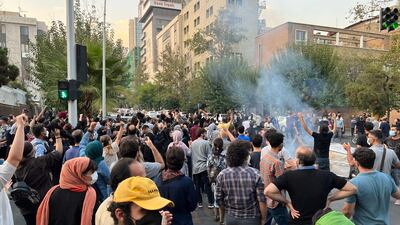
The crowd chanted 'Death to the dictator', meaning Supreme Leader Ayatollah Ali Khamenei, while some women took off their headscarves. AFP -
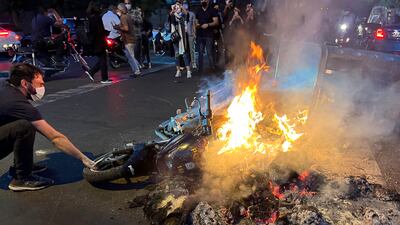
A man pulls out a police motorcycle set on fire during the protest. Amini had been detained for violating the country's conservative dress code. AP -
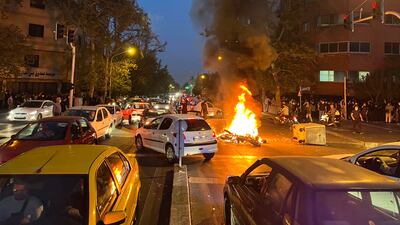
In recent months, rights activists have urged women to remove their veils in public, a gesture that would risk their arrest for defying a dress code as the country's rulers crack down on 'immoral behaviour'. AP -
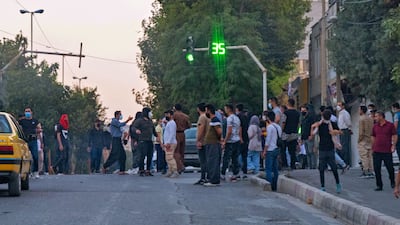
Iranians protest in Sanandaj, the capital of Iran's Kurdistan province, following the Amini's death while in custody. AFP -

Iranian police officers clash with demonstrators in Tehran. Police said Amini fell into a coma as she waited with other detained women at a morality police station, rejecting allegations that she was probably beaten. AFP


Though the protests do not appear close to toppling the government, unrest has swept the whole country and areas home to ethnic minorities with long-standing grievances against the state, including parts of the Kurdish north and Zahedan, the provincial capital of the Sistan-Balochistan province of south-eastern Iran at the border with Pakistan and Afghanistan. The region is home to the Baluch ethnic minority.
Families torn apart
On Sunday, AFP spoke to the husband of a human-rights activist jailed in the country’s notorious Evin prison. Speaking from exile in Paris, Taghi Rahmani described how his imprisoned wife and other detainees were being prevented from having any contact with their families, including their children, and that it amounted to psychological torture.
Mr Rahmani’s wife — prize-winning campaigner Narges Mohammadi — has not seen her 16-year-old twins for seven years and has not seen her husband for a decade.
In a new restriction — an apparent response to the protests, the authorities have now stripped Ms Mohammadi, 50, of her prison telephone cards for the next two months, her husband said.
She had already been blocked by authorities from telephoning her children Ali and Kiana in France for the past seven months: the latest restriction means that she cannot now even speak to her family inside Iran.
“The system of prisons in Iran is torturing families,” Mr Rahmani told AFP in an interview in the French capital.
“It is not just a torture for the prisoner but for the entire family. The children have not heard Narges' voice for the last seven months.”
Crackdown in the south
On Saturday Iran's Revolutionary Guard Corp (IRGC) accused a Sunni cleric of agitating against the government and warned it may cost him dearly after he said officials including the supreme leader were responsible for dozens of deaths in the city of Zahedan last month.
Amnesty International has said security forces killed at least 66 people in a crackdown after Friday prayers in Zahedan, in the south-east, on September 30, some of the deadliest unrest during five weeks of protests following Mahsa Amini's death.
Molavi Abdolhamid, Zahedan's leading Sunni cleric, said during his Friday sermon that officials including Supreme Leader Ayatollah Ali Khamenei, were “responsible before God” for the September 30 killings.
A short statement on Sepah News, the IRGC’s official news site, said: “Mr Abdolhamid, encouraging and agitating youths against the sacred Islamic Republic of Iran may cost you dearly! This is the last warning!”
State media had said that “unidentified armed individuals” opened fire on a police station, prompting security forces to return fire.
After protests erupted in Zahedan again on Friday, the deputy interior minister for security, Majid Mir Ahmadi, said calm had returned, official news agency IRNA reported on Saturday.
He said 150 “thugs attacked public property and even those shops belonging to Sunnis”.
On Friday, at least 57 were arrested after protesters — “rioters” — threw rocks and attacked banks in the city, provincial police chief Ahmad Taheri was quoted as saying by the official news agency IRNA on Friday.
State television said up to 300 protesters marched in the city after Friday prayers. It showed banks and shops with smashed windows.
Mr Abdolhamid, the Sunni cleric, described the September 30 killing as a massacre, saying bullets had been fired at heads and chests. “Scores were killed here. I don't have the exact number. Some have reported 90, some say less, some say more,” he said in the sermon posted on his website.
Rights groups say the government has long discriminated against ethnic minorities including the Kurds, in whose region unrest has also been particularly intense since Amini's death.
The state denies accusations of discrimination.
Iran has blamed unrest on an array of enemies including armed dissidents. The IRGC has attacked bases of armed Iranian Kurdish groups in neighbouring Iraq.
Protesters have sought to stress national unity with chants expressing solidarity between various ethnic groups.
Rights groups Hengaw reported that shopkeepers had gone on strike on Saturday in the provincial capital of Iran's Kurdistan province, Sanandaj, and Saqez — Amini's home town, in addition to Bukan, another north-western city.
The activist news agency HRANA reported on Friday that 244 protesters had been killed in the countrywide unrest, including 32 children. State TV has reported that at least 26 members of the security forces have been killed during the unrest.

